|
Safety Emporium for all your lab and safety needs
 The Glassware Gallery
Heating Sources
Introduction
Heating Mantles
One of the most popular and safest methods to heat a reaction mixture in a synthetic organic, inorganic, or organometallic laboratory is a heating mantle, a resistively heated flexible fiberglass shell that conforms to the shape of the reaction flask. Most heating mantles are hemispherical in design and come in a variety of sizes designed to fit round bottom flasks from 50 mL up to 5000 mL or more.
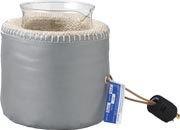
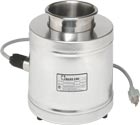
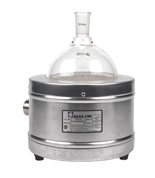
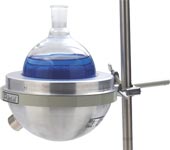
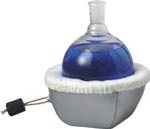
Shown below are three examples of heating mantles. The one on the left has a shell that supports the flask, the middle one has a hemispherical outer aluminum shell and the one on the right has a flexible all-fiberglass design. Most chemists prefer the latter two types because these are easiest to use in combination with a magnetic stir plate. Combination heating/stirring mantles are also available, but are somewhat more expensive:
 |
 |
 |
| Now available! We now stock the complete line of Glas-Col heating mantles and accessories. Please visit our on-line store, Safety Emporium or click one of the items above. We have volume discounts on most mantles and accessories. | ||
Some heating mantles come in two piece designs that zip or tie together to enclose almost the entire flask except for the neck(s), but these are usually only used for special apparatuses. Heating tapes are also available which can be used to keep distillation columns warm or to regenerate catalyst columns.
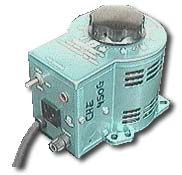
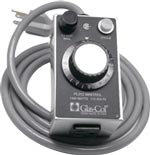
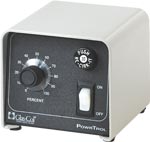
Heating mantles should NEVER be plugged directly into an outlet. A heating mantle can easily generate enough heat to vaporize most organic materials and will melt a flask if used on full power. ALWAYS plug the heating mantle into a grounded variable voltage transformer or percentage timer control (which runs at full power but cycles on and off to control the heat). Such devices are often known by the trademarked name, Variac (below, left) or MiniTrol (below, middle). Start with the lowest power setting -- 20-30% power is usually enough to cause most common organic liquids to reflux. A few examples of these are shown below:
 |
 |
 |
| Now available! We carry a variety of temperature controllers suitable for use with heating mantles. Visit Safety Emporium for details. | ||
Remember that heating mantles and Variacs are electrical appliances, so follow the appropriate precautions. To prolong the life of your heating mantle, clean up spills (solid or liquid) right away. Except for the cord, mantles are not generally repairable. If the fiberglass is brittle or cracked or if any wires are exposed then discard the heating mantle. Never immerse a heating mantle in water or other liquids (or place these in the mantle) and always use a properly grounded outlet. Do not allow the cords to dangle down the front of the lab bench or hood, a snag/trip danger.
Additional warning:  Some older models of Variacs will keep whatever is plugged into them electrically live even though the Variac is switched off! Touching this device and ground at the same time could complete a circuit with your body and lead to electrocution.
Variacs also find use around the laboratory for other purposes, such as controlling the heating of a high vacuum line diffusion pump or the rate of a stirring motor.
Heating Baths
Bath Materials
Fluids have good thermal transfer coefficients and are an effective way of heating reactions. The simplest bath we can think of is a hot water bath, however even at 70 degrees C, water evaporates too quickly to make this a practical bath fluid for most purposes.
The key, then, is to find a bath fluid that does not evaporate readily and is not flammable at the temperatures being used. This depends on knowing the flash point of the material, i.e. the point at which the bath material can form a flammable mixture with air at the liquid interface. NEVER heat a bath fluid above its flash point (and as a good rule of thumb, not even within 20 degrees of its flash point).
Fluid heating baths are inherently dangerous, and a heating mantle or solid (dry) bath material should be used instead unless absolutely necessary (see below). A hot fluid can be easily spilled or spattered, especially if water is accidentally introduced into a hot fluid. In addition, there is an electrical heat source in close proximity and a hot bath is very difficult to deal with in an emergency situation. Bath fluids expand upon heating, so overflows are another potential pitfall.
Despite the potential hazards, fluid heating baths are sometimes used by chemists instead of heating mantles because of their convenience and ability to prevent thermal fluctuations. For example, it would be extremely difficult to heat an NMR tube with a heating mantle, and the temperature would be very difficult to monitor. For the best thermal stability, magnetically stir the bath during operation.
The bath container is typically a beaker or large crystallizing dish. This is convenient because you can usually see your reaction flask through the bath. For very high temperature materials, a metal container is sometime used, although this can present a shock hazard if the apparatus is not properly grounded.
Here are some bath materials commonly used in chemistry laboratories.
| Bath Material | Flash Point (°C) | Useful Range (°C) | Comments |
|---|---|---|---|
| Water | NA | 0 - 70 |
|
| Mineral Oil | 113 | 25-100 |
|
| Dibutyl phthalate | 171 | 25 - 150 |
|
| Parrafin Wax | varies | 55 - 180 |
|
| Silicone Oil | 150 - 350 | 25 - 230 |
|
| Wood's Metal 50% Bi, 25% Pb, 12.5% Sn, 12.5% Cd | NA | 70-350 |
|
| Eutectic ( ) salt mixtures 51.3% KNO3; 48.7% NaNO3 40% NaNO2; 7%NaNO3; 53%KNO3 |
NA | 230 - 500 142 - 500 |
|
| Sand | NA | 25-500+ |
|
If you need to use a fluid bath for a kinetics run, NMR tube experiment etc., silicone oil is a good choice for temperatures below 200 degrees and molten salts are a good choice for temperatures 200-500 degrees C.
You'll notice that we list sand as the last entry in the fluid table. Solid (dry) heating baths using sand, inert shot, and similar materials are superior as they pose no spatter danger, are non-flammable, are non-toxic, and generally don't degrade. Solid baths are a great choice when you have an odd-shaped apparatus and don't want to use a fluid. Commercially available solid baths are discussed in the next section.<.p>
Bath Heat Sources
Having a bath in which to immerse your reaction flask is not enough...you have to have a heat source. There are many different ways to heat your reaction; here are the the most common:

Synthesis and Technique
in Inorganic Chemistry:
A Laboratory Manual
by Girolami, Rauchfuss & Angelici

The Laboratory Companion:
A Practical Guide to
Materials, Equipment,
and Technique
by Gary S. Coyne
- Dry block heaters can be filled with sand, metal shot, and other inert materials and are the safest and best choice in most cases. You'll need to purchase an appropriate dry block heater, bath liner, and bath material such as those shown here. These are not designed for use with bath fluids:
- Hotplates or stirring hotplates are probably the easiest and most common way to heat a fluid bath. However, the final working temperature of the bath is limited by the poor thermal contact between the top of the hotplate and the bath container. In addition, the hot surface of the hotplate presents a safety hazard in its own right and the excess heat absorbed by the surrounding apparatus can create additional problems. Spills of fluid on the hot surface can lead to discoloration, failure of the ceramic top or a fire (because the temperature of the hot plate will be much hotter than the temperature of the bath).
- Resistive heating coils made of coiled Nichrome or Chromel wire are often used as immersion heaters for oil baths. This coil is typically placed in the bottom of the bath and is connected via banana plugs, alligator clips or pinch clamps to a standard electrical plug which is plugged into a Variac to control the heating output.
- Heating mantles are available that are specially designed for beakers. The extra insulating nature and stirability of these mantles suggests they would be ideal for NMR tube reactions and kinetics experiments. Some examples of these mantles are shown below. These are now available at Safety Emporium:
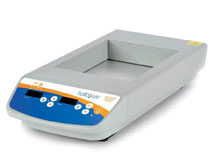
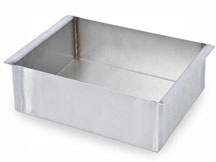
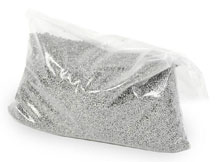
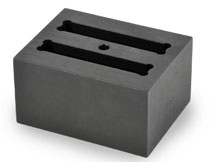
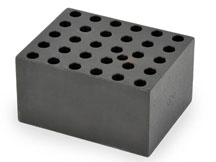
Dry block heaters are available in a variety of configurations and sizes. Units can hold between 1 and 6 blocks (or three double-size blocks). Some models include digital displays, timers, feedback controls and heated lids, which make them ideal for use in biochemical applications such as incubation and activation of cultures, enzyme reactions, immunoassays, and melting/boiling points. In addition, specially designed solid metal blocks are available to hold common lab equipment such as test tubes, centrifuge tubes, PCR plates/strips, titer plates, cuvettes and vials:
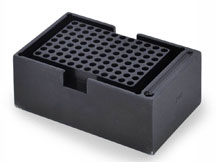
Regular plates tend to cycle on and off rather than outputting a constant temperature. This can result in drifting of the desired bath temperature by up to +/- 10 degrees C. If you are planning to use a hotplate hot/plate stirrer as your heating source, look for one that has a good thermal stability specifications and safety features to prevent runaway temperature in the event of control failure. You can even buy hotplate-stirrers that have a feedback thermocouple probe for precision temperature control:
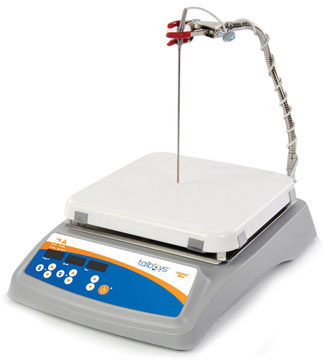
Finally, note that virtually every hotplate or stirplate available you find is not explosion-proof, so if the bath material is heated above its flash point a fire and/or explosion could occur.
These are INCREDIBLY DANGEROUS and it is with good reason that they are called suicide cords in common lab slang. Exposed electrical wires are a very dangerous situation and should be avoided at all times. Accidentally contacting a wire or even the bath material could lead to electrocution. NEVER use an immersion heater that has exposed electrical contacts.
Additional warning: Some older models of Variacs will keep whatever is plugged into them electrically live even though the Variac is switched off! Touching this device and ground at the same time could complete a circuit with your body and lead to electrocution. Always disconnect a Variac from the outlet before working with the device plugged into it. You can read about someone who died in a similar scenario.
A good immersion heater, with no exposed contacts and connected to a grounded Variac, can afford temperature stability comparable or better than a simple hotplate and can be just as easy to use.