
|
Safety Emporium for all your lab and safety needs
Structure World
The Sodium Chloride Structure

General Notes
Get your PPE such as made in USA NIOSH-approved N95 masks from Safety Emporium.
Structural Information
| NaCl Vital Statistics | |
|---|---|
| Formula | NaCl |
| Cystal System | Cubic |
| Lattice Type | Face-Centered |
| Space Group | Fm3m, No. 225 |
| Cell Parameters | a = 5.6402 Å, Z=4 |
| Atomic Positions | Cl: 0, 0, 0 Na: 0.5, 0.5, 0.5 (can interchange if desired) |
| Density | 2.17 |
| Melting Point | 804 degrees C |
| Alternate Names | Halite, rock salt, sea salt, table salt, salt |
| Isostructural Compounds |
MgO, TiO, TiC, LaN, NaI KCl, RbF, AgCl, SrS |
Structure
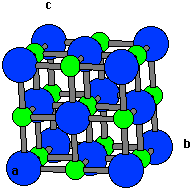 |
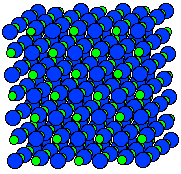 |
| Fig. 1 A single unit cell of NaCl | Fig. 2 A 3x3x3 lattice of NaCl |
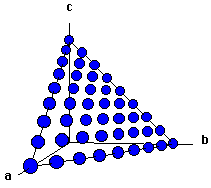
Shown below are two crystallographic planes in NaCl. Notice that the (111) plane is hexagonally closest packed.
 |
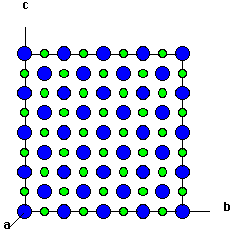 |
| Fig. 3 The (111) plane of NaCl. | Fig. 4 The (100 plane of NaCl. |
Something that surprises novices is that the 111 plane does not contain the body centered atom. It is important for the beginning student to recognize that the 111 plane does not cut through 1/2, 1/2, 1/2! Take a look at the models above and below to convinvce yourself of this very important fact!
Here is a polyhedral representation of the NaCl unit cell. We could have drawn octahedra around either of the two atoms. In the case below, we have drawn them around the corner atoms and changed the color to improve the image contrast:

Interactive 3D models
Loading interactive model…
The sticks show the neighbor connections recorded in the original model file; they are a guide to the lattice geometry. Download the selected MOL file.