|
Safety Emporium for all your lab and safety needs
Structure World
The Zincblende (ZnS) Structure

General Notes
Structural Information
| Zincblende Vital Statistics | |
|---|---|
| Formula | ZnS |
| Cystal System | Cubic |
| Lattice Type | Face-Centered |
| Space Group | F4(bar)3m, No. ??? |
| Cell Parameters | a = 5.41 Å, Z=4 |
| Atomic Positions | S: 0, 0, 0 Zn: 0.25, 0.25, 0.25 (can interchange if desired) |
| Density | 4.102 |
| Melting Point | phase transition at 1020 degrees C |
| Alternate Names | zincblende, sphalerite |
| Isostructural Compounds |
AgInS2, BN, BC, XY (X = Al, Ga, In; Y = P, As, Sb) |
Structure
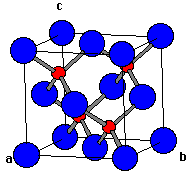
In Figure 1, notice how that only 1/2 of the tetrahedral sites (i.e. four of the eight octants of the cube) are occupied by Zn2+ (red).
 |
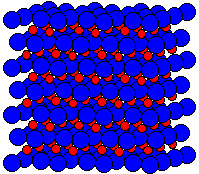 |
| Fig. 1 A single unit cell of zincblende | Fig. 2 A 3x3x3 lattice of zincblende |
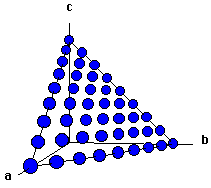
Shown below are two crystallographic planes in zincblende. Notice that the (111) plane is identical to the (111) in NaCl. That's not too surprising given that the anion lattice is identical. Unlike NaCl, the (100) plane of zincblende contains only anions. Look at Figure 4 -- can you see how this cuts through the unit cell in Figure 1?
 |
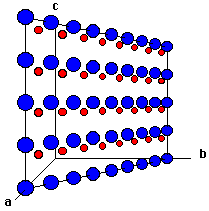 |
| Fig. 3 The (111) plane of zincblende. | Fig. 4 The (110) plane of zincblende. |
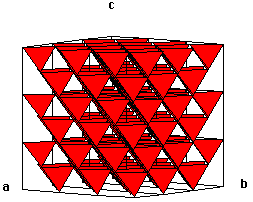
Here is a polyhedral representation of the zincblende structure. We could have drawn tetrahedra around either of the two atoms. Notice that all of the tetrahedra point in the same directions (recall that we have T- and T+ sites in fcc lattices...).