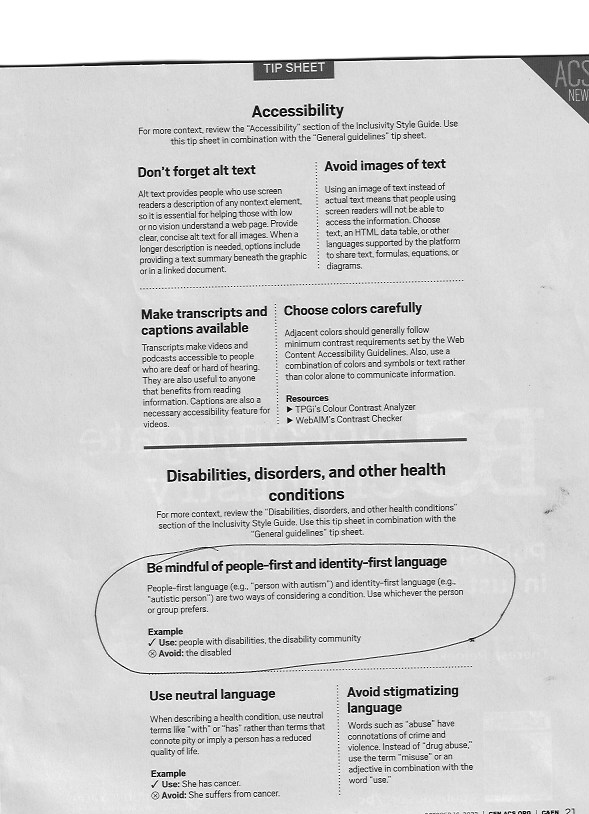

Hi all,
I wanted to forward on this message with a thoughtful question from Doug. I
apologize to Doug for the delay, but it's a topic I have some familiarity
with and wanted to take the time to pull together some good resources.
What Doug asked about ("people with disabilities" vs. "autistic person")
goes to the heart of the discussion of "person-first language" versus
"identity-first language." I'll link to some good articles exploring this at
the end of my message, but to summarize, person-first language uses phrasing
to emphasize someone's personhood separate from their identity, disorder,
disability, etc., while identity-first language emphasizes a trait being
intrinsic to a person. Historically, identity-first language has been much
more prevalent, but in the latter half of the 1900s there was a push to
start using person-first language. Many people with disabilities felt that
identity-first language contributed to them being reduced to nothing more
than their disability, that people thought of them as "disabled" and nothing
else. The NIH gives the example of people with AIDS in the 1980s: "We
condemn attempts to label us as 'victims,' a term that implies defeat, and
we are only occasionally 'patients,' a term that implies passivity,
helplessness, and dependence upon the care of others. We are 'People With
AIDS.'"
On the flip side of this, however, there are some communities that feel
person-first language implies that they can be separated from their
condition, whereas they view it as an intrinsic part of who they are. In
some cases, they feel pride in their identity, and feel that person-first
language implies something negative about it. One prominent example of this
is the Deaf community, who prefer to be referred to as deaf or
hard-of-hearing rather than "person with hearing loss" or something similar.
This is rooted in the Deaf community having their own language (American
Sign Language) and culture. Within the autistic community there is more of a
divide. Many autistic people prefer identity-first language as they view
autism as being more of a different way of experiencing the world than a
disability. With that said, there are many, including many parents of
autistic children, who advocate for person-first language.
Every article I read discusses that there is always, within every community,
some degree of debate, and everyone has personal preferences. The key, then,
is to think carefully about the intention and implications of the language
you use: generally speaking, if you come from a place of trying to be kind
and respectful to others, people will reflect that back if they object to
the terminology you have used, and it's important to be open to changing
based on new information and the preferences of the person you're speaking
with. I would say in general, it's best to avoid phrasing that reduces
someone to a single word (e.g., "a schizophrenic" vs. "person with
schizophrenia"), implies suffering (e.g., "AIDS victim" vs. "person with
AIDS"), or attributes negative connotations to objects or practices that
help them (e.g., "wheelchair bound" vs. "wheelchair user").
I hope this helps, and I look forward to any discussion on the topic. As
promised, here are a few good articles:
NIH:
https://www.nih.gov/about-nih/what-we-do/science-health-public-trust/perspec
tives/writing-respectfully-person-first-identity-first-language
Association of Health Care Journalists:
https://healthjournalism.org/blog/2019/07/identity-first-vs-person-first-lan
guage-is-an-important-distinction/
Autistic Self-Advocacy Network:
https://autisticadvocacy.org/about-asan/identity-first-language/
Sincerely,
Jack Reidy (he/him)
Chair of DCHAS Membership Committee
Asst. Chemical Hygiene Officer, Stanford University
Tel: (650) 497-7614
I acknowledge that the land on which I live and work is the ancestral and
unceded land of the Muwekma Ohlone Tribe. As an uninvited guest on these
lands, I am a beneficiary of the ongoing displacement of the Ohlone people.
I pay my respects to the Native peoples, past and present.
-----Original Message-----
From: Doug Walters <waltersdbw**At_Symbol_Here**gmail.com>
Sent: Wednesday, October 25, 2023 10:25 AM
To: DCHAS-L**At_Symbol_Here**Princeton.EDU
Subject: Question??
Hi Pat,
Questionre: attachment from C&EN (Oct. 16, 2023, p 21)
I understand , as C&EN illustrates, the proper term is" people with
disabilities," etc.
But I do not understand the sentence above what states the proper usage term
is "autistic person."
Can you enlighten me? Am I misreading what they printed?
Thanks,
Doug
---
For more information about the DCHAS-L e-mail list, contact the Divisional
membership chair at membership**At_Symbol_Here**dchas.org
---
For more information about the DCHAS-L e-mail list, contact the Divisional membership chair at membership**At_Symbol_Here**dchas.org