From:
Jeffrey Lewin <jclewin**At_Symbol_Here**MTU.EDU>
Subject:
Re: [DCHAS-L] Storing ACS-grade acetic acid with ACS grade hydrochloric acid
Date:
Feb 29, 2024 21:06 UTC
Reply-To:
ACS Division of Chemical Health and Safety <DCHAS-L**At_Symbol_Here**Princeton.EDU>
In-Reply-To:
Re: [DCHAS-L] Storing ACS-grade acetic acid with ACS grade hydrochloric acid
I usually start with
Prudent Practices for storage questions:
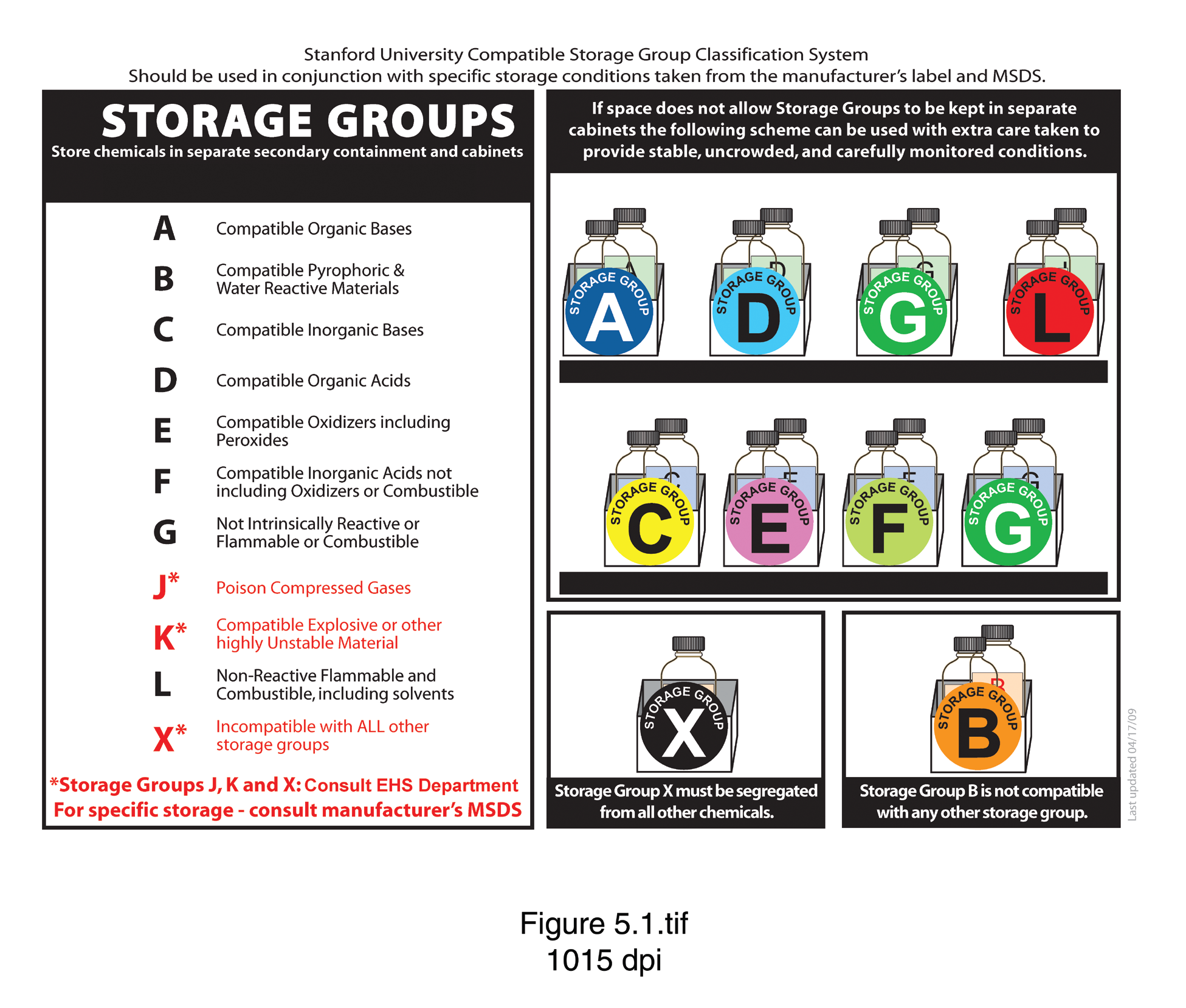
A: Compatible Organic Bases
Diethylamine
Piperidine
Triethanolamine
Benzylamine
Benzyltrimethylammonium hydroxide
B: Compatible Pyrophoric & Water-Reactive Materials
Sodium borohydride
Benzoyl chloride
Zinc dust
Alkyl lithium solutions such as methyl lithium in tetrahydrofuran
Methanesulfonyl chloride
Lithium aluminum hydride
C: Compatible Inorganic Bases
Sodium hydroxide
Ammonium hydroxide
Lithium hydroxide
Cesium hydroxide
D: Compatible Organic Acids
Acetic acid
Citric acid
Maleic acid
Propionic acid
Benzoic acid
E: Compatible Oxidizers Including Peroxides
Nitric acid
Perchloric acid
Sodium hypochlorite
Hydrogen peroxide
3-Chloroperoxybenzoic acid
F: Compatible Inorganic Acids not Including Oxidizers or Combustibles
Hydrochloric acid
Sulfuric acid
Phosphoric acid
Hydrogen fluoride solution
J: Poison Compressed Gases
Sulfur dioxide
Hexafluoropropylene
K: Compatible Explosives or Other Highly Unstable Materials
Picric acid dry(<10% H2O)
Nitroguanidine
Tetrazole
Urea nitrate
L: Nonreactive Flammables and Combustibles, Including Solvents
Benzene
Methanol
Toluene
Tetrahydrofuran
X: Incompatible with ALL Other Storage Groups
Picric acid moist (10-40% H2O)
Phosphorus
Benzyl azide
Sodium hydrogen sulfide
Hi Margaret,
Acetic acid is a flammable liquid and needs to be stored in a flammable cabinet and also should not be stored with inorganic acids. It is actually one of the most commonly incorrectly stored chemicals we come across when doing our lab inspections.
-Christa
Good evening--
The chemical compatibility charts I've reviewed indicate inorganic acids should be stored separately from organic acids. This makes sense if a lab is storing a variety of both types. We all know what happens with nitric acid and organic acids..
However, we're renovating a geology lab that uses mostly hydrochloric acid and occasionally uses acetic acid, both ACS grade (which are further diluted before using to digest rock or soil samples). I have reviewed both Sigma and Fisher SDS's for these two materials, and it does not seem to me that storing several 500mL-1 Liter bottles of each together in a corrosives cabinet would be incompatible storage or create a safety risk. Storing them with caustics, permanganates, oxidizing acids, metals--that would be a concern, but this lab doesn't use any of these incompatible reagents.
Thoughts? Am I missing something?
Many thanks as always-
Margaret
-- Margaret A. Rakas, Ph.D.
Lab Safety & Compliance Director
Clark Science Center
Smith College
413-585-3877 (p)
-- Jeff Lewin
Director of Chemical Laboratory Operations
Research Integrity Office
Laboratory Operations
205 Lakeshore Center
Michigan Technological University
---
For more information about the DCHAS-L e-mail list, contact the Divisional membership chair at
membership**At_Symbol_Here**dchas.org

