
About This Archive | DCHAS-L 2024 Index | DCHAS-L Yearly Index | DCHAS-L Home Page
Subject: Re: [DCHAS-L] School Incident with Dry Ice
Date: Mar 2, 2024 08:55 UTC
Author: Alan Hall <oldeddoc**At_Symbol_Here**GMAIL.COM>
Subject: Re: [DCHAS-L] School Incident with Dry Ice
Date: Mar 5, 2024 16:59 UTC
Author: Monona Rossol <0000030664c37427-dmarc-request**At_Symbol_Here**LISTS.PRINCETON.EDU>
From: David EldrEdge <Dave.EldrEdge**At_Symbol_Here**NALTIC.COM>
Subject: Re: [DCHAS-L] School Incident with Dry Ice
Date: Mar 5, 2024 16:45 UTC
Reply-To: ACS Division of Chemical Health and Safety <DCHAS-L**At_Symbol_Here**Princeton.EDU>
In-Reply-To: Re: [DCHAS-L] School Incident with Dry Ice
--- For more information about the DCHAS-L e-mail list, contact the Divisional membership chair at membership**At_Symbol_Here**dchas.orgIt might be good to remember that a person's expired breath contains about 4% CO2 at rest and goes up as that person exercises.Since living organisms can't survive in their own waste products, breathing air containing >1% CO2 can induce acute adverse responses including headaches, sweating, and dyspnea at rest. Symptoms get more severe with higher concentrations.
Michael T. Kleinman
Department of Environmental and Occupational Health
856 Medical Sciences Quad
College of Health Sciences
University of California, Irvine
Irvine CA 92697-1830
(949) 872-5270
From: ACS Division of Chemical Health and Safety <DCHAS-L**At_Symbol_Here**Princeton.EDU> on behalf of Monona Rossol <0000030664c37427-dmarc-request**At_Symbol_Here**LISTS.PRINCETON.EDU>
Sent: Thursday, February 29, 2024 5:24 PM
To: DCHAS-L**At_Symbol_Here**Princeton.EDU <DCHAS-L**At_Symbol_Here**Princeton.EDU>
Subject: Re: [DCHAS-L] School Incident with Dry IceDavid, The way I explain that to students is that there is CO2 in the air to start with and it doesn't settle out due to gravity. You can put a bottle of air on a shelf for 10,000 years, and the composition at the top will be the same as the composition on the bottom due to Brownian motion and the fact that all those molecules of different molecular weights all behave as if they were weightless.
What happens in the dry ice experiment is the CO2 is colder than the air in the room and the cold dense air is heavier and will drop. You can see how fast it does this by watching the "fog," which is water vapor that condenses out into tiny droplets due to the cold the same as your breath does on a cold day. The fog is not CO2, but the CO2 accompanies the fog.
There was a show where a dry ice fog machine was used without any problems until one of the actors had to "die" and remain on the floor for some time. That actor was not conscious when the curtain came down. Same thing happened at a rock concert where they used that ankle high fog effect. One of the artists had fortified himself with a bit more smack than usual, he passed out, and disappeared into the fog. After he was fished out, he returned to his previous level of compos mentis which made it difficult to assess if there was damage.
And have you ever wondered what the CO2 levels are where your seats are in the arena or theater where you watch the concert or the show where all those people are exhaling CO2 and in which CO2 fog effects are used? As one of the first songs Irving Berlin ever wrote says, "You'd be surprised!"
Enjoy Monona
On Thursday, February 29, 2024 at 06:27:12 PM EST, David EldrEdge <dave.eldredge**At_Symbol_Here**naltic.com> wrote:
Amber, your math matches mine.
In most cases CO2 doesn't simply settle at the bottom of a room due to gravity alone, despite being denser than air. In real-world conditions, gases mix and disperse in the air due to diffusion and convection currents, often aided by Brownian motion. This means CO2 released from dry ice will not only accumulate at the floor level but will also spread throughout the room's volume over time, leading to a more uniform distribution.
The approximation focused on the potential for higher concentrations at lower levels, especially shortly after sublimation begins and before thorough mixing occurs. However, CO2 will disperse evenly throughout the entire volume, affecting the overall concentration calculation.
- Volume of CO2 Produced from 5 lbs of Dry Ice:
- Mass of dry ice = 5 lbs = 2.27 kg (conversion: 1 lb = 0.453592 kg)
- Molar mass of CO2 = 44.01 g/mol
Moles of CO2 = (2.27 kg * 1000) / 44.01 g/mol = approximately 51.53 moles
- Ideal gas law at room temperature (25°C or 298 K) and 1 atm pressure, R = 0.0821 L·atm/(K·mol)
Volume of CO2 = 51.53 moles * 0.0821 L·atm/(K·mol) * 298 K = approximately 1261 liters
- CO2 Concentration in the Lower Half of the Room:
- Room volume = 10m x 10m x 3.5m = 350 cubic meters = 350,000 liters
- Lower half of the room volume = 350,000 liters / 2 = 175,000 liters
CO2 concentration = (1261 liters / 175,000 liters) * 100 = 0.72%
- Conversion to Parts Per Million (ppm):
- Conversion factor: 1% = 10,000 ppm
CO2 concentration in ppm = 0.72% * 10,000 ppm/% = 7200 ppm
- CO2 Concentration for the Entire Room (assuming uniform distribution):
CO2 concentration in ppm for the entire room = 7200 ppm / 2 = 3600 ppm
With the entire room volume considered, the CO2 concentration resulting from the sublimation of half of a 10-pound block of dry ice would be approximately 0.36% by volume throughout the room. This calculation assumes eventual uniform distribution due to gas mixing mechanisms such as diffusion and convection currents.
This lower concentration, when dispersed throughout the entire room, is significantly below the threshold for immediate health concerns according to occupational safety guidelines, which often cite a limit of 0.5% CO2 (5000 parts per million) for continuous exposure.
Yet, if all of the students were in the room, say 30, we can add another 2000 - 3000 ppm at least if the room was not well ventilated.
We are not super concerned until we see 15,000 ppm.
But even 2000 ppm is not an inviting environment especially if the source of CO2 is from people. (rebreathing a fraction of air from others lungs which likely include some infectious aerosols is not a comforting thought.)
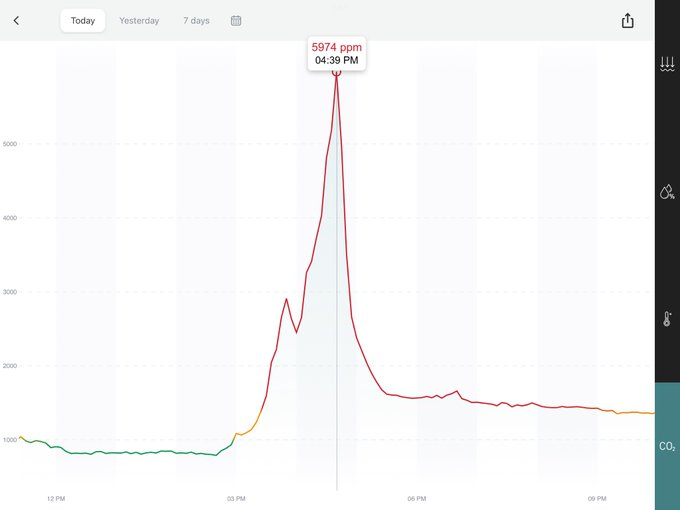
I've clocked ~6000 ppm from just 30 people breathing in a small conference room with an Aranet4. Room size 180 m^3
Warm regards,
David EldrEdgeCo-OwnerNALTIC Industrials, LLC888.891.0077435.503.4972
ᐧ
--- For more information about the DCHAS-L e-mail list, contact the Divisional membership chair at membership**At_Symbol_Here**dchas.orgOn Thu, Feb 29, 2024 at 3:20 PM Amber Wise <amber.wise**At_Symbol_Here**gmail.com> wrote:
Seeing as how dry ice is more dense than air and small children breathe closer to the floor, I could envision a closed room "filling up" with CO2 gas and pushing out adequate oxygen for them.
some back of the envelope calculations (I hope I got all my unit conversions?.....it's been awhile since I've taught undergrads chemistry) for a 10x10x3.5 meter room, the lower half of the room's volume is 170,000 Liters.
If half of a 10 pound block of dry ice sublimates (5lbs) = 51.6 moles = 1240 Liters of CO2 (using ideal gas law and room temp). That looks to me like 0.7% by volume. According to some quick googling, those levels are dangerous and can lead to dizziness, nausea and worse.
--- For more information about the DCHAS-L e-mail list, contact the Divisional membership chair at membership**At_Symbol_Here**dchas.orgOn Wed, Feb 28, 2024 at 8:35 AM Info <info**At_Symbol_Here**ilpi.com> wrote:
--- For more information about the DCHAS-L e-mail list, contact the Divisional membership chair at membership**At_Symbol_Here**dchas.orgI can’t think of any scenario with dry ice in this situation that would have caused this. You’d have to a significantly elevated level to feel something, at least 2,000 to 5,000 ppm, and the amount of CO2 you can bring into a classroom is what, a couple of pounds? The room would have to be hermetically sealed or you’d have to be huffing the stuff.
There’s either something massively left out of this story or it’s a case of chemophobic mass hysteria (guess that’s called mass psychogenic illness these days given the misogynistic origin/premise of the word hysteria). See, for example, https://www.aafp.org/pubs/afp/issues/2000/1215/p2655.html and https://www.verywellmind.com/understanding-groupthink-2671595
Similar reports have been seen in the literature, https://pubmed.ncbi.nlm.nih.gov/10631279/ and there have been cases of MPI reported at vaccination centers as well https://pubmed.ncbi.nlm.nih.gov/12814329/
Rob Toreki
======================================================Safety Emporium - Lab & Safety Supplies featuring brand namesyou know and trust. Visit us at https://www.SafetyEmporium.comesales**At_Symbol_Here**safetyemporium.com or toll-free: (866) 326-5412Fax: (856) 553-6154, PO Box 1003, Blackwood, NJ 08012
On Feb 24, 2024, at 7:30 PM, Monique Wilhelm <biocmst**At_Symbol_Here**GMAIL.COM> wrote:
--- For more information about the DCHAS-L e-mail list, contact the Divisional membership chair at membership**At_Symbol_Here**dchas.orgI do not have any additional details. Although I do suggest anyone working with hazardous materials with groups (or otherwise) to do a risk assessment and have appropriate controls in place as well as plans for any incidents that could occur.
--- For more information about the DCHAS-L e-mail list, contact the Divisional membership chair at membership**At_Symbol_Here**dchas.org
. WARNING - This email originated from outside of the UCI Health email system. Do not click any links and do not open attachments unless you can confirm the sender. PLEASE FORWARD SUSPICIOUS EMAILS TO: security**At_Symbol_Here**hs.uci.edu .
The content of this page reflects the personal opinion(s) of the author(s) only, not the American Chemical Society, ILPI, Safety Emporium, or any other party. Use of any information on this page is at the reader's own risk. Unauthorized reproduction of these materials is prohibited. Send questions/comments about the archive to secretary**At_Symbol_Here**dchas.org.
The maintenance and hosting of the DCHAS-L archive is provided through the generous support of Safety Emporium.