

About This Archive | DCHAS-L 2024 Index | DCHAS-L Yearly Index | DCHAS-L Home Page
Subject: Re: [DCHAS-L] Working in labs on the weekend proposal
Date: Mar 14, 2024 20:12 UTC
Author: Andy Glode <00001c047c05fd7f-dmarc-request**At_Symbol_Here**LISTS.PRINCETON.EDU>
Subject: Re: [DCHAS-L] Working in labs on the weekend proposal
Date: Mar 14, 2024 21:46 UTC
Author: Jack Reidy <jreidy2**At_Symbol_Here**STANFORD.EDU>
From: Jack Reidy <jreidy2**At_Symbol_Here**STANFORD.EDU>
Subject: Re: [DCHAS-L] Safety Glasses or Safety Splash-proof Goggles
Date: Mar 14, 2024 20:31 UTC
Reply-To: ACS Division of Chemical Health and Safety <DCHAS-L**At_Symbol_Here**Princeton.EDU>
In-Reply-To: [DCHAS-L] Safety Glasses or Safety Splash-proof Goggles
Hi David,
Back when I TA’d, at the start of the first session of the quarter, I would show students a scar I had on my hand from where a labmate had spilled sulfuric acid on my hand. It wasn’t a particularly heinous
scar, maybe the size of a dime on the back of my hand, so it wasn’t gruesome or off-putting, but it was still enough to drive home the importance of PPE. I had almost 0 problems with PPE in my lab sections. I was disappointed when the scar faded with time
(you can barely see it now), it was a very effective teaching tool.
Sincerely,
Jack Reidy (he/him)
Research Safety Specialist & Assistant Chemical Hygiene Officer
Environmental Health & Safety
Stanford University
484 Oak Road, Stanford, CA, 94305
Tel: (650) 497-7614
I acknowledge that the land on which I live and work is the ancestral and unceded land of the
Muwekma Ohlone Tribe. As an uninvited guest on these lands, I am a beneficiary of the ongoing displacement of the Ohlone people. I pay my respects to the Native peoples, past and present.
From: ACS Division of Chemical Health and Safety <DCHAS-L**At_Symbol_Here**Princeton.EDU>
On Behalf Of David EldrEdge
Sent: Thursday, March 14, 2024 9:06 AM
To: DCHAS-L**At_Symbol_Here**Princeton.EDU
Subject: [DCHAS-L] Safety Glasses or Safety Splash-proof Goggles
What is the consensus chemistry labs, splash-proof goggles or other (non-splash-proof with excellent ventilation)
I taught gen-chem labs at UVU for a few years, where they had a hard and fast rule, just as strong as the expectation that you wouldn't come into the lab without shoes or a shirt. Very high expectations were set for splash-proof, and there was never anyone
pushing against donning splash-proof goggles, although fogging up was an issue that we battled for a few.
I started teaching again last semester at a different community college, teaching one nursing-level elementary chemistry lab. I had no issues—everyone wore splash-proof eye protection. I didn't have to say much about it.
This semester, I'm teaching both elementary and a gen-chem II lab. However, I have encountered a challenge: about five young ladies continue to test my will. Despite warnings and even including in the rubric for the past Monday's lab that they would be graded
on safety, including the use of PPE, they still resist compliance. Twenty minutes into the lab, after a final warning, they all put their safety goggles on, but only for about 5 minutes before taking them off again.
This situation has left me pondering the best approach to ensure compliance without constantly policing the lab, which detracts from the educational experience for all involved. I'm reaching out to this community for advice and strategies you might have used
to encourage consistent use of safety goggles in your labs.
First of all, how important is mandating splash-proof goggles? I'm noticing among other institutions, even educational videos, many are not using splash-proof goggles, e.g. just safety glasses.
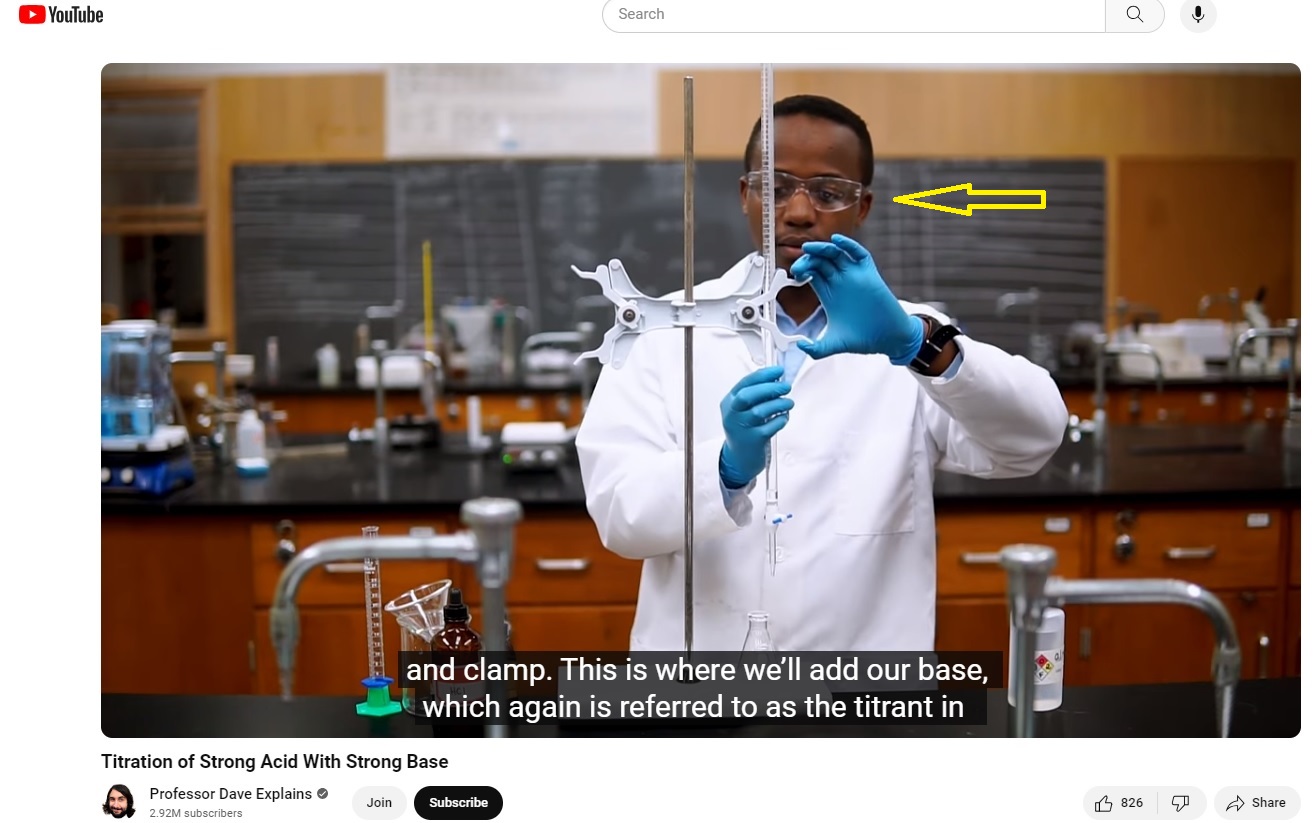
Secondly, how do you handle resistance or non-compliance, especially when it comes to something as critical as eye protection? Are there any particular methods, consequences, or educational strategies you've found effective in instilling
the importance of these safety practices in your students?
Additionally, if splash-proof goggles are really that much more important than just safety glasses, any suggestions for dealing with the fogging issue in a way that doesn't compromise safety but might make students more inclined to keep their goggles on, I
would greatly appreciate hearing those as well. (Anti-fog spray helps somewhat)
What is the level of liability risk for me and the school if students continue to not protect themselves? Is docking points off of their lab evidence enough that they have been put on notice as they continue to refuse to comply? They are adults, barely! Do
they have a choice? Taking 10-20% off of their total lab might be something they are willing to accept in place of safety. IDK.
Thank you in advance for your insights and advice. The safety of our students is paramount, and as well as protection from potential liability.
Warm regards,
David EldrEdge
Co-Owner
NALTIC Industrials, LLC
888.891.0077
435.503.4972
ᐧ
--- For more information about the DCHAS-L e-mail list, contact the Divisional membership chair at
membership**At_Symbol_Here**dchas.org
The content of this page reflects the personal opinion(s) of the author(s) only, not the American Chemical Society, ILPI, Safety Emporium, or any other party. Use of any information on this page is at the reader's own risk. Unauthorized reproduction of these materials is prohibited. Send questions/comments about the archive to secretary**At_Symbol_Here**dchas.org.
The maintenance and hosting of the DCHAS-L archive is provided through the generous support of Safety Emporium.