

About This Archive | DCHAS-L 2024 Index | DCHAS-L Yearly Index | DCHAS-L Home Page
Date: Apr 30, 2024 17:29 UTC
Author: Kristi Ohr <kohr**At_Symbol_Here**UMASS.EDU>
Subject: [DCHAS-L] 2024 Spring CHAS Workshops
Date: May 7, 2024 18:10 UTC
Author: Jack Reidy <jreidy2**At_Symbol_Here**STANFORD.EDU>
From: Craig Merlic <merlic**At_Symbol_Here**CHEM.UCLA.EDU>
Subject: Re: [DCHAS-L] Self-heating chemical storage
Date: May 1, 2024 19:19 UTC
Reply-To: ACS Division of Chemical Health and Safety <DCHAS-L**At_Symbol_Here**Princeton.EDU>
In-Reply-To: Re: [DCHAS-L] Self-heating chemical storage
The issue is that as a azo compound it is self-heating, not that it is flammable. Hence, the half-life upon heating and the reason to store it cold. The problem with GHS pictograms is that there are only nine, so not much granularity. The flame pictogram applies to flammable, pyrophoric, self-heating, emits flammable gas, self-reactive, and organic peroxide.
In my research lab I store azo and organic peroxide compounds cold for added safety, and fortunately all of my refrigerators and freezers are flammable rated.
Craig
From: ACS Division of Chemical Health and Safety <DCHAS-L**At_Symbol_Here**Princeton.EDU> on behalf of Sandra Keyser <sandrakkeyser**At_Symbol_Here**GMAIL.COM>
Reply-To: ACS Division of Chemical Health and Safety <DCHAS-L**At_Symbol_Here**Princeton.EDU>
Date: Wednesday, May 1, 2024 at 7:31 AM
To: <DCHAS-L**At_Symbol_Here**Princeton.EDU>
Subject: Re: [DCHAS-L] Self-heating chemical storage
Hi all,
Craig, I completely agree with you regarding salts and flammability, but the SDS does provide an ignitable hazard characteristic. I know that it would be a tough argument to sell to a fire inspector if they happen to check the contents of that fridge and see that pictogram (not sure how much you have to worry about that, Jack).
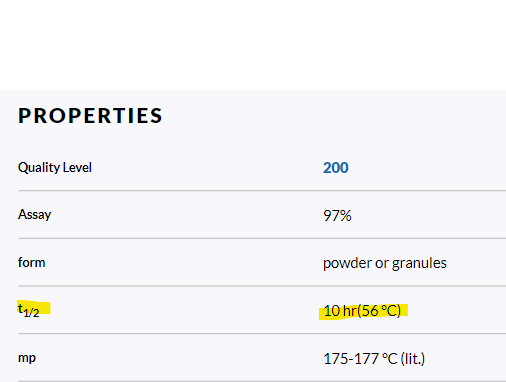
By nature of the material, it'll decompose to form N2 gas - it looks like Sigma Aldrich gives a half-life of 10 hours at 56 C (screenshot below)!
Jack, could the group borrow some space from a neighboring flammables-rated fridge?
Best,
Sandra
On Mon, Apr 29, 2024 at 7:12 PM Tammy M. Lutz-Rechtin <tlutzrec**At_Symbol_Here**uark.edu> wrote:
I think your main issue in storage is to keep away from moisture.
ECHA info says Registration Dossier - ECHA (europa.eu)
Recommended storage temperature: < 40 °C,
No decomposition if used and stored according to specifications. Stable at ambient temperature. Decomposes before melting. Self-accelerating Decomposition Temperature (SADT): > 75 °C
Sigma says: 11633 (sigmaaldrich.com)
Storage conditions Keep container tightly closed in a dry and well-ventilated place. Store under inert gas. Moisture sensitive. Heat sensitive. Storage class Storage class (TRGS 510): 4.2: Pyrophoric and self-heating hazardous materials
-Tammy
From: ACS Division of Chemical Health and Safety <DCHAS-L**At_Symbol_Here**Princeton.EDU> On Behalf Of Craig Merlic
Sent: Monday, April 29, 2024 4:45 PM
To: DCHAS-L**At_Symbol_Here**Princeton.EDU
Subject: Re: [DCHAS-L] Self-heating chemical storage
Jack,
That chemical is a double salt, so is far from meeting the definition of a flammable. (Salts have no vapor pressure to create a flash point.) As an organic it is combustible (burns), but not flammable. Therefore storage in a fridge should be fine.
Craig
Craig A. Merlic
Professor of Chemistry, UCLA Department of Chemistry and Biochemistry
Executive Director, UC Center for Laboratory Safety
From: ACS Division of Chemical Health and Safety <DCHAS-L**At_Symbol_Here**Princeton.EDU> on behalf of Jack Reidy <jreidy2**At_Symbol_Here**STANFORD.EDU>
Reply-To: ACS Division of Chemical Health and Safety <DCHAS-L**At_Symbol_Here**Princeton.EDU>
Date: Monday, April 29, 2024 at 2:18 PM
To: <DCHAS-L**At_Symbol_Here**Princeton.EDU>
Subject: [DCHAS-L] Self-heating chemical storage
Hi all,
A researcher reached out asking about how to store 2,2′-Azobis(2-methylpropionamidine) dihydrochloride (aka AAPH). It’s a new lab working in borrowed space, and they don’t have a refrigerator rated for storing flammables. Is this something you think a lab could safely store in a flammables cabinet? Thanks!
Sincerely,
Jack Reidy (he/him)
Research Safety Specialist & Assistant Chemical Hygiene Officer
Environmental Health & Safety
Stanford University
484 Oak Road, Stanford, CA, 94305
Tel: (650) 497-7614
I acknowledge that the land on which I live and work is the ancestral and unceded land of the Muwekma Ohlone Tribe. As an uninvited guest on these lands, I am a beneficiary of the ongoing displacement of the Ohlone people. I pay my respects to the Native peoples, past and present.
--- For more information about the DCHAS-L e-mail list, contact the Divisional membership chair at membership**At_Symbol_Here**dchas.org
--- For more information about the DCHAS-L e-mail list, contact the Divisional membership chair at membership**At_Symbol_Here**dchas.org
--- For more information about the DCHAS-L e-mail list, contact the Divisional membership chair at membership**At_Symbol_Here**dchas.org
--
Sandra Keyser, PhD
Merck Senior Safety Specialist
North Jersey ACS Chair
ACS Committee on Chemical Safety Member
ACS Career Counselor
--- For more information about the DCHAS-L e-mail list, contact the Divisional membership chair at membership**At_Symbol_Here**dchas.org
The content of this page reflects the personal opinion(s) of the author(s) only, not the American Chemical Society, ILPI, Safety Emporium, or any other party. Use of any information on this page is at the reader's own risk. Unauthorized reproduction of these materials is prohibited. Send questions/comments about the archive to secretary**At_Symbol_Here**dchas.org.
The maintenance and hosting of the DCHAS-L archive is provided through the generous support of Safety Emporium.