
About This Archive | DCHAS-L 2025 Index | DCHAS-L Yearly Index | DCHAS-L Home Page
Subject: Re: [DCHAS-L] Use of Fume Hood "Max Height"stickers with alarms vs just alarms
Date: Jul 3, 2025 17:30 UTC
Author: David EldrEdge <Dave.EldrEdge**At_Symbol_Here**NALTIC.COM>
Subject: [DCHAS-L] Fwd: Science News Summary for Fri, Jul 4, 2025
Date: Jul 4, 2025 16:26 UTC
Author: Stephen Taylor <stephen**At_Symbol_Here**LABSAFETYINSTITUTE.ORG>
From: Daniel Crowl <crowl**At_Symbol_Here**MTU.EDU>
Subject: Re: [DCHAS-L] Use of Fume Hood "Max Height"stickers with alarms vs just alarms
Date: Jul 3, 2025 17:58 UTC
Reply-To: ACS Division of Chemical Health and Safety <DCHAS-L**At_Symbol_Here**Princeton.EDU>
In-Reply-To: Re: [DCHAS-L] Use of Fume Hood "Max Height"stickers with alarms vs just alarms
OSHA: “General air flow should not be turbulent and should be relatively uniform throughout the laboratory, with no high velocity or static areas; air flow into and within the hood should not be excessively turbulent; hood face velocity should be adequate. (Typically 60-110 fpm.)”
ANSI/AIHA Z9.5: “Each hood shall maintain an average face velocity of 80-120 fpm with no face velocity measurement more than plus or minus 20% of average.”
SEFA: “Face velocities of laboratory fume hoods may be established on the basis of the toxicity or hazard of the materials used or the operations conducted within the fume hood. Note: Governmental codes rules and regulation may require specific face velocities. A fume hood face velocity of 100 fpm is considered acceptable in standard practice. In certain situations face velocity of up to 125 fpm or as low as 75 fpm may be acceptable to meet required capture velocities of the fume hood.”
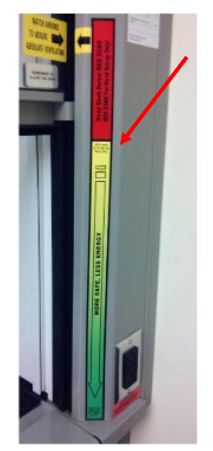
--- For more information about the DCHAS-L e-mail list, contact the Divisional membership chair at membership**At_Symbol_Here**dchas.orgHi Margaret:I worked with our Sustainability office to develop a fume hood sticker to mark 18" sash height and to encourage people to lower the sash. Here's the sticker:It's included in SafetyNet #35 here: https://safetyservices.ucdavis.edu/safetynet/how-use-chemical-fume-hood-safelyHope this helps. We were able to have these printed on heavy duty vinyl by on-campus Reprographics for about a dollar each. Hoods have both an alarm and a visual cue for proper sash height. If you choose to use this sticker, please credit UCDavis Safety Services. Some hoods have a manufacturer-applied 18" sash height sticker, as you can see in this image.Hope this helps.Debbie M. Decker (she/her/hers), ACS FellowChemical & Laboratory Safety Manager (ret.)(916)616-7548Opinions my ownOn Tue, Jul 1, 2025 at 11:47 AM Margaret Rakas <mrakas**At_Symbol_Here**smith.edu> wrote:--- For more information about the DCHAS-L e-mail list, contact the Divisional membership chair at membership**At_Symbol_Here**dchas.orgGood morning,When we moved into our 'wet lab' building about 15 years ago, each fume hood was equipped with a mechanical stop placed at 18 inches, as well as an alarm system governed by Phoenix controls. In this time, we have only had a malfunction with an alarm (didn't go off) in one hood. The mechanical stop is on one side of the hood, and can be manually released to raise the hood above the stop point in order to set up apparatus, etc.Because the mechanical stop is easy to 'hit', even though students are generally careful, over 15 years we have recently seen two incidents of the sash cable becoming frayed and as a result, the sash is difficult to open/shut. Repairs are costly plus a large inconvenience as the hood and solvent cabinets underneath must be emptied and deconned.Apparently these 18" mechanical sash stops are rare in other institutions per our vendor; and we are planning to remove them. We were thinking of placing labels denoting the 18 inch mark after the stops were removed, but this would mean installing about 70-80 labels pretty quickly. Not a difficult task, but enough time spent with a tape measure that I wanted to ask...Does your institution rely on just the alarm going off if the sash is raised above the setpoint, or do you also have a visual guide to the maximum set point on the side of each fume hood? We would confirm the alarms were working at the beginning of each semester as well as the beginning of the summer research period.thank you!
Margaret--Margaret A. Rakas, Ph.D.
Lab Safety & Compliance Director
Clark Science CenterSmith College
413-585-3877 (p)
The content of this page reflects the personal opinion(s) of the author(s) only, not the American Chemical Society, ILPI, Safety Emporium, or any other party. Use of any information on this page is at the reader's own risk. Unauthorized reproduction of these materials is prohibited. Send questions/comments about the archive to secretary**At_Symbol_Here**dchas.org.
The maintenance and hosting of the DCHAS-L archive is provided through the generous support of Safety Emporium.