

About This Archive | DCHAS-L 2026 Index | DCHAS-L Yearly Index | DCHAS-L Home Page
Subject: Re: [DCHAS-L] Invitation to Participate in PhD Research on Chemical Hazard Classification
Date: Jan 23, 2026 01:08 UTC
Author: Amanda MacPherson <aj.macpherson5**At_Symbol_Here**GMAIL.COM>
Subject: Re: [DCHAS-L] [EXTERNAL] Re: [DCHAS-L] DCHAS-L Digest - 14 Jan 2026 to 15 Jan 2026 (#2026-5)
Date: Jan 23, 2026 17:55 UTC
Author: Wardecke, Jon <000024045122adfd-dmarc-request**At_Symbol_Here**LISTS.PRINCETON.EDU>
From: 000006c59248530b-dmarc-request**At_Symbol_Here**LISTS.PRINCETON.EDU
Subject: Re: [DCHAS-L] DCHAS-L Digest - 14 Jan 2026 to 15 Jan 2026 (#2026-5)
Date: Jan 23, 2026 14:00 UTC
Reply-To: ACS Division of Chemical Health and Safety <DCHAS-L**At_Symbol_Here**PRINCETON.EDU>
In-Reply-To: Re: [DCHAS-L] DCHAS-L Digest - 14 Jan 2026 to 15 Jan 2026 (#2026-5)
This is one of those tough cases. You are trying to use a secondary measure(like CO2) as a surrogate measurement for everything (or perhaps at least some things) else. Sometimes that works; often it works for something and not others.
I have not good data to give you but I would raise two potential issues for you to consider:
Not sure this is much help, but I think the commendable goal may be very difficult to address practically.
Good luck. Feel free to call outside this discussion if you feel I could be of any help.
Richard Palluzi
Richard P Palluzi LLC
72 Summit Drive
Basking Ridge, NJ 07920
rpalluzi**At_Symbol_Here**verizon.net
908-285-3782
https://www.linkedin.com/in/richardppalluzillc/
From: ACS Division of Chemical Health and Safety <DCHAS-L**At_Symbol_Here**PRINCETON.EDU> On Behalf Of David EldrEdge
Sent: Wednesday, January 21, 2026 1:35 PM
To: DCHAS-L**At_Symbol_Here**PRINCETON.EDU
Subject: Re: [DCHAS-L] DCHAS-L Digest - 14 Jan 2026 to 15 Jan 2026 (#2026-5)
Hi Richard,
Thank you for the thoughtful and candid response. I appreciate the reality check regarding the complexity and limitations of comprehensive VOC monitoring programs.
My primary concern is narrower in scope. I am thinking specifically about potential exposure during the first trimester of pregnancy, when precautionary thresholds are often much lower and when uncertainty itself becomes part of the risk.
I agree completely that full-spectrum chemical monitoring across an instructional lab is impractical. What I am wrestling with is where to draw a reasonable, defensible line in the absence of compound-specific monitoring.
If VOCs are readily detectable by smell, that is clearly a problem. But what concerns me more are sub-odor-threshold concentrations, where there is no sensory warning, yet chronic low-level exposure may still be relevant for certain populations.
Do you see value in using limited indicators as a screening or triage tool, rather than as a compliance system? For example, CO₂ is something I have raised only as a proxy for ventilation effectiveness and air exchange, not as a surrogate for chemical exposure. I am using it primarily to quantify ACH and to identify situations where dilution ventilation may be insufficient.
For reference, one approach we have discussed is CO₂ decay after occupancy (or using dry ice to load the room first), using:
ACH (h⁻¹) = ln[(CO₂_start − CO₂_ambient) / (CO₂_end − CO₂_ambient)] / (t_end − t_start)
Turn off all ventilation, load the room/lab with CO2, then measure the decay. (with no occupance of course)
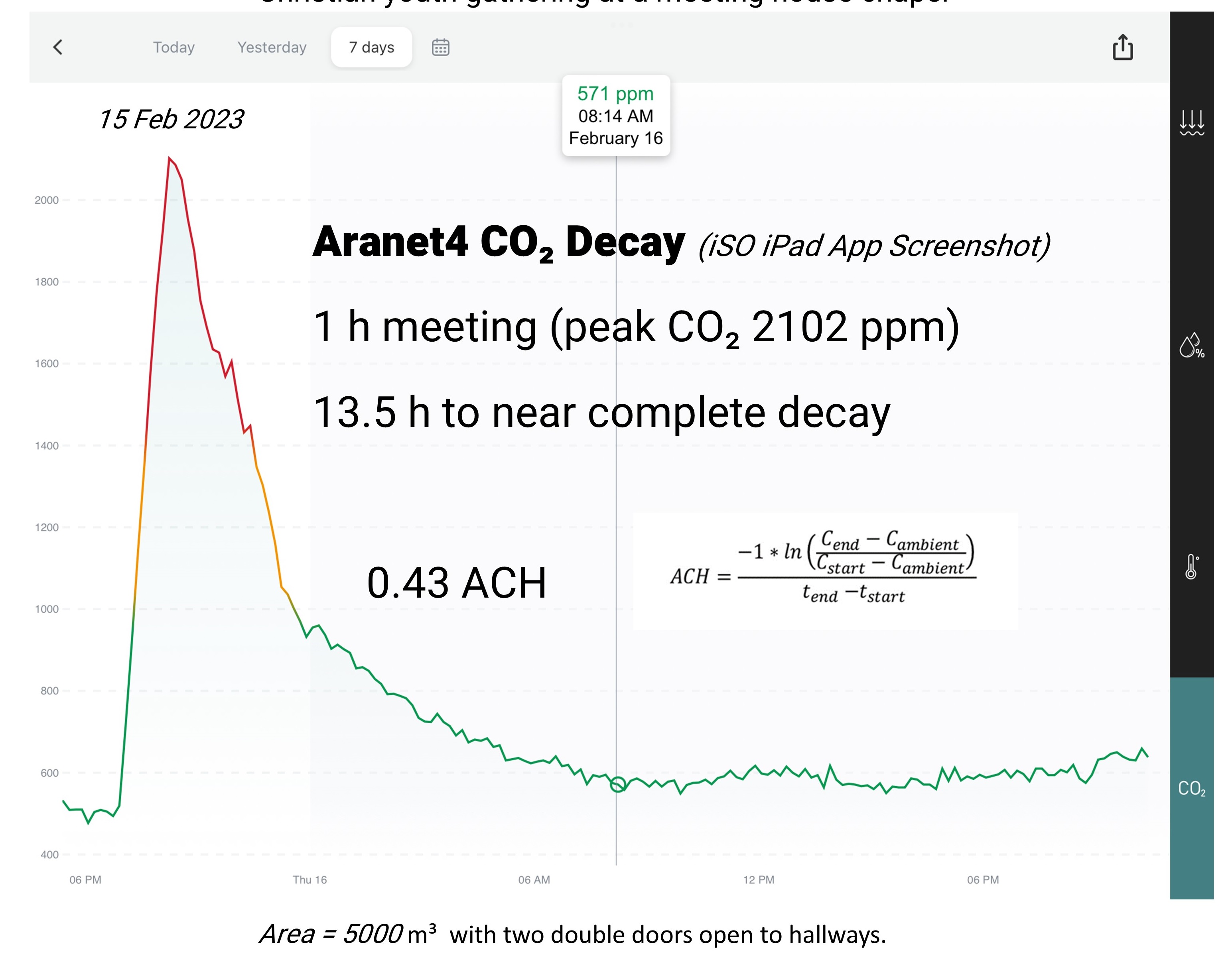
Data collected above with an Aranet4 CO2 sensor.
A more coarse CO2 approach is using people as the source of CO2 using this formula: tinyurl.com/ACHcalc1
Using this coarse equation with the tinyURL above, we get about 5 ACH. I am not sure that is enough.
I am not looking for a single instrument or metric to “declare safety,” but rather for guidance on whether there are practical early-warning indicators that can inform decisions such as additional controls, modified participation, or temporary avoidance during early pregnancy.
I appreciate your caution and would welcome any perspective on how you have seen institutions draw these lines in a way that is both realistic and responsible.
Thanks again!
Warm regards,
David EldrEdge
Co-Owner
NALTIC Industrials, LLC
888.891.0077 Main
435.503.4972 Cell
435.767.7714 Google Voice & Text
435.654.2727 Fax
On Wed, Jan 21, 2026 at 11:03 AM <000006c59248530b-dmarc-request**At_Symbol_Here**lists.princeton.edu> wrote:
CO2 is one concern but monitoring an entire laboratory for potential chemical contaminants is a much more difficult task. You need to determine all the potential emissions of concern. You need to evaluate if any monitors are positioned by some compounds and will fail too quickly. You need to look at sensitivity for all the compounds as some may trip at so low a level that they may realistic operation unlikely or so high a level that they provide no protection. You need an ongoing calibration and maintenance program that requires training, procedures, and expendables along with a system that says it is being followed properly.
I have worked with many clients on this and it often becomes an unrealistic option.
So be careful before you go too far down the path. Depending on what you are concerned about (CO2 for example) it may be fairly easy and straightforward or something that is a lot more expensive, complex and unreliable.
Richard Palluzi
PE, CSP
Pilot plant and laboratory consulting, safety, design,reviews, and training
Linkedin Profile
Richard P Palluzi LLC
72 Summit Drive
Basking Ridge, NJ 07920
rpalluzi**At_Symbol_Here**verizon.net
908-285-3782
-----Original Message-----
From: ACS Division of Chemical Health and Safety <DCHAS-L**At_Symbol_Here**PRINCETON.EDU> On Behalf Of Joe Sabol
Sent: Friday, January 16, 2026 8:02 AM
To: DCHAS-L**At_Symbol_Here**PRINCETON.EDU
Subject: Re: [DCHAS-L] DCHAS-L Digest - 14 Jan 2026 to 15 Jan 2026 (#2026-5)
CHAS,
Re: air quality monitoring in organic laboratory
A variety of inexpensive air quality monitors are available and easy to use (some are capable of data logging.) I've used both CO2 and VOC/H2CO/PM2.5 monitors in my home and when traveling.
During the COVID pandemic, when we realized that CO2 was a proxy for fresh air, I bought a $40 pocket size CO2 monitor. I've observed CO2 > 1500 ppm routinely on airplanes, trains, and buses; can approach 3000 ppm during deplane and also in crowded bars and nightclubs. CO2 > 1200 ppm can make people drowsy, i.e., students in a classroom.
Two years ago, I recommended that my local library get a VOC/H2CO/PM2.5 monitor (and separate CO2 monitor) and I used it to confirm unhealthy PM2.5 concentrations during the Canadian wildfires. The state has outdoor air quality monitors (including NOx, ozone, etc) but I'm concerned about my indoor air quality. (I have a Corsi-Rosenthal box fan filter on 24 hr/day, essentially for dust control; my house has hot water heat, so no furnace filters.)
I have a gas stove and when on CO2 increases from indoor ambient 500-600 ppm to ~1000 ppm, but not so much VOC or H2CO or PM2.5. NO2 is another matter, I'm not aware of any inexpensive real time monitors, but film badge devices and I've observed high NO2 when the stove/oven is on, via 24 hr period of heavy cooking vs no cooking. (The action level for NO2 is much lower than for carbon monoxide.)
Just my opinion, but every classroom should have a CO2 monitor. I know people who have installed commercial heat exchangers in their house to bring in fresh air and retain heat (or AC.) I read a paper a few years ago that showed increased PM2.5 during high student traffic on carpets (enter and exit classrooms.) Laboratories need other monitors, especially if solvent use and/or Bunsen burners. Sadly, some people (not on this list) feel that if you don't measure it, it's not a problem. For ~$250 you can get reliable monitors, but having them in your local library of things is also a good idea.
I add that I'm a member of CES and in 2025 we were preparing a DAC CCC grant proposal to distribute funds to the ten ACS regions, for redistribution to local sections for air quality (and water, etc) monitoring, citizen science. However, we were unable to submit, but plan to try in 2026.
I hope this helps. Let me know if you need more information on indoor air quality monitors.
Joe Sabol
--
> On 01/16/2026 12:00 AM EST DCHAS-L automatic digest system <listserv**At_Symbol_Here**lists.princeton.edu> wrote:
>
>
> There is 1 message totaling 129 lines in this issue.
>
> Topics of the day:
>
> 1. “Canary in the Coal Mine” Indicators for College Organic
> Chemistry Labs
>
> ---
> For more information about the DCHAS-L e-mail list, contact the
> Divisional membership chair at membership**At_Symbol_Here**dchas.org
>
> ----------------------------------------------------------------------
>
> Date: Wed, 14 Jan 2026 18:22:28 -0700
> From: David EldrEdge <Dave.EldrEdge**At_Symbol_Here**NALTIC.COM>
> Subject: “Canary in the Coal Mine” Indicators for College Organic
> Chemistry Labs
>
> Dear DCHAS-L colleagues,
>
> I’m reaching out to see whether anyone has had success using *VOC
> sensors or other real-time indicators* as a practical “canary in the
> coal mine” to help assess air quality in undergraduate teaching laboratories.
>
> I’m starting a new organic chemistry lab semester, and a student has
> shared that she is actively trying to become pregnant. This has
> prompted me to think more carefully about whether our laboratory air
> is truly as safe as we assume, particularly with respect to *chronic,
> low-level VOC exposure*, even in a space that is generally considered well ventilated.
>
> Our lab has multiple fume hoods and decent overall ventilation, but it
> is not a wind tunnel, and at times VOCs are still noticeable in the
> room. I’m interested in tools that might help move beyond subjective
> perception and provide *actionable data* to inform decisions,
> conversations with ADA or Title IX, and discussions with students’ health care providers.
>
> Specifically, I’m curious whether anyone has experience with:
>
> -
>
> Portable or fixed *VOC sensors* used in teaching labs
> -
>
> CO₂ used as a proxy for ventilation effectiveness, in combination with
> chemical use
> -
>
> Other indicators or monitoring approaches that have proven useful in
> practice
> -
>
> Lessons learned about what *does not* work well in this context
>
> I am not looking for medical guidance, but rather for practical,
> evidence-based approaches that can help faculty better understand and
> communicate the level of risk in real instructional environments.
>
> Any insights, references, or experiences would be greatly appreciated.
>
> Thank you in advance for your time and expertise.
> Warm regards,
>
> David EldrEdge
> Co-Owner
> NALTIC Industrials, LLC
> de**At_Symbol_Here**naltic.com
> www.naltic.com
> 888.891.0077 Main
> 435.503.4972 Cell
> 435.767.7714 Google Voice & Text
> 435.654.2727 Fax
>
>
> ᐧ
>
> ---
> For more information about the DCHAS-L e-mail list, contact the
> Divisional membership chair at membership**At_Symbol_Here**dchas.org
>
> ------------------------------
>
> End of DCHAS-L Digest - 14 Jan 2026 to 15 Jan 2026 (#2026-5)
> ************************************************************
---
For more information about the DCHAS-L e-mail list, contact the Divisional membership chair at membership**At_Symbol_Here**dchas.org
---
For more information about the DCHAS-L e-mail list, contact the Divisional membership chair at membership**At_Symbol_Here**dchas.org
ᐧ
--- For more information about the DCHAS-L e-mail list, contact the Divisional membership chair at membership**At_Symbol_Here**dchas.org
The content of this page reflects the personal opinion(s) of the author(s) only, not the American Chemical Society, ILPI, Safety Emporium, or any other party. Use of any information on this page is at the reader's own risk. Unauthorized reproduction of these materials is prohibited. Send questions/comments about the archive to secretary**At_Symbol_Here**dchas.org.
The maintenance and hosting of the DCHAS-L archive is provided through the generous support of Safety Emporium.