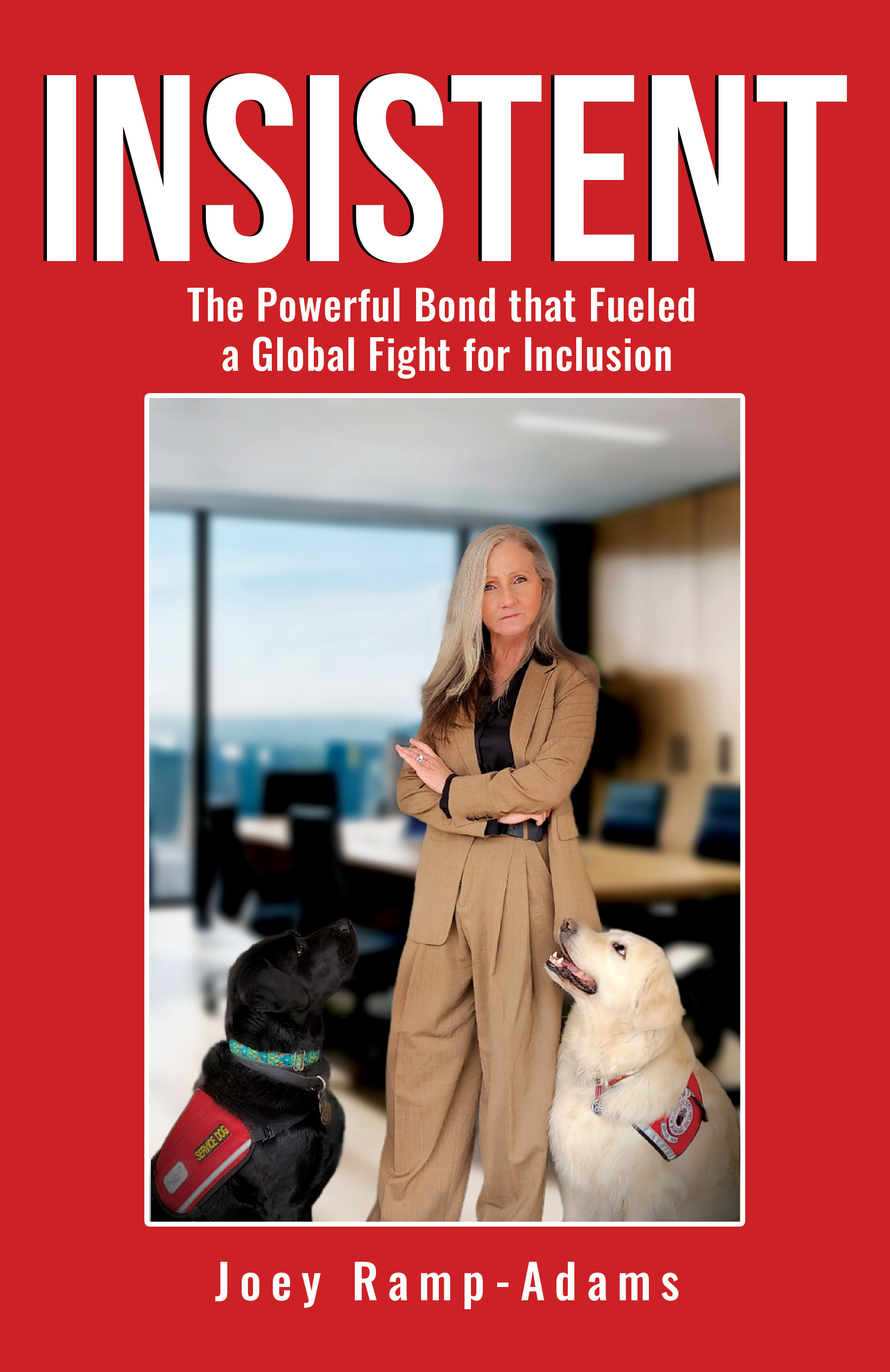
Thank you James! Piggybacking off that here is my story -
The Dog in the Laboratory
When I arrived at the University of Illinois as a nontraditional undergraduate neuroscience student, a student that was 42, disabled and recovering from a brain injury, managing independence with the assistance of a service dog, many people viewed us as an
impossibility.
At the time, the prevailing assumption across academia was that service dogs and laboratories simply could not coexist. The concerns came quickly and often: contamination, infection control, animal behavior, research integrity, distractions, safety. To many,
the presence of a service dog in a scientific laboratory was not merely unusual—it was viewed as unacceptable.
What was striking was that most of these concerns were based not on evidence, but on tradition, assumptions, and fear of the unknown.
Yet science is supposed to be about evidence.
As I worked my way through undergraduate research, becoming the first student at the University of Illinois to work in laboratories with a service dog, something interesting happened. The catastrophic disruptions people predicted never materialized. Experiments
were not ruined. Laboratories did not collapse into chaos. Research did not grind to a halt.
Instead, what emerged was something far less dramatic and far more important: practical solutions.
My service dogs (two in my academic and research career) learned laboratory protocols. We developed positioning procedures, developed service dog specific protective equipment to be used, when necessary, workflow adjustments, and safety controls. The same scientific
principles used to manage every other laboratory hazard were applied to service dog access. Risk was evaluated, controls were implemented, and work continued safely.
After completing my academic and research career, I developed a company and would become an advocate, liaison, and consultant for disability access to science. During those years, about 10 years ago, I remember a conversation with a Director of Safety and Compliance
from Bayer and Boehringer Ingelheim. As we discussed the barriers service dog handlers faced in science, he smiled and said, "Twenty years ago we were pipetting by mouth. In twenty years, people won't even know service dogs were once prohibited from science
laboratories."
At the time, his prediction seemed optimistic. Today, it feels remarkably accurate.
The culture of science has changed.
I have been privileged to work with individuals across the country, service dog handlers who are now working successfully as physicians, nurses, laboratory professionals, graduate students, field researchers, pharmacy technicians and academic researchers. They
are contributing in clinical environments, research facilities, and laboratories operating at Biosafety Levels 1, 2, and even 3. The question is no longer whether service dogs can exist in scientific environments. The question has become how to evaluate access
appropriately and safely.
The answer is the same answer science has always relied upon: risk assessment.
Not assumptions.
Not bias.
Not tradition.
Risk assessment.
As the conversations around service dog access evolved, so did the work itself. What began as a student trying to gain access to a laboratory grew into a broader effort to help institutions navigate the issue in a practical, evidence-based manner.
Drawing from my experiences in research and years of collaboration with biosafety professionals, disability specialists, and laboratory personnel, I developed comprehensive laboratory risk assessment frameworks and policy templates specifically designed for
evaluating service dog access in research environments. These tools help institutions move beyond blanket assumptions and instead evaluate actual hazards, exposure pathways, mitigation measures, and residual risks.
The goal has never been to lower safety standards, but to apply them consistently and scientifically.
Today, I travel nationally and internationally speaking on the topic of disability inclusion with a high focus on service dog access in scientific environments. I work alongside attorneys, Environmental Health and Safety professionals, biosafety officers, disability
services personnel, researchers, and institutional leadership to develop practical solutions that provide access for qualified service dog handlers while protecting laboratory safety, research integrity, and regulatory compliance. Whether the setting is a
teaching laboratory, a clinical environment, or a high-containment research facility, the conversation remains the same: identify the hazard, evaluate the exposure pathway, implement appropriate controls, and make decisions based on evidence rather than assumptions.
What once seemed like an unusual problem has become a recognized area of expertise. I have had the privilege of presenting keynote addresses, conducting laboratory evaluations, assisting institutions with policy development, and helping organizations navigate
some of the most complex questions surrounding disability access in scientific settings.
Perhaps one of the most meaningful milestones was Over the past decade, when I found myself moving from student/researcher to advocate I was invited to contribute a chapter on service dog access in research environments for an upcoming IGI Global academic textbook.
For someone who was once told that a service dog did not belong in a laboratory, the opportunity to help shape the scholarly conversation on inclusion in science represents more than a professional achievement. It reflects how far the field has come and demonstrates
that meaningful change is possible when science is willing to examine its assumptions and follow the evidence.
Perhaps one of the most meaningful milestones was, alongside more than two dozen biosafety organizations, scientific societies, disability advocates, federal agencies, and a coalition of Members of Congress, I worked to address one of the most persistent barriers
facing service dog handlers in science. Together, we pushed for clarification within the CDC's Biosafety in Microbiological and Biomedical Laboratories (BMBL), a document that had often been cited to justify blanket exclusion of service dogs from laboratory
environments.
The result was a federal clarification in March 2026 affirming what many of us had argued for years:
service dog access should be evaluated through individualized risk assessments and in compliance with federal disability law.
That clarification was never about forcing access. It was about ensuring decisions are based on evidence.
A hazard only becomes a meaningful risk when an exposure pathway exists. Controls reduce risk further. These are fundamental principles every scientist understands. Service dog access should be evaluated no differently than any other laboratory variable.
Looking back, I sometimes think about the frightened predictions made when I first entered a laboratory with a service dog. Many people genuinely believed science and disability inclusion were incompatible.
What they failed to recognize was that science itself provides the solution. Science teaches us to gather data. Science teaches us to test assumptions. Science teaches us to challenge longstanding beliefs when evidence points in a different direction.
And perhaps most importantly, science teaches us that progress occurs when we are willing to follow the evidence rather than the tradition.
The story of service dogs in laboratories was never really about dogs. It was about whether science would apply its own principles to itself.
For decades, decisions affecting disabled scientists were often made based on assumptions rather than evidence, tradition rather than data, and fear rather than risk assessment. We would never accept those standards in our research. We would never publish conclusions
without evidence, reject data because it challenged long-held beliefs, or dismiss an entire line of inquiry because it made us uncomfortable. Yet that is precisely how many institutions approached disability and service dog access in science.
The question facing academic and research professionals today is not whether service dog handlers belong in laboratories. That question has already been answered by the students, physicians, nurses, researchers, and laboratory professionals successfully working
in those environments every day.
The real question is whether our institutions are willing to hold themselves to the same scientific standards they demand of everyone else.
If science is truly committed to evidence-based decision-making, then policies must be based on evidence. If science values innovation, then it must be willing to challenge outdated assumptions. If science seeks the best minds to solve humanity's greatest challenges,
then it cannot afford to exclude talented individuals because of disability, convenience, or institutional inertia.
The future of science will not be determined by how effectively we preserve the traditions of the past. It will be determined by how courageously we evaluate those traditions when the evidence tells us they are no longer serving us.
Twenty years from now, I believe science professionals will look back with genuine surprise that service dogs were ever considered incompatible with science. They will wonder why so much energy was spent defending barriers that lacked evidence, while overlooking
the contributions of people capable of advancing discovery.
My challenge to science professionals is simple: Protect safety. Protect civil rights. Conduct risk assessments. Follow the data. Follow the law. Follow the science.
And if our policies cannot withstand the same level of scrutiny we expect from our research, then perhaps the opportunity is not to reevaluate the disabled scientist, but to reevaluate the assumptions that shaped those policies in the first place.
Thank you for this thread!
Joey Ramp-Adams
Empower Ability Consulting (EAC), CEO
Opportunities, not obstacles. Solutions, not situations. Breakthroughs, not barriers.
Neuroscience | Disability Services | Education Policy
Neuroscience Research Affiliate | University of Illinois
Beckman Institute for Advanced Science and Technology
University of Arizona | Consultant of Grant DEIA Oversite
Legislative and Advocacy Committee Member Assistance Dogs International
Author of "INSISTENT: The Powerful Bond that Fueled a Global Fight for Inclusion"
From: ACS Division of Chemical Health and Safety <DCHAS-L**At_Symbol_Here**PRINCETON.EDU> on behalf of James Kaufman <jkaufman**At_Symbol_Here**LABSAFETYINSTITUTE.ORG>
Sent: Sunday, June 14, 2026 8:15 AM
To: DCHAS-L**At_Symbol_Here**PRINCETON.EDU <DCHAS-L**At_Symbol_Here**PRINCETON.EDU>
Subject: Re: [DCHAS-L] I Remember When…”: Reflecting on the Evolution of Laboratory Safety
Fifty-three years ago, I went to work for Dow Chemical. On that first day, I learned more about safety than I had learned in 25 years in school.
Two weeks later, I turned my round-bottom flask with a condenser and a calcium chloride drying tube into a Roman candle with purple flames and black smoke. Everyone (50 employees) was out on the lawn
looking at me and asking what I had done. No one was injured.
The next morning, we were all in the conference room. The lab director said: “We want to thank Dr. Kaufman for his display of pyrotechnics. But we hope he’ll confine it to the 4th of July.”
I wanted to hide under my chair. Then, he added: “We pay you to do three things. Work safely, do your research, and write your reports and patent disclosures.”
Working safely wasn’t something extra. It was one of the primary colors. It was
integral. It was important.
Two weeks later, I was driving home to my apartment in Marlboro. I heard on the radio that there had been an explosion at WPI. I drove back to Worcester to Goddard Hall. I walked up to the second
floor to the lab. The fluorescent lights had been blown off the ceiling. The windows had been blown out. The corner of the stone-topped bench with the oak cabinets underneath was gone. It looked like someone had passed a hot knife thru butter. And, a
grad student had blown off parts of both hands doing six things that I had learned at Dow on the first day that you just don’t do.
As I looked around, I realized that there was no way that my 25 years in school had prepared me to work up to the standards of Dow Chemical. I decided to try to share what I was learning at Dow with
schools and colleges.
My supervisor encouraged me to write some lab safety guidelines. I did. I wrote “Laboratory Safety Guidelines”. Dow sent the publication to 2000 colleges and universities in the mid-seventies. Within
one year, Dow had received requests for a quarter of a million reprints. We had struck a nerve in academia.
Today, more than six million copies of those guidelines have been distributed in 23 languages. Guideline #11 is four simple questions: What are the hazards? What can go wrong? What do you need to
do to be prepared? And, what are the prudent practices, protective facilities and protective equipment needed to minimize the risk. Guideline #11 is the great grandfather of RAMP.
Want a free copy: see
www.labsafety.org resources.
James A. Kaufman, PhD
Founder/President Emeritus
The Laboratory Safety Institute (LSI)
A Non-profit Educational Organization for Safety
in Academic, Industrial, and Government Laboratories
101 Oak Street, Wellesley, MA 02482 (MA Office)
(O) 508-647-1900 (C) 508-574-6264
Skype: labsafe; 508-401-7406
jkaufman**At_Symbol_Here**labsafety.org www.labsafety.org
Teach, Learn, and Practice Science Safely
As we celebrate 150 years of the American Chemical Society, June has been dedicated as the ACS Safety Pillar. I would like to invite members of this vibrant and highly knowledgeable community to join ACS staff in recognizing the remarkable
evolution of laboratory safety, becoming a central and integral part of both chemistry education and research.
As scientists, we value data, but stories are also powerful indicators of meaningful and ongoing change.
We would love to hear your perspective.
- How has laboratory safety changed over the course of your career, whether over the past 30, 20, or even 5 years?
- What stands out most to you about this transformation?
Let’s explore this evolution through a personal lens, perhaps by sharing an
“I remember when…” moment that captures how practices, expectations, or culture have shifted over time. These reflections can bring our collective progress to life and resonate deeply across our community.
I’m confident there are many powerful stories among us so let’s uncover them together!
One of my stories:
I got my undergraduate degree in Poland, and one of my professors had quite the dramatic introduction to lab safety: he was missing a finger due to a refrigerator explosion in his lab. Our class had about 100 students, and lectures were
held in a huge auditorium. During the very first lecture, he proudly displayed his incomplete hand and declared that we were all very brave for choosing chemistry as our future profession. According to him, true scientists should be prepared to make sacrifices
at the altar of scientific discovery.
I remember sitting there thinking that perhaps I was not ideal chemist material, since I had no intention of sacrificing any body parts in the name of science.
Of course, after that first lecture, we all laughed about this safety demo, but the professor himself was completely serious. He wore his injury almost like a badge of honor , proof of his “scientific stamina.”
Years later, I heard that his lab was eventually shut down because the refrigerator explosions kept happening, and one of them even destroyed a very expensive piece of instrumentation. I believe he retired shortly after that ban. In hindsight,
perhaps the university finally decided that repeated explosions were not an essential component of scientific freedom.
Looking back, what once may have been seen as a “badge of honor” now feels more like a reflection of poor safety practices and a lack of professional responsibility. Today, a faculty member proudly displaying injuries from preventable
laboratory accidents would likely be viewed not as a scientific hero, but as a liability to the institution. I hope that, thanks to all our collective efforts, our discipline is evolving. Modern chemistry starts recognizing that good scientists are not the
ones who cause and survive accidents; they are the ones who create strong safety cultures so accidents do not happen in the first place.
--- For more information about the DCHAS-L e-mail list, contact the Divisional membership chair at
membership**At_Symbol_Here**dchas.org
--- For more information about the DCHAS-L e-mail list, contact the Divisional membership chair at
membership**At_Symbol_Here**dchas.org