

DCHAS-L Archives · Post dated September 29, 2026
Subject: Re: [DCHAS-L] SDS HyperGlossary updates and additions
Date: Sep 27, 2026 00:01 UTC
Author: Rob Toreki <info**At_Symbol_Here**ILPI.COM>
Subject: [DCHAS-L] Benzyl alcohol
Date: Sep 30, 2026 12:52 UTC
Author: Neal Langerman <chemsaf**At_Symbol_Here**GMAIL.COM>
From: Rob Toreki <info**At_Symbol_Here**ILPI.COM>
Subject: [DCHAS-L] Pennsylvania high school bonfire explosion
Date: Sep 29, 2026 04:23 UTC
Reply-To: ACS Division of Chemical Health and Safety <DCHAS-L**At_Symbol_Here**PRINCETON.EDU>
In-Reply-To:
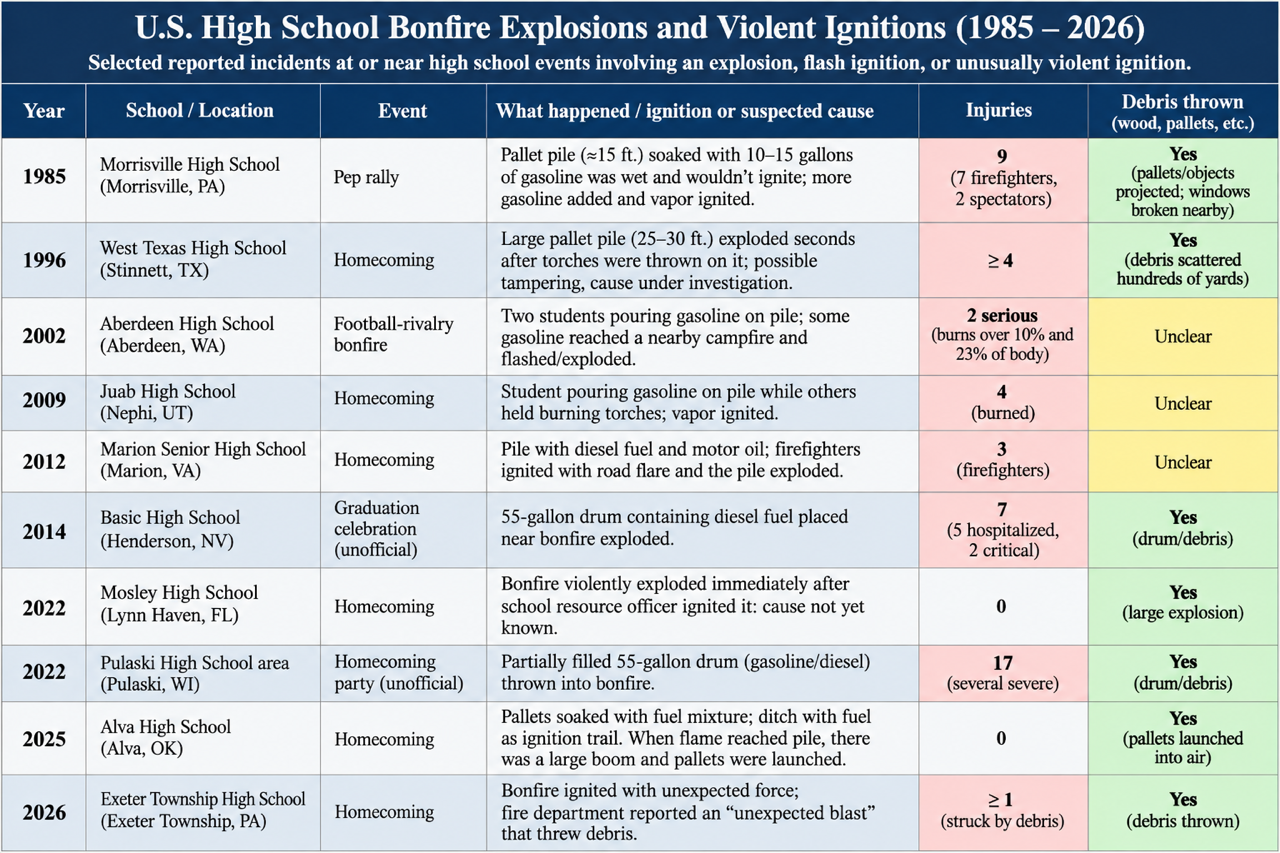
West Texas High School, Stinnett, Texas — September 1996. A 25–30-foot pile of pallets exploded seconds after torches were thrown onto it in front of roughly 250–300 people. At least four were injured, including a school maintenance director apparently struck by flying wood. Debris was scattered for hundreds of yards across the campus. Police initially believed someone may deliberately have caused the explosion, although the contemporary report says the exact cause was still under investigation. TTU DSpace
Aberdeen, Washington — November 2002. More than 100 students had gathered for Aberdeen High School's traditional pre-football-game burning of a "Johnny Hoquiam" effigy. Two students were pouring gasoline onto the wood pile; some gasoline reached a nearby campfire and an explosion/flash resulted. One student suffered burns over 10% of his body and another over 23%. Seattle Post-Intelligencer
Juab High School, Nephi, Utah — September 2009. This was another remarkably clear gasoline-vapor accident. A student was photographed standing on the pile pouring gasoline onto the wood while other students nearby held burning torches. Before he could get down, the vapor ignited. Police attributed the explosion to gasoline fumes reaching the torches. Four students were badly burned. Interestingly, the bonfire was a longstanding school tradition but had not actually been school-sanctioned for nearly a decade. KSL News
Marion Senior High School, Virginia — September 2012. Five volunteer firefighters were preparing an approximately eight-foot homecoming bonfire. Diesel fuel and motor oil reportedly had been applied. A road flare ignited vapor and the pile exploded. One firefighter suffered first- and second-degree burns to his arms, chest, neck and face; two others were also injured. Officials were puzzled because they said the materials they knowingly used should not have generated the readily ignitable vapor involved, and the state police arson team investigated. Firehouse
Basic High School graduation, Henderson, Nevada — June 2014. This one wasn't a school-sponsored homecoming bonfire, so I would put an asterisk beside it. Graduates were celebrating around a desert bonfire when a 55-gallon drum containing diesel fuel was moved close to the fire and subsequently exploded. Seven young people were injured; five were admitted to a burn center, including two initially listed in critical condition. BostonGlobe.com
Mosley High School, Florida — October 5, 2022. This is probably the best recent example of an official event where proper spectator separation prevented the explosion from becoming a mass-casualty event. A school resource officer ignited the traditional homecoming bonfire and it exploded dramatically. Students had been kept behind a fence and nobody was injured. The district subsequently ended school bonfires altogether, while the sheriff said the cause wasn't yet known and that his department was "out of the bonfire business." https://www.wsfa.com
Pulaski, Wisconsin — October 14, 2022. This was an unofficial homecoming-weekend party involving Pulaski High students and recent graduates. A partially filled 55-gallon drum containing gasoline and diesel fuel was thrown into the bonfire. At least 17 teenagers suffered burns, several severe. The event subsequently resulted in criminal prosecution and multiple civil suits. The Washington Post
Alva High School, Oklahoma — September 2025. This one is especially interesting in light of Exeter because it occurred only a year earlier and involved firefighters conducting the ignition. Wooden pallets were soaked with a fuel mixture and a shallow ditch containing fuel served as a remote ignition trail. When the flame reached the pile, there was a large boom and pallets were launched into the air. Nobody was close enough to be hit. The fire chief thought the fuel mixture may have been improperly mixed and instituted tighter procedures rather than eliminating the bonfire. Alva Review-Courier
Exeter Township High School, Pennsylvania — September 24, 2026. The fire department lit the traditional homecoming bonfire, which the district says "ignited with unexpected force." The fire department described an "unexpected blast" that threw debris from the fire location. At least one person was struck and evaluated but apparently not seriously injured. The district then announced that it would permanently discontinue the homecoming bonfire. AOL.com
What jumped out at me in reconstructing the search is that Exeter isn't an unprecedented freak occurrence. There are at least several very close precedents involving school bonfires, firefighters or other responsible adults, fuel-assisted ignition, and wood/pallet debris being propelled outward by the resulting pressure event. Morrisville 1985, Stinnett 1996, Mosley 2022, Alva 2025, and Exeter 2026 form a particularly interesting subset.
There's also an important distinction among these events. Some are straightforward flammable-vapor deflagrations—Morrisville and Juab are essentially textbook examples. Others involved fuel containers placed into or near an existing fire, such as Pulaski and Henderson. And a third group—particularly Stinnett, Mosley and Exeter—involved a violent explosion of the pile for which the immediately reported cause wasn't established. That distinction matters if your interest is specifically in understanding what could have happened at Exeter rather than merely compiling bonfire injuries.

The content of this page reflects the personal opinion(s) of the author(s) only, not the American Chemical Society, ILPI, Safety Emporium, or any other party. Use of any information on this page is at the reader's own risk. Unauthorized reproduction of these materials is prohibited. Send questions/comments about the archive to secretary**At_Symbol_Here**dchas.org.
The maintenance and hosting of the DCHAS-L archive is provided through the generous support of Safety Emporium.