| The Home page of ILPI's Safety Data Sheet (SDS) Resource, the leader in SDS information since 1995! | |
| The history and philosophy behind this resource. | |
| A curated collection of books and reference materials concerning Safety Data Sheets and closely related topics. | |
| Paste your plain text SDS into the SDS-Demystifier, and it will be converted into a hypertext-enriched document with links to detailed explanations of each key term. | |
| An extensive list of frequently asked questions about Safety Data Sheets including regulations, content, compliance, and more. | |
| A humorous take on Safety Data Sheet jargon. Fill in the blanks on our entry form to generate a personalized Unsafety Data Sheet to share with your coworkers. | |
| Since 1995, we've maintained this massive curated list of the best places to find Safety Data Sheets on the Internet. | |
| Way more than a glossary, this hypertext-enhanced resource covers hundreds of SDS-related terms and expert knowledge. Each entry includes both the SDS relevance and links to additional authoritative resources. | |
| Archived results of Safety Data Sheet related polls taken by some of our millions of site visitors | |
| You are here! The OSHA regulations behind SDS regulations, including the inspection guidelines and over 400 official interpretations letters under the Hazard Communication Standard | |
| Commercial suppliers of SDS authoring and management software as well as cloud compliance services. | |
| Commercial companies that will create SDS's for your specific needs as well as SDS translation companies. |

Safety signs, banners, and scoreboards? Get yours at Safety Emporium!
OSHA Hazard Communication Letters of Interpretation
Maintaining MSDSs on a computer data base.
- Issued
- Record type
- Interpretation
- Historical standard
- 1910.1200, original 1983 rule (PDF)
- Current standard
- HCS 2024, as amended
- Record-standard history
- 1910.20 at issuance; renumbered 1910.1020 in 1996
- Current record standard
- 1910.1020
ILPI assessment: Electronic access remains acceptable; safeguards and citations updated
This letter addresses the original 1983 Hazard Communication Standard (HCS), which is now obsolete. Its central conclusion remains consistent with current paragraph (g)(8): electronic SDS access is permitted when it creates no barriers to immediate employee access in the workplace. An accessible computer alone is not sufficient if employees cannot use it or obtain the information during every shift or an emergency.
The historical “any form” citation to paragraph (g)(9) now corresponds to paragraph (g)(10). Current paragraph (g)(9) addresses employees who travel between workplaces. Keep these SDS-access duties separate from exposure-record retention and access under 1910.1020: its record-request timetable does not permit a delay in obtaining an SDS needed during work.
The letter's reference to access within “15 days” is incomplete for current record requests. Current paragraph (e)(1)(i) uses fifteen working days and requires notice of the reason and earliest availability date if access cannot reasonably be provided within that time. OSHA's page also marks a March 26, 2009 contact correction; the old contact below should not be used for current inquiries.
Last reviewed: .
About this ILPI assessment
This comparison with current requirements is not a finding that OSHA has formally withdrawn this letter. This assessment reflects editorial judgment informed by human review and AI assistance. It is an opinion, may contain errors or omissions, and is not an official OSHA determination. For guidance on how OSHA requirements apply to your circumstances, contact your local OSHA office.
OSHA's notice about interpretation letters
The following notice is published on OSHA's interpretation pages; it is general guidance, not a letter-specific withdrawal notice.
OSHA requirements are set by statute, standards and regulations. Our interpretation letters explain these requirements and how they apply to particular circumstances, but they cannot create additional employer obligations. This letter constitutes OSHA's interpretation of the requirements discussed. Note that our enforcement guidance may be affected by changes to OSHA rules. Also, from time to time we update our guidance in response to new information. To keep apprised of such developments, you can consult OSHA's website at https://www.osha.gov.
Source: OSHA's original letter page.
January 13, 1986
Mr. F. Michael Friedman
Arney, Pagano & Friedman
Attorneys At Law
321-323 West Front Street
Post Office Box 1000
Media, Pennsylvania 19063
Dear Mr. Friedman:
Reference is made to your letter dated November 20, 1985, requesting if material safety data sheets (MSDS) on a computer data base would be in compliance with provisions of 29 CFR 1910.
There are two standards in OSHA's General Industry Standards, 29 CFR 1910, that specifically address employee access to MSDS's. They are: 1910.1020, "Access to employee exposure and medical records", and 1910.1200 "Hazard Communication".
[ILPI note: OSHA's online letter uses the later record-standard number 1910.1020. At issuance it was 1910.20, renumbered in 1996. Links labeled 1910.1020 on this page lead to that current counterpart; HCS citations lead to the original 1983 rule, with current counterparts identified here.]

Under 1910.1020, the MSDS is considered a record and as per 1910.1020(d)(1)(ii)(B), "need not be retained for any specified period as long as some record of the identity (chemical name if known) of the substance or agent, where it was used, and when it was used is retained for at least thirty (30) years....
" Due to the length of time involved, storage of MSDS's as records under 1910.1020 on a computer data base could require special planning on the part of the employer. Also, 1910.1020(e) states that any employer must provide access to a record in a reasonable time, place, and manner, but in no event later than 15 days after the request for access is made. Based on your letter, this requirement should pose no compliance problem for the proposed method of storing MSDS's.
[ILPI note: The current record-access timetable uses fifteen working days, with a required explanation and earliest-availability date if timely access cannot reasonably be provided. It does not authorize delaying SDS access during a work shift.]
However, under 1910.1200(g)(8), the employer must ensure that the MSDS's are readily accessible during each work shift to employees when they are in their work area(s). 1910.1200(g)(9) reiterates the above and allows MSDS's to be kept in any form.
[ILPI note: Current counterparts: electronic access without barriers and information kept in any form. Current (g)(9) instead addresses employees who travel between workplaces.]
In conclusion, if the employee's work area includes the area where the MSDS's can be obtained, then maintaining MSDS on a computer would be in compliance. If the MSDS's can only be accessed out of the employee's work area(s), than the employer would not be in compliance with 1910.1200(g)(8) or (9).
If you have any further questions, please contact the Office of Health Compliance Assistance on (202)523-8036.
[ILPI note: OSHA's March 26, 2009 correction substitutes the Office of Health Enforcement at (202) 693-2190. This records that correction; use the current OSHA office directory for present inquiries.]
Sincerely,
John B. Miles, Jr., Director
Directorate of Field Operations
November 20, 1985
Mr. John Miles
Director of Field Operations
U.S. Department of Labor - O.S.H.A.
200 Constitution Avenue N.W.
Room No. N 3603
Washington, D.C. 20210
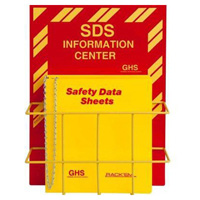
Your employees can stay informed and safety-ready with right to know stations and labels from Safety Emporium.
Re: Employer Compliance with Material Safety Data Sheet Requirements of 29 CFR part 1910 by means of Computer Data Base.
Dear Mr. Miles:
We are requesting a formal opinion of whether an employer who maintains the required material safety sheets (M.S.D.S.) on a personal computer disc data base will be in compliance with the provisions of 29 CFR part 1910. The information would be called up by a program and the employer would make available to employees ready access to the computer and necessary assistance in its use during all work shifts. A hard copy print-out could also be provided by printer at any time. If this is sufficient information for you to advise us of whether this would be satisfactory compliance, we would appreciate your opinion. If you need further information please do not hesitate to contact us.
Respectfully yours,
ARNEY, PAGANO AND FRIEDMAN
F. Michael Friedman
Arney, Pagano & Friedman
ATTORNEYS AT LAW
321-323 WEST FRONT STREET
MEDIA, PENNSYLVANIA 19063
The original official public domain version of this document is available from OSHA at https://www.osha.gov/laws-regs/standardinterpretations/1986-01-13.