| The Home page of ILPI's Safety Data Sheet (SDS) Resource, the leader in SDS information since 1995! | |
| The history and philosophy behind this resource. | |
| A curated collection of books and reference materials concerning Safety Data Sheets and closely related topics. | |
| Paste your plain text SDS into the SDS-Demystifier, and it will be converted into a hypertext-enriched document with links to detailed explanations of each key term. | |
| An extensive list of frequently asked questions about Safety Data Sheets including regulations, content, compliance, and more. | |
| A humorous take on Safety Data Sheet jargon. Fill in the blanks on our entry form to generate a personalized Unsafety Data Sheet to share with your coworkers. | |
| Since 1995, we've maintained this massive curated list of the best places to find Safety Data Sheets on the Internet. | |
| Way more than a glossary, this hypertext-enhanced resource covers hundreds of SDS-related terms and expert knowledge. Each entry includes both the SDS relevance and links to additional authoritative resources. | |
| Archived results of Safety Data Sheet related polls taken by some of our millions of site visitors | |
| You are here! The OSHA regulations behind SDS regulations, including the inspection guidelines and over 400 official interpretations letters under the Hazard Communication Standard | |
| Commercial suppliers of SDS authoring and management software as well as cloud compliance services. | |
| Commercial companies that will create SDS's for your specific needs as well as SDS translation companies. |

Safety signs, banners, and scoreboards? Get yours at Safety Emporium!
OSHA Hazard Communication Letters of Interpretation
Application of the Hazard Communication Standard to lift trucks.
- Issued
- Record type
- Interpretation
- Historical standard
- 1910.1200, original 1983 rule (PDF)
- Current standard
- HCS 2024, as amended
ILPI assessment: Machine/container distinction retained; chemical duties remain
This letter addresses the original 1983 Hazard Communication Standard (HCS), which is now obsolete. Its central HazCom distinction remains consistent with the current HCS: a lift truck does not require an SDS as though it were a chemical container, while hazardous fuels and other workplace chemical hazards still require communication. The current container definition expressly excludes engines, fuel tanks, and other operating systems in vehicles.
That exclusion does not exempt supplied fuels/fluids from their applicable labeling and SDS duties, or remove employee access and training requirements. Address hazards such as carbon monoxide. The article-definition debate and comment deadline below are historical; use the current definition for a present article assessment.
Last reviewed: .
About this ILPI assessment
This comparison with current requirements is not a finding that OSHA has formally withdrawn this letter. This assessment reflects editorial judgment informed by human review and AI assistance. It is an opinion, may contain errors or omissions, and is not an official OSHA determination. For guidance on how OSHA requirements apply to your circumstances, contact your local OSHA office.
OSHA's notice about interpretation letters
The following notice is published on OSHA's interpretation pages; it is general guidance, not a letter-specific withdrawal notice.
OSHA requirements are set by statute, standards and regulations. Our interpretation letters explain these requirements and how they apply to particular circumstances, but they cannot create additional employer obligations. This letter constitutes OSHA's interpretation of the requirements discussed. Note that our enforcement guidance may be affected by changes to OSHA rules. Also, from time to time we update our guidance in response to new information. To keep apprised of such developments, you can consult OSHA's website at https://www.osha.gov.
Source: OSHA's original letter page.
March 17, 1986
Mr. Kevin C. Donaghue
Rollins Burdick Hunter of Oregon, Inc.
Pacwest Center, Suite 600
1211 S. W. Fifth Avenue
Portland, Oregon 97204-3799
Dear Mr. Donaghue:
Thank you for your letter dated November 11, 1985, addressed to Mr. Carl Halgren, in regard to the Hazard Communication Standard. Please accept my apology for the delay in response. The overwhelming number of letters and telephone calls regarding the Hazard Communication Standard has caused unavoidable delays in responding to the public's concerns.

OSHA considers lift trucks to be machines and not containers. Containers are required to be labeled according to the standard. Labeling vehicle components seems to be impractical and would be cumbersome.
[ILPI note: Current counterpart: container definition, expressly excluding engines, fuel tanks, and other operating systems in vehicles. The exclusion does not remove chemical SDS and training duties.]
Material safety data sheets do not have to be provided for lift trucks. However, material safety data sheets are required for the gasoline and other fuels used by the lift trucks. Employees should be aware of the potential for exposure to carbon monoxide and associated physical hazards of petroleum fuel products such as fire and explosion.
Labeling of vehicle components is not necessary. Lift trucks do not meet the current definition of an "article" because of potential exposures to carbon monoxide and physical hazards of petroleum fuel products. The "article" definition was one of the issues upon which OSHA requested comment in the November 27, 1985, publication of the Federal Register. Comments were accepted until February 25, 1986.
[ILPI note: This debate and deadline are historical. Use the current article definition, rather than substituting the 1986 discussion for today's test.]
If we can be of further assistance please contact our Office of Health Compliance Assistance at (202) 523-8036.
Sincerely,
John B. Miles, Jr., Director
Directorate of Field Operations
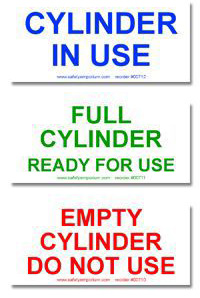
Safety Emporium has a great lineup of gas cylinder signs, storage racks, clamps and more.
MEMORANDUM FOR: ROY GIBBS, Industrial Hygienist , Hazard Communication Health Compliance Assistance
THROUGH: JOHN B. MILES, JR., Director, Director of Field Operations
FROM: JAMES W. LAKE, Regional Administrator Region X
SUBJECT: Request for Hazard Communication Interpretation
Based on a December 13, 1985, telephone conversation with Joseph Hopkins of your office, I am forwarding a request for an interpretation regarding lift trucks and the hazard communication standard.
The requester, Mr. Kevin C. Donaghue, has been notified that his questions have been referred to your office and that a response will be forthcoming. I would appreciate a copy of your response.
Occupational Safety and Health Administration 909 First Avenue Seattle, Washington 98174 December 13, 1985
November 11, 1985
Mr. Carl Halgren
Area Director
U. S. Department of Labor
Occupational Safety & Health Administration
1220 S. W. Third, Room 640
Portland, Oregon 97204
Dear Mr. Halgren:
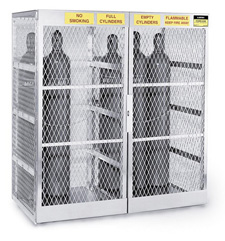
Safety Emporium has gas cylinder signs, racks, carts, clamps, lockouts and more to ensure your workers' safety.
I recently had a meeting with Hyster Company concerning the Hazard Communication Standard. During our meeting several items were discussed including the Standards inevitable expansion. There were three questions which Hyster Company would appreciate a written response from OSHA:
- Does Hyster Company have to provide Material Safety Data Sheets (MSDS) for lift trucks (by-product of combustion-carbon monoxide)?
- Does Hyster Company have to label all radiators (antifreeze), brake lines (brake fluid), gasoline, propane, diesel tanks (fuel), crank case (various oils), etc.?
- Are they exempt from having to comply with items one and two because lift trucks are considered articles?
I appreciate you considering these questions and am looking forward to your reply.
Sincerely,
KEVIN C. DONAGHUE
Loss Control Consultant
Rollins Burdick Hunter of Oregon, Inc.
Pacwest Center, Suite 600, 1211 S.W. Fifth Avenue
Portland, Oregon 97204-3799
Telephone 503-224-9700
The original official public domain version of this document is available from OSHA at https://www.osha.gov/laws-regs/standardinterpretations/1986-03-17.