| The Home page of ILPI's Safety Data Sheet (SDS) Resource, the leader in SDS information since 1995! | |
| The history and philosophy behind this resource. | |
| A curated collection of books and reference materials concerning Safety Data Sheets and closely related topics. | |
| Paste your plain text SDS into the SDS-Demystifier, and it will be converted into a hypertext-enriched document with links to detailed explanations of each key term. | |
| An extensive list of frequently asked questions about Safety Data Sheets including regulations, content, compliance, and more. | |
| A humorous take on Safety Data Sheet jargon. Fill in the blanks on our entry form to generate a personalized Unsafety Data Sheet to share with your coworkers. | |
| Since 1995, we've maintained this massive curated list of the best places to find Safety Data Sheets on the Internet. | |
| Way more than a glossary, this hypertext-enhanced resource covers hundreds of SDS-related terms and expert knowledge. Each entry includes both the SDS relevance and links to additional authoritative resources. | |
| Archived results of Safety Data Sheet related polls taken by some of our millions of site visitors | |
| You are here! The OSHA regulations behind SDS regulations, including the inspection guidelines and over 400 official interpretations letters under the Hazard Communication Standard | |
| Commercial suppliers of SDS authoring and management software as well as cloud compliance services. | |
| Commercial companies that will create SDS's for your specific needs as well as SDS translation companies. |

Safety signs, banners, and scoreboards? Get yours at Safety Emporium!
OSHA Hazard Communication Letters of Interpretation
OSHA's Hazard Communication Standard.
- Issued
- Record type
- Interpretation
- Historical HazCom standard
- HCS 1987 expanded rule (PDF)
- Current HazCom standard
- HCS 2024, as amended
ILPI assessment: Core program and access duties generally consistent
Its main HazCom conclusions remain consistent: construction employers need a workplace-specific program, coordinated hazard information, and accessible SDSs. The HCS itself does not require a training log, although other applicable standards or State Plan rules may require records. This letter addresses the obsolete 1987 HCS.
Under the current HCS, apply multi-employer coordination, written-program availability, ready SDS access, and effective information and training. Off-site storage that prevents immediate access is insufficient; see the SDS FAQ on immediate access. A job title or ordinary consumer product does not alone establish an exemption: the consumer-product exemption (FAQ) depends on actual intended use and exposure. Historical office contacts and rollout dates below are not current instructions.
Last reviewed: .
About this ILPI assessment
This comparison with current requirements is not a finding that OSHA has formally withdrawn this letter. This assessment reflects editorial judgment informed by human review and AI assistance. It is an opinion, may contain errors or omissions, and is not an official OSHA determination. For guidance on how OSHA requirements apply to your circumstances, contact your local OSHA office.
OSHA's notice about interpretation letters
The following notice is published on OSHA's interpretation pages; it is general guidance, not a letter-specific withdrawal notice.
OSHA requirements are set by statute, standards and regulations. Our interpretation letters explain these requirements and how they apply to particular circumstances, but they cannot create additional employer obligations. This letter constitutes OSHA's interpretation of the requirements discussed. Note that our enforcement guidance may be affected by changes to OSHA rules. Also, from time to time we update our guidance in response to new information. To keep apprised of such developments, you can consult OSHA's website at https://www.osha.gov.
Source: OSHA's original letter page.
September 7, 1989
The Honorable Mel Hancock
House of Representatives
Washington, D.C. 20515
Dear Congressman Hancock:

Keep multi employer worksites compliant with SDS information stations from Safety Emporium.
This is in response to your letter of August 10, on behalf of your constituent, Mr. Wayne D. Towe, Executive Vice President of MECO Systems, Inc., in Springfield, Missouri. Mr. Towe expressed concern over the implementation and enforcement of the Occupational Safety and Health Administration's (OSHA) Hazard Communication Standard (HCS), 29 CFR 1926.59 [ILPI: Original HCS 1987 context (PDF) · Current HCS; construction now incorporates 1910.1200 through 1926.59], in the construction industry.
OSHA's HCS was first promulgated by the Agency in 1983. Under order from the U.S. Court of Appeals for the Third Circuit, the scope of the standard was expanded on August 24, 1987, to include all employers with employees exposed to hazardous substances, including employers in the construction industry. The intent of the HCS is to ensure that all employees, including employees in the construction industry, receive information on the potential hazards from occupational exposures to the hazardous substances they may be exposed to in their workplaces.
The HCS sets performance-oriented employee training requirements at section 1926.59(h) [ILPI: Original HCS 1987 context (PDF) · Current HCS; construction now incorporates 1910.1200 through 1926.59] in order to ensure that employees are provided with information and training about the hazardous chemicals they work with, both at the time of their initial assignment and whenever a new hazard is introduced into their work area. However, contrary to what Mr. Towe expressed in hisletter to you, there is no requirement that "employee training records" be maintained at each jobsite, in fact, there is no requirement in the HCS to maintain any records of employee training. The standard does require however, that each employer develop and maintain at his workplace a written hazard communication program. The written program must describe how the employer will meet the standard's requirements to provide container labeling, collection and availability of material safety data sheets (MSDS) and how employee training will be conducted. The written program must also contain a list of the hazardous chemicals in each work area, and the means the employer will use to inform employees of the hazards of non-routine tasks.
If, as for a construction job, the workplace has multiple employers on-site, employers are to ensure that information regarding the hazards that are present at the worksite and information on measures employees can take to protect themselves is made available to the other employers on-site. Employers on multi-employer worksites must provide other on-site employers (whose employees may be exposed to hazards not brought onto the worksite by their own employer) with a copy of applicable MSDSs, or make them available at a location coordinated by both employers at a convenient on-site location. Allowing a construction contractor to maintain MSDSs in his home office (which could be miles away from the actual jobsite) would not afford employees ready access to the hazard information during each work shift, as is their right under the standard. The employer's written hazard communication program and applicable MSDSs may be kept anywhere on the jobsite, including a vehicle or contractor's trailer, as long as employees know where to find it.
[ILPI note: Original HCS 1987 context (PDF) · Current HCS. Current counterparts: multi-employer coordination, ready SDS access, and program access. A shared location must be accessible whenever affected employees are working, not only when a trailer is unlocked.]
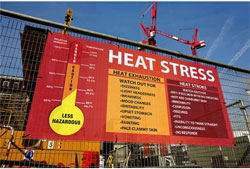
Safeguard your work site with mesh flow-through safety banners from Safety Emporium.
In your letters, both you and Mr. Towe requested that OSHA develop an updated list of common hazardous chemicals found in construction worksites. No such OSHA-generated list now exists for either general industry or construction worksites. Each workplace contains its own unique exposure potentials, and an important aspect of an employer's hazard communication program is the preparation of an inventory of the chemicals and hazardous substances known to be present at the worksite, either by individual work area or for the entire workplace. This inventory, which is unique to that workplace, then results in the list of hazardous substances upon which the employer's hazard communication program is based. Again, the list is unique to the worksite, not to the industry sector, and must be developed for each specific workplace.
Mr. Towe also expressed concern that MSDSs are required for consumer products such as "the air freshener cake in chemical toilets." The HCS rule clearly states that where such consumer products are used in the workplace in a manner comparable to normal conditions of consumer use, the chemical would not have to be included in the employer's hazard communication program. However, if a worker is using a consumer product in a manner that results in a duration and frequency of exposure greater than that of normal consumer use, the product would have to be covered in the employer's hazard communication program. This is clearly not the case for "air freshener cakes" found in chemical toilets.
I hope this discussion will be beneficial to you and Mr. Towe's further understanding of OSHA's HCS. If Mr. Towe has further questions regarding compliance with the HCS, he may want to consult with the HCS Coordinator in OSHA's Kansas City Regional Office at (816)426-5861, or of course, he may feel free to contact us again.
Sincerely,
Alan C. McMillan
Acting Assistant Secretary
The original official public domain version of this document is available from OSHA at https://www.osha.gov/laws-regs/standardinterpretations/1989-09-07-0.