| The Home page of ILPI's Safety Data Sheet (SDS) Resource, the leader in SDS information since 1995! | |
| The history and philosophy behind this resource. | |
| A curated collection of books and reference materials concerning Safety Data Sheets and closely related topics. | |
| Paste your plain text SDS into the SDS-Demystifier, and it will be converted into a hypertext-enriched document with links to detailed explanations of each key term. | |
| An extensive list of frequently asked questions about Safety Data Sheets including regulations, content, compliance, and more. | |
| A humorous take on Safety Data Sheet jargon. Fill in the blanks on our entry form to generate a personalized Unsafety Data Sheet to share with your coworkers. | |
| Since 1995, we've maintained this massive curated list of the best places to find Safety Data Sheets on the Internet. | |
| Way more than a glossary, this hypertext-enhanced resource covers hundreds of SDS-related terms and expert knowledge. Each entry includes both the SDS relevance and links to additional authoritative resources. | |
| Archived results of Safety Data Sheet related polls taken by some of our millions of site visitors | |
| You are here! The OSHA regulations behind SDS regulations, including the inspection guidelines and over 400 official interpretations letters under the Hazard Communication Standard | |
| Commercial suppliers of SDS authoring and management software as well as cloud compliance services. | |
| Commercial companies that will create SDS's for your specific needs as well as SDS translation companies. |

Safety signs, banners, and scoreboards? Get yours at Safety Emporium!
OSHA Hazard Communication Letters of Interpretation
Hazwoper training in hospitals.
- Issued
- Record type
- Interpretation
- Historical HazCom standard
- HCS 1987 expanded rule (PDF)
- Current HazCom standard
- HCS 2024, as amended
- Other primary standard
- HAZWOPER: 1989 final rule; current 1910.120
ILPI assessment: Task-based response training retained; proposed certification rule withdrawn
Its HazCom-related principle remains useful: hospital employees need information and training on the chemical hazards they may encounter. Emergency response to ethylene oxide also requires a separate HAZWOPER analysis; ordinary HazCom or SCBA instruction alone does not establish responder competency.
Apply current HAZWOPER emergency-response duties, ethylene-oxide emergency requirements, and applicable respiratory protection. Evacuation-only assignments and incidental releases differ from assigned emergency cleanup. Coordinate overlapping training where all applicable objectives are actually met; do not treat the letter as an automatic waiver of chemical-specific instruction.
OSHA's source correction explains that the proposed 1910.121 training-program accreditation rule was withdrawn from the regulatory agenda. The passage predicting its future promulgation is historical, not a current certification requirement. Apply the actual current competency, refresher and documentation provisions; OSHA does not individually certify responders.
OSHA source notice: [Corrected 1/20/2005. On August 15, 2002 the proposed 1910.121 "Accreditation of Training Programs for Hazardous Waste Operations" proposed rule was withdrawn from the Unified Regulatory Agenda (see
Last reviewed: .
About this ILPI assessment
This comparison with current requirements is not a finding that OSHA has formally withdrawn this letter. This assessment reflects editorial judgment informed by human review and AI assistance. It is an opinion, may contain errors or omissions, and is not an official OSHA determination. For guidance on how OSHA requirements apply to your circumstances, contact your local OSHA office.
OSHA's notice about interpretation letters
The following notice is published on OSHA's interpretation pages; it is general guidance, not a letter-specific withdrawal notice.
OSHA requirements are set by statute, standards and regulations. Our interpretation letters explain these requirements and how they apply to particular circumstances, but they cannot create additional employer obligations. This letter constitutes OSHA's interpretation of the requirements discussed. Note that our enforcement guidance may be affected by changes to OSHA rules. Also, from time to time we update our guidance in response to new information. To keep apprised of such developments, you can consult OSHA's website at https://www.osha.gov.
Source: OSHA's original letter page.
December 2, 1991
Mr. Richard F. Andree
Safety and Health Management Consultants, Inc.
161 William Street
New York, New York 10038
Dear Mr. Andree:
This is in response to your inquiry of May 14, concerning the Occupational Safety and Health Administration's (OSHA) Hazardous Waste Operations and Emergency Response final rule (29 CFR 1910.120). We hope the delay in our reply has not been an inconvenience.
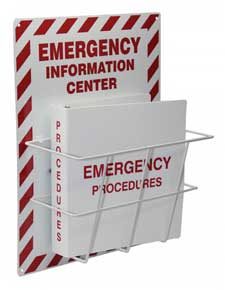
Plan for emergencies with emergency exit and egress products from Safety Emporium.
Your specific question concerns the training of a hospital maintenance worker who is expected to respond to ethylene oxide gas leaks. The maintenance worker received training on the proper use of Self Contained Breathing Apparatus (SCBA) and was provided 1910.120 instruction.
OSHA interprets the scope of 1910.120 to cover hospitals in at least three scenarios; 1) when hospitals have an internal release of a hazardous substance which requires an emergency response; 2) when hospitals respond as an integral unit of a community-wide emergency response to a release of hazardous substance; and 3) if a hospital is a RCRA permitted Treatment, Storage and Disposal Facility.
1910.120(q) covers emergency response operations for releases of, or substantial threats of releases of, hazardous substances regardless of location, including hospitals. It is not possible to know, based on your letter, if the leaks you described need to be treated as an emergency response. However, due to the hazards that ethylene oxide presents, most leaks would probably require an emergency response. In any case, if the hospital maintenance worker is expected to handle all releases of ethylene oxide, then the level of training should be based on how to safely handle worse case scenarios. This would most likely require compliance with 1910.120(q).
Your description of the hospital's current procedure to handle ethylene oxide leaks may be adapted to comply with 1910.120 paragraph (q). A few changes may be necessary, such as training a second maintenance worker as back-up to perform assistance or a rescue, if this is not already part of the hospital's procedure.
The Ethylene Oxide Standard (29 CFR 1910.1047) must also be complied with, if the hospital is not already in compliance. 1910.1047 sets forth medical surveillance, handling procedures, and emergency response training based on ethylene oxide's specific hazards. The hospital does not need to train the maintenance worker in emergency response twice, as the training required by 1910.120(q) will meet, and go beyond, the requirements for "emergency situations" in 1910.1047(h). Other standards that are relevant to the hospital's response to ethylene oxide are the Hazard Communication (29 CFR 1910.1200 [ILPI: Original HCS 1987 context (PDF) · Current HCS]), Respiratory Protection (29 CFR 1910.134), and General Requirements for Personal Protective Equipment (29 CFR 1910.132).
The hospital's maintenance worker may be certified as equivalently trained under 1910.120(q), as per the regulation's training level requirements, which states that emergency responders must be trained "...or have had sufficient experience to objectively demonstrate competency in the following areas..." The hospital must ensure that the employee accomplishes all training objectives. Additionally, employees who fall under 1910.120(q) must receive annual refresher training or demonstrate competencies on a yearly basis, regardless of their previous experience or education.
OSHA does not certify individuals, it is the employer who must show by documentation or certification that an employee's work experience and/or training meets the requirements of 1910.120. There must be a written document which clearly identifies the employee, the person certifying the employee, and the training and/or past experience which meets the requirements. One possibility would be to include this information in the employee's personnel file. The preferred method is to include this information on a separate certificate for each employee.
OSHA is working on a new regulation concerning certification of 1910.120 training programs (29 CFR 1910.121), which will be promulgated in the future. Currently, this new rule is in rule making. Your organization may want to monitor the progress of this new standard and anticipate needed changes in your training and certification programs to insure continued compliance by your training division.
[ILPI note: Original HCS 1987 context (PDF) · Current HCS. OSHA's correction states that the proposed 1910.121 accreditation rule was withdrawn from the agenda in 2002. This is not a current pending certification mandate. See current competencies and refresher requirements.]
[Corrected 1/20/2005. On August 15, 2002 the proposed 1910.121 "Accreditation of Training Programs for Hazardous Waste Operations" proposed rule was withdrawn from the Unified Regulatory Agenda (see Federal Register 67:74749-74785 dated December 9, 2002).]
Sincerely,
Gerard F. Scannell
Assistant Secretary
The original official public domain version of this document is available from OSHA at https://www.osha.gov/laws-regs/standardinterpretations/1991-12-02-0.