| The Home page of ILPI's Safety Data Sheet (SDS) Resource, the leader in SDS information since 1995! | |
| The history and philosophy behind this resource. | |
| A curated collection of books and reference materials concerning Safety Data Sheets and closely related topics. | |
| Paste your plain text SDS into the SDS-Demystifier, and it will be converted into a hypertext-enriched document with links to detailed explanations of each key term. | |
| An extensive list of frequently asked questions about Safety Data Sheets including regulations, content, compliance, and more. | |
| A humorous take on Safety Data Sheet jargon. Fill in the blanks on our entry form to generate a personalized Unsafety Data Sheet to share with your coworkers. | |
| Since 1995, we've maintained this massive curated list of the best places to find Safety Data Sheets on the Internet. | |
| Way more than a glossary, this hypertext-enhanced resource covers hundreds of SDS-related terms and expert knowledge. Each entry includes both the SDS relevance and links to additional authoritative resources. | |
| Archived results of Safety Data Sheet related polls taken by some of our millions of site visitors | |
| You are here! The OSHA regulations behind SDS regulations, including the inspection guidelines and over 400 official interpretations letters under the Hazard Communication Standard | |
| Commercial suppliers of SDS authoring and management software as well as cloud compliance services. | |
| Commercial companies that will create SDS's for your specific needs as well as SDS translation companies. |

Safety signs, banners, and scoreboards? Get yours at Safety Emporium!
OSHA Hazard Communication Letters of Interpretation
Employers' responsibilities towards temporary employees.
- Issued
- Record type
- Interpretation
- Historical standard
- 1910.1200, 1987 expanded rule (PDF)
- Current standard
- HCS 2024, as amended
ILPI assessment: Shared employer responsibility remains; contracts do not waive duties
This letter addresses the obsolete 1987 version of the Hazard Communication Standard (HCS). Its central HazCom conclusion remains consistent: staffing agencies and host employers share responsibility for temporary workers, with generic and site-specific training coordinated before exposure.
Under the current HCS, apply current information and training requirements and OSHA's temporary-worker guidance. Written allocation helps coordination but does not relieve either employer of its own legal obligations. PPE, medical surveillance, exposure monitoring and retention depend on the applicable standards and actual roles; use PPE requirements and medical/exposure-record requirements as applicable. NAICS superseded SIC; the historical industry-code/court-stay account is not a present exemption.
OSHA marks its matching original corrected 12/6/2024.
Last reviewed: .
About this ILPI assessment
This comparison with current requirements is not a finding that OSHA has formally withdrawn this letter. This assessment reflects editorial judgment informed by human review and AI assistance. It is an opinion, may contain errors or omissions, and is not an official OSHA determination. For guidance on how OSHA requirements apply to your circumstances, contact your local OSHA office.
OSHA's notice about interpretation letters
The following notice is published on OSHA's interpretation pages; it is general guidance, not a letter-specific withdrawal notice.
OSHA requirements are set by statute, standards and regulations. Our interpretation letters explain these requirements and how they apply to particular circumstances, but they cannot create additional employer obligations. This letter constitutes OSHA's interpretation of the requirements discussed. Note that our enforcement guidance may be affected by changes to OSHA rules. Also, from time to time we update our guidance in response to new information. To keep apprised of such developments, you can consult OSHA's website at https://www.osha.gov.
Source: OSHA's original letter page.
February 3, 1994
Mr. Michael F. Moreau
National Employment Service Corporation
95 Albany Street Suite 3
Portsmouth, New Hampshire 03801
Dear Mr. Moreau:
This is in response to your inquiry of May 3, concerning the Occupational Safety and Health Administration's Hazard Communication Standard (HCS), 29 CFR 1910.1200 [ILPI: Original HCS 1987 context (PDF) · Current HCS].

Your employees can stay informed and safety-ready with right to know stations and labels from Safety Emporium.
Your question concerns clarification on employers' responsibilities towards temporary employees, particularly in regard to the HCS. Your questions will be answered in the order that you presented them:
- Who is responsible for hazard communication training of the temporary employee. The [temp] agency or the client employer?
OSHA considers temporary employment agencies who send their own employees to work at other facilities to be employers whose employees may be exposed to hazards. Since it is your company, which maintains a continuing relationship with its employees, but another employer (the client) who creates and controls the hazards, there is a shared responsibility for assuring that your employees are protected from the workplace hazards. The client has the primary responsibility of such protection. The "lessor employer" likewise has a responsibility under the Occupational Safety and Health Act.
In meeting the requirements of OSHA's Hazard Communication standard the lessor employer would, for example, be expected to provide the training and information requirements specified by the HCS section (h)(1) [ILPI: Original HCS 1987 context (PDF) · Current HCS]. Client employers would then be responsible for providing site-specific training and would have the primary responsibility to control potential exposure conditions. The client, of course, may specify what qualifications are required for supplied personnel, including training in specific chemicals or personal protective equipment (PPE). Contracts with your client employer and your employees should clearly describe the responsibilities of both parties in order to ensure that all requirements of the regulation are met.
[ILPI note: At issuance: 1910.1200, 1987 expanded rule (PDF). Contract terms help coordinate compliance but cannot waive either employer's responsibilities. Use current current information and training requirements and temporary-worker guidance for actual worksite hazards and training before exposure.]
- Who is responsible for the provision and assured use of appropriate personal protective equipment by the temporary employees?
Client employers would be responsible for providing PPE for site- specific hazards to which employees may be exposed. However, again, the client may specify the services that it wants the lessor employer to supply, including provision of PPE for the placed employees. Contracts with the client employer should clearly describe the responsibilities of both parties in order to ensure that all requirements of OSHA's regulations are met.
- When medical surveillance or monitoring is indicated, who is responsible for conducting the monitoring and maintaining records?

Encourage use of proper hearing protection with electronic decibel meter signs from Safety Emporium.
The client employer must offer and perform the required medical surveillance or evaluations. The lessor employer must ensure that the records of the required medical surveillance or evaluations are maintained in accordance with the appropriate OSHA standards.
- Is the temporary help service required to maintain cumulative exposure data (eg. 30 day lead exposure, 6 months noise exposure, etc.), when the employee works for several different companies during the year?
Yes, the temporary help service must maintain employee records in accordance with the appropriate OSHA standard (e.g. the Lead standard, the Occupational Noise Exposure standard, etc.). However, the client employer must perform the site characterization and monitoring of exposure to hazardous chemicals on the work site.
- If 29 CFR 1910.1200(h) [ILPI: Original HCS 1987 context (PDF) · Current HCS] requires training on hazardous chemicals in the work area at the time of the initial assignment and whenever a new hazard was introduced into their work place, when does the initial assignment begin and who is responsible for the initial training and the on-going training?
The lessor employer would be expected to provide some generic training and client employers would be responsible for providing site-specific training, or training to update employees on new hazards in the workplace. Please see the answer to question 1 for a further explanation.
- How does hazard communication training tie into the SIC code 7363?
The current HCS final rule covers all Standard Industrial Classification (SIC) codes. In 1987 the Office of Management and Budget (OMB) prevented OSHA from enforcing HCS in the construction industry. On OMB's advice, OSHA published a statement of concurrence in the Federal Register on August 8, 1988 (Volume 53, page 29822). However, on August 19, 1988, the U.S. Court of Appeals for the Third Circuit invalidated OMB's actions as being outside OMB's authority under the Paperwork Reduction Act (see United Steelworkers of America v. Pendergrass, 855 F.2d 108, (3rd Cir. 1988), Ex. 4-190). As ordered by the Court, OSHA published a notice in the Federal Register on February 15, 1989 (Volume 54 page 6886) to inform affected employers and employees that all provisions of the HCS would be in effect in all industries, and set March 17, 1989, as the date for initiation of programmed compliance inspections.
We hope this information is helpful. If you have any further questions please contact the Office of Health Compliance Assistance at (202) 219-8036.
Sincerely,
Roger A. Clark, Director
Directorate of Compliance Programs
May 3, 1993
OSHA
Attn: Roger Clark
Director of Compliance Programs
Room N3468
200 Constitution Ave. N.W.
Washington D.C. 22102
Subject: Temporary Help Supply Service
Dear Roger,
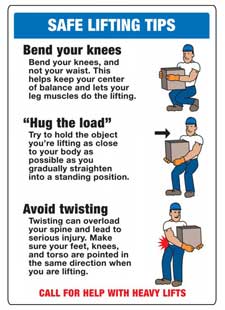
Keep your employees healthy and safe with ergonomic signs and posters from Safety Emporium.
I am writing to you as requested by Tom Galassi of your office. I own a temporary service which provided industrial temporary employees to perform various tasks in different plants. There are several questions that I wish you could clarify for me.
- Who is responsible for hazard communication training of the temporary employee. The agency or the client employer?
- Who is responsible for the provision and assured use of appropriate personal protection equipment by the temporary employees?
- When medical surveillance or monitoring is indicated, who is responsible for conducting the monitoring and maintaining records?
- Is the temporary help service required to maintain cumulative exposure data (eg. 30 day lead exposure, 6 months noise exposure, etc.), when the employee works for several different companies during the year?
- If 29 CFR 1910.1200(h) [ILPI: Original HCS 1987 context (PDF) · Current HCS] requires training on hazardous chemicals in the work area at the tire of the initial assignment and whenever a new hazard was introduced into their work place. When does the initial assignment begin and who is responsible for the initial training and the ongoing training?
- How does hazard communication training tie into the SIC Code 7363?
Your clarification of these questions would be appreciated.
Yours Truly,
Michael F. Moreau
President
The original official public domain version of this document is available from OSHA at https://www.osha.gov/laws-regs/standardinterpretations/1994-02-03.