| The Home page of ILPI's Safety Data Sheet (SDS) Resource, the leader in SDS information since 1995! | |
| The history and philosophy behind this resource. | |
| A curated collection of books and reference materials concerning Safety Data Sheets and closely related topics. | |
| Paste your plain text SDS into the SDS-Demystifier, and it will be converted into a hypertext-enriched document with links to detailed explanations of each key term. | |
| An extensive list of frequently asked questions about Safety Data Sheets including regulations, content, compliance, and more. | |
| A humorous take on Safety Data Sheet jargon. Fill in the blanks on our entry form to generate a personalized Unsafety Data Sheet to share with your coworkers. | |
| Since 1995, we've maintained this massive curated list of the best places to find Safety Data Sheets on the Internet. | |
| Way more than a glossary, this hypertext-enhanced resource covers hundreds of SDS-related terms and expert knowledge. Each entry includes both the SDS relevance and links to additional authoritative resources. | |
| Archived results of Safety Data Sheet related polls taken by some of our millions of site visitors | |
| You are here! The OSHA regulations behind SDS regulations, including the inspection guidelines and over 400 official interpretations letters under the Hazard Communication Standard | |
| Commercial suppliers of SDS authoring and management software as well as cloud compliance services. | |
| Commercial companies that will create SDS's for your specific needs as well as SDS translation companies. |

Safety signs, banners, and scoreboards? Get yours at Safety Emporium!
OSHA Hazard Communication Letters of Interpretation
Third-party SDS distribution, electronic delivery, and fees
- Issued
- Record type
- Interpretation
- Historical standard
- HCS 1994, 1910.1200(g)(6)
- Current standard
- HCS 2024, as amended
ILPI assessment: Core distribution principles generally consistent with the current HCS
This letter addresses the obsolete 1994 Hazard Communication Standard (HCS). Its main HazCom conclusions remain useful: using a third-party service does not transfer the manufacturer/importer/distributor's duties, and electronic delivery must actually provide the required current sheet to the recipient. This is not an OSHA endorsement of the service or a determination of private contractual rights.
Under the current HCS, apply manufacturer/importer and distributor transmission/request duties, SDS accuracy and updating, and ready employee access. Electronic systems must not create barriers to immediate workplace access; see the SDS-access FAQ and downstream supply-chain explanation. A service provider that independently acts as a manufacturer, importer, or distributor must meet the duties of that role.
The cost-recovery discussion does not permit withholding a required SDS or charging employees for required workplace access. It distinguishes supplier distribution duties from a third party's separate commercial requests. Required current SDS content follows Appendix D, regardless of historical paper, fax, CD, or Internet delivery methods. The enclosed November 1996 inquiry describes the company's concerns and proposal, not additional OSHA findings.
OSHA correction notice: The matching OSHA original is marked “Corrected 12/6/2024.” The text below reproduces that corrected online version. OSHA does not describe the scope of that correction on the page.
Last reviewed: .
About this ILPI assessment
This comparison with current requirements is not a finding that OSHA has formally withdrawn this letter. This assessment reflects editorial judgment informed by human review and AI assistance. It is an opinion, may contain errors or omissions, and is not an official OSHA determination. For guidance on how OSHA requirements apply to your circumstances, contact your local OSHA office.
OSHA's notice about interpretation letters
The following notice is published on OSHA's interpretation pages; it is general guidance, not a letter-specific withdrawal notice.
OSHA requirements are set by statute, standards and regulations. Our interpretation letters explain these requirements and how they apply to particular circumstances, but they cannot create additional employer obligations. This letter constitutes OSHA's interpretation of the requirements discussed. Note that our enforcement guidance may be affected by changes to OSHA rules. Also, from time to time we update our guidance in response to new information. To keep apprised of such developments, you can consult OSHA's website at https://www.osha.gov.
Source: OSHA's original letter page.
February 7, 1997
Mr. Bobby Logue, CEO
Envirocare International Incorporated
121 Shivel Drive
Hendersonville, Tennessee 37075
Dear Mr. Logue:
Thank you for your inquiry of November 24, 1996, regarding the Hazard Communication Standard (HCS). The questions you posed have primarily to do with a manufacturer's responsibility for distributing MSDSs to downstream users of hazardous chemicals and the involvement of a third party, such as Envirocare, in this process.
While third-party service providers, no doubt, supply a beneficial service, they are not recognized entities under the HCS and have no duties under the standard. In the system you described, Envirocare has entered into a contractual agreement with the downstream user. OSHA is not in a position to address the contractual obligations that Envirocare has with their clients and the responsibilities and privileges under HazCom that those obligations may confer.
We can, however, answer your questions from the perspective of the HCS. The questions you raised have been paraphrased and answered below.
1. Are manufacturers within their rights to refuse to provide MSDSs to a third party such as Envirocare?
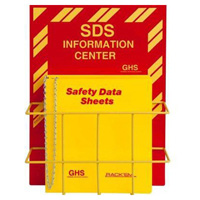
Your employees can stay informed and safety-ready with right to know stations and labels from Safety Emporium.
If a third party, such as Envirocare, is acting as a representative of the downstream user and has contractual responsibilities in that regard, it would seem reasonable that a manufacturer who is aware of that relationship would provide the requested information to the third party.
However, because the manufacturer holds the primary responsibility for the distribution of MSDSs, it may choose to deal directly with their downstream users, and has no obligation under the HCS to go through a third-party.
2. Is Envirocare justified in refusing to accept sources such as a "fax-back" or Internet addresses for MSDS retrieval? Envirocare is concerned that these sources may not qualify as being "from the manufacturer" and would have no way to verify that the MSDSs are maintained in a current state at those sites.
Electronic transmission of MSDSs is an acceptable means of providing information to downstream users. The manufacturer is responsible for the content of the information found at those sites and must ensure that the information is current. Under a system of electronic transmission, the manufacturer must also ensure that the downstream recipient of the information has access to the technology required to retrieve the information and is agreeable to this type of distribution.
[ILPI note: At issuance: HCS 1994. Current counterparts: manufacturer delivery, distributor delivery, and ready workplace access. Delivering to an employer and enabling immediate employee access are distinct duties; see the FAQ.]
3. Can a manufacturer require a company such as Envirocare to purchase a subscription CD as the only means to receive the manufacturer's MSDSs on a periodic basis?
From the standpoint of the HCS the information on the MSDS is intended for the downstream users. This information "belongs" to the manufacture/importer and final disposition of that information, aside from the manufacturer/importer's obligations under the HCS can be decided by them. Therefore, the manufacturer may charge a company such as Envirocare for MSDS information.
The manufacturer/importer's obligation to provide a MSDS to the downstream user begins when the downstream user accepts the product. Manufacturers, importers, and distributors are allowed to recoup costs of supplying the required MSDSs. This could take the form of a direct or indirect charge. However, failure to send MSDSs to a downstream user would result in a citation for non-compliance and abatement would require that the MSDS be provided to the user at no cost.
[ILPI note: Read this as a qualified cost-recovery discussion, not permission to withhold an SDS required by paragraph (g)(6) or (g)(7), or to impose a barrier on employee access.]
4. Is it correct that downstream users of hazardous chemicals must obtain the MSDSs from the distributor if the distributor was the source of the purchase? Who accepts the liability, the distributor or the downstream user, in the event that the distributor does not maintain current files?
The distributor would be the appropriate source for the MSDS if the distributor was the source of the purchase. Nothing in the standard, however, precludes the employer from contacting the manufacturer for the MSDS since the manufacturer has an obligation to provide this information at the request of an employer or distributor.
Neither the downstream user nor the distributor are responsible for updating information on MSDSs if they are, in good faith, maintaining MSDSs provided to them by a chemical manufacturer. However, a distributor has a duty to contact the chemical manufacturer whenever it becomes aware that an MSDS has been updated, in the event that the manufacturer failed to send one. OSHA has in place citation referral procedures which put the primary responsibility for disseminating updated chemical information on the manufacturer. The user of the product, therefore, is in no way liable for the contents of an MSDS due to an alleged "lack of diligence" on behalf of a distributor to update the data sheet.
Each of the above questions involves the privileges (i.e., the receipt of hazard information) to which a third party is entitled under the HCS. This issue cannot be addressed by OSHA as it involves obligations which are contractual and separate from the HCS.
The manufacturer (importer, distributor) and the employer maintain the primary responsibility under the HCS and a third party-service provider would not, generally, be cited for violations of the standard. From OSHA's perspective, it would seem reasonable that in a system such as the one you described, there would be an agreement among those involved, (i.e., the manufacturer, importer, or distributor; the employer; and the service provider).
5. Are there guidelines which establish parameters for manufacturers' fees for providing MSDSs.
OSHA knows of no such guidelines.
I hope that this information is helpful. Please do not hesitate to contact [the Office of Health Enforcement at (202) 693-2190].
Sincerely,
John B. Miles, Jr., Director
Directorate of Compliance Programs
[ILPI note: The following is the enclosed November 24, 1996 inquiry from Envirocare. Its proposals and assertions are the correspondent's, not additional OSHA interpretations.]
November 24, 1996
John B. Miles
Director of Compliance Program
U.S. Department of Labor
Occupational Safety and Health Administration
200 Constitution Avenue
Washington, DC 20210
Dear Sir,

ENVIROCARE is a service business engaged in assisting our clients in the building and maintenance of their MSDS libraries. We are available on a project basis for building such a library or as a subscription service for the continuing maintenance of an existing library. The client retains the responsibility for collecting MSDS records for any new products they purchase or any updates to existing MSDS library files which they receive from the manufacturer of those products. ENVIROCARE assists in providing an audit function of the library files to comply with the requirement that they are the MSDS currently being provided by the manufacturers.
In providing this audit function the ENVIROCARE master library has grown to contain over eighteen thousand MSDS files from over seven hundred different manufacturers. As you can imagine, several prominent chemical product manufacturers account for a substantial number of those MSDS files. The economy of scale we have achieved is based upon our being able to make a single contact with such a chemical manufacturer in which we may ask for MSDS records on several hundred of their products in order to validate the status of multiple client libraries.
Needless to say, a number of these manufacturers have become well aware of our presence and the costs associated with responding to our request. The regulatory status of issues related to this procedure is what prompts this letter.
In order to assure our clients that the MSDS records in their library qualify as being "current" and "from the manufacturer" we know of no way to achieve such assurance other than to ask the manufacturer to provide current MSDS records on a list of their products we provide and ask that they send such records to us by US mail. When the mail is opened, we stamp the date received on each document, compare the newly received MSDS to the one in our master library, determine which records have been updated by the manufacturer and pass a copy of that updated MSDS on to the library maintained by our clients. This process is repeated on a six month cycle.
Due to the level of activity between the individual manufacturers and ENVIROCARE, some manufacturers have become acutely aware of the need to implement some type of cost control or cost avoidance program. A number of them refuse to accept a request from a third party such as ENVIROCARE. We address this issue by having the client safety officer initiate the request and mail the MSDS packet to us upon receipt from the manufacturer. This increases the processing cost on the receiving end but we believe the manufacturer is acting completely within his rights. Is this a correct assumption?
Some manufacturers direct us to a Fax-Back or Internet type address and suggest that we take their MSDS records from those sources. We do not choose to use such sources because of a concern that they might not qualify as being "from the manufacturer", have no way to verify that they are being maintained "current" at those sites, and would require an enormous amount of our system time to download a large number of MSDS files. Are we within our rights to refuse to accept such sources?
Various manufacturers provide subscriptions to on-line or CD type services as a means to receive their MSDS files. Even though the ENVIROCARE master library is much larger than any individual client, we do not have a concentration of any manufacturer's products that would justify such a subscription. As an example, one very prominent manufacturer has over twenty thousand records on a CD that they update quarterly but we only need a total of three hundred forty-one (341) for all our clients. Can a manufacturer require us to purchase such a subscription as the only means to receive their MSDS on a periodic basis?
One manufacturer cites Federal Register/Vol. 59, No. 27/page 6181: "Chemical manufacturers, importers, and distributors of hazardous chemicals are all required to provide the appropriate labels and material safety data sheets to the employers to which they ship the chemicals." Their interpretation is that buyers of those products must obtain the MSDS from the distributor and not the manufacturer. Our experience has shown that many distributors do not properly maintain their MSDS files and provide records which are old and have been superseded by the manufacturer with subsequent revisions. If this interpretation is correct, then the buyer of the product is required to accept the liability associated with any lack of diligence on behalf of the distributor in keeping their files current. Is this a correct interpretation?
In conclusion, I am well aware that every business must be able to recover expenses involved in providing a product or service and am not opposed to paying a service fee to the manufacturers for providing current MSDS records. Such expenses will be passed on to ENVIROCARE clients and they simply include it as part of the purchase price of those products. However, I need to know if there are any established guidelines for such expense categories or if this is a judgment issue dictated by each manufacturer.
I appreciate the opportunity to obtain your interpretation of these issues.
Yours truly,
Bobby T. Logue
Chief Operating Officer
The original official public domain version of this document is available from OSHA at https://www.osha.gov/laws-regs/standardinterpretations/1997-02-07.