| The Home page of ILPI's Safety Data Sheet (SDS) Resource, the leader in SDS information since 1995! | |
| The history and philosophy behind this resource. | |
| A curated collection of books and reference materials concerning Safety Data Sheets and closely related topics. | |
| Paste your plain text SDS into the SDS-Demystifier, and it will be converted into a hypertext-enriched document with links to detailed explanations of each key term. | |
| An extensive list of frequently asked questions about Safety Data Sheets including regulations, content, compliance, and more. | |
| A humorous take on Safety Data Sheet jargon. Fill in the blanks on our entry form to generate a personalized Unsafety Data Sheet to share with your coworkers. | |
| Since 1995, we've maintained this massive curated list of the best places to find Safety Data Sheets on the Internet. | |
| Way more than a glossary, this hypertext-enhanced resource covers hundreds of SDS-related terms and expert knowledge. Each entry includes both the SDS relevance and links to additional authoritative resources. | |
| Archived results of Safety Data Sheet related polls taken by some of our millions of site visitors | |
| You are here! The OSHA regulations behind SDS regulations, including the inspection guidelines and over 400 official interpretations letters under the Hazard Communication Standard | |
| Commercial suppliers of SDS authoring and management software as well as cloud compliance services. | |
| Commercial companies that will create SDS's for your specific needs as well as SDS translation companies. |

Safety signs, banners, and scoreboards? Get yours at Safety Emporium!
OSHA Hazard Communication Letters of Interpretation
Requirements for labeling of products shipped for export only to non-U.S. destinations, under the revised Hazard Communication Standard (HCS 2012)
- Issued
- Record type
- Interpretation
- Historical HazCom standard
- HCS 2012
- Current HazCom standard
- HCS 2024, as amended
ILPI assessment: Export accommodation is conditional; domestic worker protection remains
The accommodation described here is conditional on sealed export packaging and the stated handling/exposure facts; it is not a general exemption for anything intended for export. The manufacturer's scenario is not an OSHA finding about every clay or sorbent product. This letter interprets HCS 2012.
For current duties apply shipped-label requirements, sealed-container duties, ready SDS access and effective information and training. Consider the later June 10, 2016 export-label letter and the related ACA import/export letter. Domestic manufacturing, warehousing and dock exposures still need protection; DOT/IMO transport requirements are separate. Apply actual current classification rather than treating the correspondent's silica percentages as universal thresholds.
Last reviewed: .
About this ILPI assessment
This comparison with current requirements is not a finding that OSHA has formally withdrawn this letter. This assessment reflects editorial judgment informed by human review and AI assistance. It is an opinion, may contain errors or omissions, and is not an official OSHA determination. For guidance on how OSHA requirements apply to your circumstances, contact your local OSHA office.
OSHA's notice about interpretation letters
The following notice is published on OSHA's interpretation pages; it is general guidance, not a letter-specific withdrawal notice.
OSHA requirements are set by statute, standards and regulations. Our interpretation letters explain these requirements and how they apply to particular circumstances, but they cannot create additional employer obligations. This letter constitutes OSHA's interpretation of the requirements discussed. Note that our enforcement guidance may be affected by changes to OSHA rules. Also, from time to time we update our guidance in response to new information. To keep apprised of such developments, you can consult OSHA's website at https://www.osha.gov.
Source: OSHA's original letter page.
November 23, 2015
Mr. Robert Soral
Product Regulatory Affairs Director
Oil-Dri Corporation of America
410 North Michigan Avenue
Chicago, Illinois 60611
Dear Mr. Soral:
Thank you for your May 18, 2015, letter to the Occupational Safety and Health Administration's (OSHA) Directorate of Enforcement Programs. You requested an interpretation of the labeling requirements in OSHA's Hazard Communication Standard (HCS 2012), 29 CFR 1910.1200 [ILPI: Original HCS 2012 context · Current HCS], as it applies to products manufactured for export only. This letter constitutes OSHA's interpretation only of the requirements herein, and may not be applicable to any questions not delineated within your original correspondence. Your paraphrased statement and question are presented below, followed by our response.
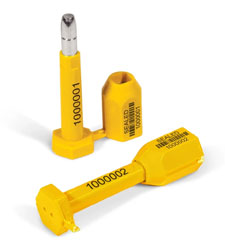
Ensure shipping security with anti-tamper seals from Safety Emporium.
Statement: Oil-Dri Corporation of America manufactures a select number of products used in the livestock feed industry and sold for export only. These products are enterosorbents, which absorb and bind naturally-occurring mycotoxins that exist in animal feed. The product is manufactured by crushing, drying and grinding clay to create a finer particle. The potential hazard in these products is the presence of 0.006% - 0.01% of respirable silica depending upon the type of clay, and non-respirable silica which is present in amounts above 0.1%. The product is packaged into 50-lb. reinforced paper bags, placed onto pallets and shrink-wrapped. The pallets are loaded into ISO-certified shipping containers, and then move directly to dock loading areas at various US ports where they are loaded onto cargo ships for overseas transport.
Once the product leaves the manufacturing facility, because of the manner in which the products are packaged and transported, there is no exposure under normal conditions of use, nor in a foreseeable emergency situation.
In addition, all of the employees engaged in the manufacturing, packaging, and the loading of trucks are trained in compliance with the requirements of HCS 2012. The only U.S. employees who come into contact with the products are the trucking and wharf employees. However, at this point of contact, the products are shrink-wrapped products and in sealed ISO-certified containers. Safety Data Sheets (SDSs) for the products accompany the cargo containers from the manufacturer's facility to the wharf.
Question: Are packages of Oil-Dri's sorbent products, shipped for export only to non-U.S. destinations, required to be labeled in accordance with HCS 2012?
Response: Paragraph 29 CFR 1910.1200(f)(1) [ILPI: Original HCS 2012 context · Current HCS; same paragraph number; shipped-label requirements revised] requires manufacturers (and importers and distributors) to ensure that each shipped container leaving the workplace is labeled, tagged, or marked in accordance with paragraphs (f)(1)(i)-(vi) [ILPI: Original HCS 2012 context · Current HCS; label elements (i) through (vi); same numbering]. OSHA recognizes that some containers shipped to destinations outside of the U.S. are sealed and sent directly overseas with no anticipated exposures to workers downstream (i.e. , U.S. warehouse and dock workers) during normal conditions of handling. In these situations, as an accommodation when working with sealed containers of hazardous chemicals that are packaged for direct shipment to destinations outside of the U.S. , OSHA would allow the following labeling schemes:
[ILPI note: Original HCS 2012 context · Current HCS. These are conditional accommodations for the stated export/packaging situation, not a blanket exemption. Current counterparts: shipped labels, sealed-container provisions and the later 2016 export-label explanation.]
- If sealed containers of hazardous chemicals are prepared for direct shipment to a destination outside of the U.S., and are placed inside of a U.S. Department of Transportation (DOT) or other similarly-approved shipping container, the manufacturer can label the sealed containers for the destination country. In these cases, there is no requirement to label each immediate container with an HCS 2012 label. However, an HCS 2012 label compliant with 29 CFR 1910.1200(f)(1) [ILPI: Original HCS 2012 context · Current HCS; same paragraph number; shipped-label requirements revised] is required on the outside of the shipping container or attached to the accompanying shipping papers or bill of lading. This accommodation will provide basic hazard information to downstream workers such as warehouse or dock workers who may be exposed in case of a spill, release, or other emergency. The shipping container must also be labeled in accordance with DOT and/or International Maritime Organization (IMO) labeling regulations or requirements during shipping.
- If sealed containers of hazardous chemicals are prepared for direct shipment to a destination outside of the U.S., but are temporarily stored at a manufacturer's on-site warehouse, the manufacturer must label the external packaging (i.e., shipping container) with workplace (in-house) labeling in accordance with § 1910.1200(f)(6) [ILPI: Original HCS 2012 context · Current HCS] while the containers remain in the warehouse, in addition to the requirements described above in labeling scheme (1).
- If sealed containers of hazardous chemicals are prepared for direct shipment to a destination outside of the U.S., but are temporarily stored at an off-site manufacturer's or third party warehouse, the HCS requirements of § 1910.1200(b)(4) [ILPI: Original HCS 2012 context · Current HCS] would apply, in addition to the requirements described above in labeling scheme (1). The manufacturer must provide a safety data sheet to the third-party employer.

DOT shipping signs and labels plus a host of safety and compliance posters are available at Safety Emporium.
In all situations, employers shall ensure that safety data sheets are maintained, available upon request, and readily accessible to employees during each work shift. See 29 C.F.R. § 1910.1200(g)(8) [ILPI: Original HCS 2012 context · Current HCS]. Employers must also provide information and training to employees to protect them in the event of a spill or leak of a hazardous chemical from a sealed container. See 29 CFR § 1910.1200(h)(1) [ILPI: Original HCS 2012 context · Current HCS].
Thank you for your interest in occupational safety and health. We hope you find this information helpful. OSHA requirements are set by statute, standards, and regulations. Our letters of interpretation do not create new or additional requirements but rather explain these requirements and how they apply to particular circumstances. This letter constitutes OSHA's interpretation of the requirements discussed. From time to time, letters are affected when the Agency updates a standard, a legal decision impacts a standard, or changes in technology affect the interpretation. To ensure that you are using the correct information and guidance, please consult OSHA's website at https://www.osha.gov. If you have any further questions, please feel free to contact the Office of Health Enforcement at (202) 693-2190.
Sincerely,
Thomas Galassi, Director
Directorate of Enforcement Programs
cc: Kathryn McMahon, Conn Maciel Carey PLLC
The original official public domain version of this document is available from OSHA at https://www.osha.gov/laws-regs/standardinterpretations/2015-11-23.