| The Home page of ILPI's Safety Data Sheet (SDS) Resource, the leader in SDS information since 1995! | |
| The history and philosophy behind this resource. | |
| A curated collection of books and reference materials concerning Safety Data Sheets and closely related topics. | |
| Paste your plain text SDS into the SDS-Demystifier, and it will be converted into a hypertext-enriched document with links to detailed explanations of each key term. | |
| An extensive list of frequently asked questions about Safety Data Sheets including regulations, content, compliance, and more. | |
| A humorous take on Safety Data Sheet jargon. Fill in the blanks on our entry form to generate a personalized Unsafety Data Sheet to share with your coworkers. | |
| Since 1995, we've maintained this massive curated list of the best places to find Safety Data Sheets on the Internet. | |
| Way more than a glossary, this hypertext-enhanced resource covers hundreds of SDS-related terms and expert knowledge. Each entry includes both the SDS relevance and links to additional authoritative resources. | |
| Archived results of Safety Data Sheet related polls taken by some of our millions of site visitors | |
| You are here! The OSHA regulations behind SDS regulations, including the inspection guidelines and over 400 official interpretations letters under the Hazard Communication Standard | |
| Commercial suppliers of SDS authoring and management software as well as cloud compliance services. | |
| Commercial companies that will create SDS's for your specific needs as well as SDS translation companies. |

Safety signs, banners, and scoreboards? Get yours at Safety Emporium!
OSHA Hazard Communication Letters of Interpretation
Coverage of steel, aluminum, and other metals under the Hazard Communication Standard.
- Issued
- Record type
- Interpretation
- Historical standard
- 1910.1200, original 1983 rule (PDF)
- Current standard
- HCS 2024, as amended
ILPI assessment: Generally consistent; use the current article definition
This letter addresses the original 1983 Hazard Communication Standard (HCS), which is now obsolete. Its central point remains consistent with the current HCS: metal products are not automatically exempt, and hazards associated with their normal use must be evaluated. Apply current hazard classification requirements and the articles exemption to the particular product and its use.
The quoted 1983 article definition below has changed. Use the current definition, which includes shape and end-use criteria, limits releases to very small quantities, and requires no physical hazard or health risk to employees. The historical wording should not be substituted for that complete test.
For non-exempt solid metal products, paragraph (f)(4) provides a separate labeling provision. Current SDS distribution rules generally require the SDS with the initial shipment, the first shipment after an update, and upon request; the incoming letter's claim that an SDS is required with every order is not a statement of the current general rule.
Last reviewed: .
About this ILPI assessment
This comparison with current requirements is not a finding that OSHA has formally withdrawn this letter. This assessment reflects editorial judgment informed by human review and AI assistance. It is an opinion, may contain errors or omissions, and is not an official OSHA determination. For guidance on how OSHA requirements apply to your circumstances, contact your local OSHA office.
OSHA's notice about interpretation letters
The following notice is published on OSHA's interpretation pages; it is general guidance, not a letter-specific withdrawal notice.
OSHA requirements are set by statute, standards and regulations. Our interpretation letters explain these requirements and how they apply to particular circumstances, but they cannot create additional employer obligations. This letter constitutes OSHA's interpretation of the requirements discussed. Note that our enforcement guidance may be affected by changes to OSHA rules. Also, from time to time we update our guidance in response to new information. To keep apprised of such developments, you can consult OSHA's website at https://www.osha.gov.
Source: OSHA's original letter page.
January 15, 1986
Mr. Warren Podolske
President
Milwaukee Metal Products Company
8000 W. Florist Avenue
Milwaukee, Wisconsin 53218
Dear Mr. Podolske:
President Reagan has asked the Occupational Safety and Health Administration (OSHA) to respond to your letter of November 8, 1985, concerning the coverage of steel, aluminum, and other metals under the Hazard Communication Standard (HCS). Please accept my apology for the delay in response.
The HCS requires that manufacturers perform a hazard determination on products they sell. As part of the evaluation the manufacturer must anticipate the uses to which product will normally be put. Both physical and health characteristics must be considered during the hazard determination procedure.
[ILPI note: Current counterpart: paragraph (d)(1), including changes in physical form and chemical reaction products associated with known or reasonably anticipated uses. For non-exempt solid metals, see the separate labeling provision.]
If through this evaluation (see 29 CFR 1910.1200(d)) it is determined that a product does contain hazardous chemicals which may be released during its use, then the product is covered by the HCS and proper labels and MSDS must be transmitted. If this is not the case, however, the product may meet the standard's definition of an article: "a manufactured item: (i) which is formed to a specific shape or design during manufacture; (ii) which has end use function(s) dependent in whole or in part upon its shape or design during end use; and (iii) which does not release, or otherwise result in exposure to, a hazardous chemical under normal conditions of use.
"
[ILPI note: The quoted definition is historical. Apply the current article definition, including the very-small-release and no-physical-hazard/health-risk conditions, and current exemption.]
The HCS does not apply to products that meet the definition of an article. A hazard determination must be performed to establish this, however.
It is not OSHA's intent that all materials require material safety data sheets (MSDSs) and labels; rather, only those that are hazardous and present a possibility of employee exposure to the hazard.
Please feel free to contact us if further assistance is needed.
Sincerely,
John B. Miles, Jr., Director
Directorate of Field Operations
November 8, 1985
The President
White House
Washington, D. C. 20500
Dear Mr. President:
The OSHA Communication Std. 1910.1200 is being interpreted as classifying steel, aluminum and other metals as "hazardous chemicals".
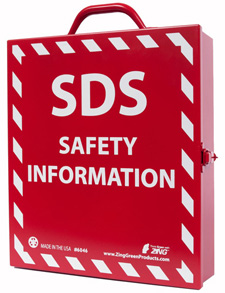
Your employees can stay informed and comply with OSHA regulations with SDS information stations and compliance products from Safety Emporium.
Accordingly, safety data sheets must be sent by us to each customer with each order of stampings or fabrications.
[ILPI note: This is the correspondent's assertion, not OSHA's instruction to provide an SDS with every order. Current paragraph (g)(6) specifies initial shipments, the first shipment after an update, and requests.]
We are a job shop which basically shears, punches and forms these materials to our customer's specifications. We are also familiar with procedures for handling hazardous chemicals such as 1,1,1- trichloroethane in degreasers.
However, to include steel and aluminum fabrications under this category rather than isolating the very rare procedures that might create a hazard is a criminal waste of taxpayers money for both the administration of the standard and the increased cost of the product.
Even a cursory investigation by your staff should indicate the major amendments common sense would dictate.
We have always complied with every real health and safety regulation to the best of our ability and knowledge, but we feel that this present standard is not going to protect anyone - rather the voluminous reports will bury the now important safety data sheets coming in.
Please give this important matter your earliest possible attention.
Very truly yours,
MILWAUKEE METAL PRODUCTS COMPANY
By Warren Podolske, President
The original official public domain version of this document is available from OSHA at https://www.osha.gov/laws-regs/standardinterpretations/1986-01-15.