| The Home page of ILPI's Safety Data Sheet (SDS) Resource, the leader in SDS information since 1995! | |
| The history and philosophy behind this resource. | |
| A curated collection of books and reference materials concerning Safety Data Sheets and closely related topics. | |
| Paste your plain text SDS into the SDS-Demystifier, and it will be converted into a hypertext-enriched document with links to detailed explanations of each key term. | |
| An extensive list of frequently asked questions about Safety Data Sheets including regulations, content, compliance, and more. | |
| A humorous take on Safety Data Sheet jargon. Fill in the blanks on our entry form to generate a personalized Unsafety Data Sheet to share with your coworkers. | |
| Since 1995, we've maintained this massive curated list of the best places to find Safety Data Sheets on the Internet. | |
| Way more than a glossary, this hypertext-enhanced resource covers hundreds of SDS-related terms and expert knowledge. Each entry includes both the SDS relevance and links to additional authoritative resources. | |
| Archived results of Safety Data Sheet related polls taken by some of our millions of site visitors | |
| You are here! The OSHA regulations behind SDS regulations, including the inspection guidelines and over 400 official interpretations letters under the Hazard Communication Standard | |
| Commercial suppliers of SDS authoring and management software as well as cloud compliance services. | |
| Commercial companies that will create SDS's for your specific needs as well as SDS translation companies. |

Safety signs, banners, and scoreboards? Get yours at Safety Emporium!
OSHA Hazard Communication Letters of Interpretation
Applicability of the HCS to an employer using portland cement.
- Issued
- Record type
- Interpretation
- Historical standard
- 1910.1200, 1987 expanded rule (PDF)
- Current standard
- HCS 2024, as amended
ILPI assessment: Cement hazard communication remains; historical sheet is not a complete hazard list
This letter addresses the obsolete 1987 version of the Hazard Communication Standard (HCS). Its main conclusion remains consistent: employers using hazardous cement must provide SDS access and effective hazard information/training. The description of eye and skin irritation reflects the particular old sheet; it is not a complete current classification of every cement product.
Under the current HCS, use the product's current SDS and hazard classification, including applicable skin corrosion/irritation/eye damage/irritation and other relevant hazards. Apply SDS access and current information and training requirements. OSHA's Portland-cement guidance (PDF) also explains separate exposure/control concerns. The enforcement dates, kit prices, ordering details, and office contacts below are historical; use the current local-office link in the assessment disclosure.
Last reviewed: .
About this ILPI assessment
This comparison with current requirements is not a finding that OSHA has formally withdrawn this letter. This assessment reflects editorial judgment informed by human review and AI assistance. It is an opinion, may contain errors or omissions, and is not an official OSHA determination. For guidance on how OSHA requirements apply to your circumstances, contact your local OSHA office.
OSHA's notice about interpretation letters
The following notice is published on OSHA's interpretation pages; it is general guidance, not a letter-specific withdrawal notice.
OSHA requirements are set by statute, standards and regulations. Our interpretation letters explain these requirements and how they apply to particular circumstances, but they cannot create additional employer obligations. This letter constitutes OSHA's interpretation of the requirements discussed. Note that our enforcement guidance may be affected by changes to OSHA rules. Also, from time to time we update our guidance in response to new information. To keep apprised of such developments, you can consult OSHA's website at https://www.osha.gov.
Source: OSHA's original letter page.
January 23, 1989
Mr. Earl Woodall
205 Mill Road
Office Building 1133
West Mill Road
Evansville, Indiana 47710
Dear Mr. Woodall:
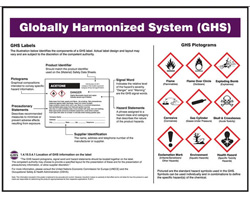
Ensure your workers are trained with safety posters and more from Safety Emporium.
Senator Dan Quayle has asked the Occupational Safety and Health Administration (OSHA) to respond directly to your letter to him dated November 28, 1988, regarding OSHA's rule requiring material safety data sheets.
The rule in question is the Hazard Communication Standard (HCS), 29 CFR 1910.1200, which was promulgated by OSHA in 1983. On August 24, 1987, the scope of the HCS was expanded to cover all employers with employees exposed to hazardous chemical. The standard requires chemical manufacturers and importers to assess the hazards of chemicals which they produce or import, and that this hazard information is transmitted to affected employers and exposed employees. Chemical manufacturers and importers must convey the hazard information they learn from their evaluations to downstream employers by means of labels on containers and material safety data sheets.
The standard requires employers to establish hazard communication programs. These programs must provide information to employees on the hazards of the chemicals they are exposed to or potentially exposed to through labels on containers, material safety data sheets, and training programs. The training programs provide hazard information to employees so they can participate in and support the protective measures utilized at their workplaces. Non-manufacturing employers were to be in compliance with all provisions of the standard by May 23, 1988. OSHA however, extended the enforcement date to August 1, due to confusion resulting from a United States Court of Appeals decision.
It appears that the chemical manufacturer of the portland cement has performed a hazard determination had has prepared the material safety data sheet enclosed in your letter. The chemical manufacturer has indicated that cement can be both an eye and skin irritant. As an employer you are required to make the material safety data sheet available to your employees who are exposed to the cement, as well as to train them regarding the potential hazards.
[ILPI note: At issuance: 1910.1200, 1987 expanded rule (PDF). This describes an old product sheet, not a complete modern hazard list. Apply current classification, SDS access, and current information and training requirements; see OSHA's cement guidance.]
OSHA has developed a number of resources to assist employers in complying with the HCS. A kit produced by OSHA is available that provides step-by-step guidance on complying with the requirements of the standard and serves equally well the needs of all employers, regardless of the industry in which they operate.
The kit may be purchased through the Superintendent of Documents, U.S. Government Printing Office, Washington, D.C., 20402-9325, at a cost of $18.00 for domestic users and $22.00 for foreign users. It has GPO Order No. 929-022-00000-9 and is OSHA 3104 Hazard Communication Compliance Kit. It may be ordered by telephone from GPO by calling (202) 783-3238 and using a credit card.
In addition, a booklet entitled "Chemical Hazard Communication" (copy enclosed) provides employers with an easy to read explanation of the responsibilities of employers under the HCS. The booklet also contains a directory of all OSHA Regional and Area Offices. Employers may contact a Regional or Area Office for additional information or assistance.
If I can be of further assistance, please feel free to contact me again.
Sincerely,
John A. Pendergrass
Assistant Secretary
The original official public domain version of this document is available from OSHA at https://www.osha.gov/laws-regs/standardinterpretations/1989-01-23.