| The Home page of ILPI's Safety Data Sheet (SDS) Resource, the leader in SDS information since 1995! | |
| The history and philosophy behind this resource. | |
| A curated collection of books and reference materials concerning Safety Data Sheets and closely related topics. | |
| Paste your plain text SDS into the SDS-Demystifier, and it will be converted into a hypertext-enriched document with links to detailed explanations of each key term. | |
| An extensive list of frequently asked questions about Safety Data Sheets including regulations, content, compliance, and more. | |
| A humorous take on Safety Data Sheet jargon. Fill in the blanks on our entry form to generate a personalized Unsafety Data Sheet to share with your coworkers. | |
| Since 1995, we've maintained this massive curated list of the best places to find Safety Data Sheets on the Internet. | |
| Way more than a glossary, this hypertext-enhanced resource covers hundreds of SDS-related terms and expert knowledge. Each entry includes both the SDS relevance and links to additional authoritative resources. | |
| Archived results of Safety Data Sheet related polls taken by some of our millions of site visitors | |
| You are here! The OSHA regulations behind SDS regulations, including the inspection guidelines and over 400 official interpretations letters under the Hazard Communication Standard | |
| Commercial suppliers of SDS authoring and management software as well as cloud compliance services. | |
| Commercial companies that will create SDS's for your specific needs as well as SDS translation companies. |

Safety signs, banners, and scoreboards? Get yours at Safety Emporium!
OSHA Hazard Communication Letters of Interpretation
Definition of a mixture under the Hazard Communication standard.
- Issued
- Record type
- Interpretation
- Historical standard
- HCS 1994, pre-GHS archive
- Current standard
- HCS 2024, as amended
ILPI assessment: Substance/mixture distinction remains; modern criteria govern content
This letter addresses the obsolete 1994 version of the Hazard Communication Standard (HCS). Its main principle remains useful: the manufacturer/importer must evaluate the actual product and communicate relevant hazards whether it is a substance or a mixture. This letter does not classify or approve Iroblast.
Use the current mixture and substance definitions, the HyperGlossary explanation, mixture classification and required SDS headings and order, no-information statements, and Appendix D. Mechanical separability is an explanatory example, not the complete modern regulatory definition. Do not use the old twelve-field MSDS list in place of current SDS content.
OSHA marks its matching original corrected 10/20/06.
Last reviewed: .
About this ILPI assessment
This comparison with current requirements is not a finding that OSHA has formally withdrawn this letter. This assessment reflects editorial judgment informed by human review and AI assistance. It is an opinion, may contain errors or omissions, and is not an official OSHA determination. For guidance on how OSHA requirements apply to your circumstances, contact your local OSHA office.
OSHA's notice about interpretation letters
The following notice is published on OSHA's interpretation pages; it is general guidance, not a letter-specific withdrawal notice.
OSHA requirements are set by statute, standards and regulations. Our interpretation letters explain these requirements and how they apply to particular circumstances, but they cannot create additional employer obligations. This letter constitutes OSHA's interpretation of the requirements discussed. Note that our enforcement guidance may be affected by changes to OSHA rules. Also, from time to time we update our guidance in response to new information. To keep apprised of such developments, you can consult OSHA's website at https://www.osha.gov.
Source: OSHA's original letter page.
October 13, 1998
Ms. Katerina Eftimoff
Porter, Wright, Morris & Arthur
41 South High Street
Columbus, Ohio 43215-6194
Dear Ms Eftimoff:
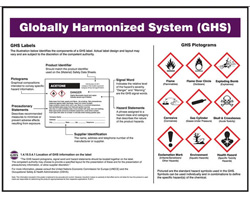
Ensure your workers are trained with safety posters and more from Safety Emporium.
Thank you for your letter of May 1, to the Occupational Safety and Health Administration (OSHA) regarding the definition of a mixture under the Hazard Communication Standard (HCS), 29 CFR 1910.1200 [ILPI: Original HCS 1994 context · Current HCS]. You asked OSHA to make the determination of whether your client's product, Iroblast, is a "mixture" as defined by the standard. Please excuse this delay in our response.
OSHA does not make hazard determinations on a case-by-case basis, since it is the manufacturer who is most familiar with a product's composition, its intended uses, and the potential downstream exposures. We are not generally involved in the hazard determination process until it is brought to our attention that the manufacturer's MSDS may be incomplete or inadequate.
[ILPI note: This letter uses the pre-GHS term "hazard determination." Beginning with HCS 2012, this was replaced by hazard classification, which applies specified criteria to assign hazard classes and, where applicable, categories. This was a substantive change, not simply a change in terminology. Chemical manufacturers and importers remain responsible for classifying their chemicals under current paragraph (d); OSHA does not routinely classify or approve individual products for them.]
Regardless of the outcome of the manufacturer's determination of Iroblast as a "mixture" or a "single substance," all information listed under paragraphs (g)(2)(i) - (xii) [ILPI: Original HCS 1994 context · Current HCS; modern SDS content replaces the old fields] must be included on the MSDS. Since the use of Iroblast, as stated in your letter, presents hazardous exposures to employees during its intended use, these exposures, their health effects, and all other required information must be reported on the MSDS. We offer the following guidance for your client in making the determination of whether this product is a mixture or a chemical:
[ILPI note: At issuance: HCS 1994, pre-GHS archive. The old MSDS fields have been replaced by mandatory modern SDS headings/order and AppendixD. Substance versus mixture status does not waive required product hazard information.]
- A hazardous chemical is considered a mixture if the components retain their chemical identity after being combined. In this case, the components can be separated by mechanical means (evaporation, distillation, abrasion, etc.).
- A chemical reaction results in a change in the arrangement of atoms or molecules to yield substances of different composition and properties. When chemical reactions occur, the original components can not be separated by mechanical means.
We trust that this information is useful to you. Further questions can be directed to the Office of Health Compliance Assistance at 202-219-8036.
Sincerely,
Richard E. Fairfax
Acting Director
Directorate of Compliance Programs
The original official public domain version of this document is available from OSHA at https://www.osha.gov/laws-regs/standardinterpretations/1998-10-13-2.