

About This Archive | DCHAS-L 2026 Index | DCHAS-L Yearly Index | DCHAS-L Home Page
Subject: Re: [DCHAS-L] I Remember When…”: Reflecting on the Evolution of Laboratory Safety
Date: Jun 14, 2026 15:15 UTC
Author: James Kaufman <jkaufman**At_Symbol_Here**LABSAFETYINSTITUTE.ORG>
Subject: [DCHAS-L] The DCHAS-L Archives are BACK and GOING PLACES! Part 2 of 2
Date: Jun 15, 2026 19:50 UTC
Author: Rob Toreki <info**At_Symbol_Here**ILPI.COM>
From: Rob Toreki <info**At_Symbol_Here**ILPI.COM>
Subject: [DCHAS-L] The DCHAS-L Archives are BACK, baby! Part 1 of 2
Date: Jun 15, 2026 19:50 UTC
Reply-To: ACS Division of Chemical Health and Safety <DCHAS-L**At_Symbol_Here**PRINCETON.EDU>
In-Reply-To:
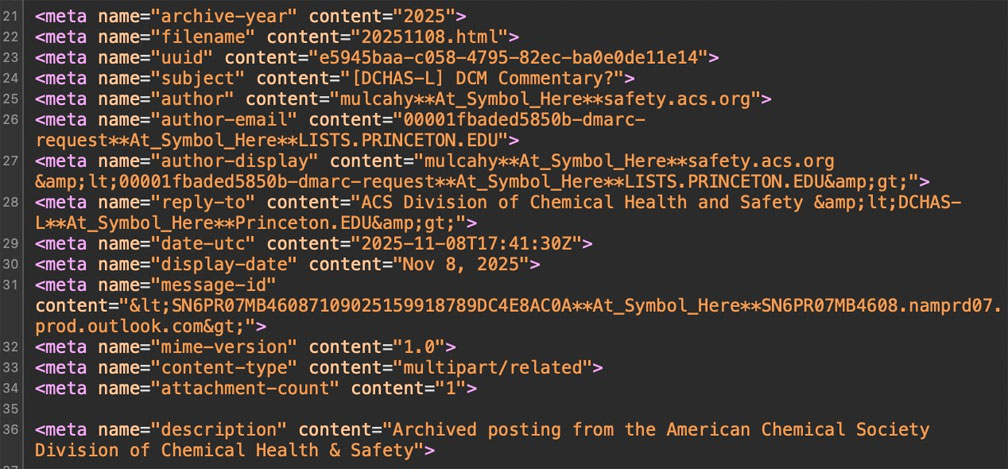
1. My new solution uses Python's (open source!) mail encoding packages to extract the post content and coerce the data into a standard encoding. What this means for the reader is that the glitchy character issues have basically disappeared and in many cases the formatting will closely match that you saw in your mail program. It's not 100% perfect - so in plain text posts a quoted section might have ">" at the beginning of each lin instead of a vertical bar and indent, but that's livable and not worth fixing.2. The Previous by Date and Next by Date tables have been replaced with a nice CSS implementation that looks like little data cards/buttons. Unlike the old clunky HTML tables (take a look at a post prior to 2022) which were unforgiving on resizing the page to small widths, the new implementation handles small screen sizes gracefully, moving them on top of each other at a mobile size. See, for example, https://www.ilpi.com/dchas/2025/20251108.html3. The annual indices such as https://www.ilpi.com/dchas/2023/index.html which one could describe as a "wall of text" now highlight in yellow when you hover over an article link. This makes it clear exactly what you are clicking on and is handy on small screens. When scrolling with a mouse it’s like having a finger on your page to keep your place.4. The main index page used to be just a bullet list of 2022, 2023, 2024 with the same long list issue. I replaced that with a tiled array that gracefully resizes with the window, shows the # of posts per year, and follows the same button/card visual motif used in the Previous/Next navigation used in individual posts: https://www.ilpi.com/dchas/index.html5. The list started accepting attached files in 2023. Which is yet another coding nightmare. Attachments are now archived with their posts - the only issue you may note is that they aren't inline. So if someone included a picture in the middle of the post, it now appears after the post body as a clickable link that opens in a new window. See, for example, https://www.ilpi.com/dchas/2023/20231024.html6. Dead link cleanup. Before starting any of this I wrote scripts to crawl the existing files and find URL's that were not responding or 404. As this is an archive, I wanted to preserve the actual URL's and post format, so the link stays there. It looks like a link but because it's dead it has a little frowny face emoticon after it. If you mouse over the dead link a little box pops up that says "dead link". But it also shows you the original URL in case you want to see if there's an archived copy on the Internet Wayback Machine (https://web.archive.org/), search the original site (if it exists) or so some web searching. And as it's not clickable, you don't experience the frustration of opening a 404 page and searchbots are not dinging the site for so many dead links. Example: https://www.ilpi.com/dchas/2022/20221223a.html
And when I say cleanup - wow. As the Archive has so many news articles, links to personal pages, links to one-time events etc.the half-life of links probably two years. I ended up deactivating approximately 8,000 dead links!
7. Differing timezones were a nightmare. Posts would come in with all sorts of different timezones and formats and determining the chronological order was a pain. The new architecture converts all posting times to UTC (Coordinated Universal Time).

The content of this page reflects the personal opinion(s) of the author(s) only, not the American Chemical Society, ILPI, Safety Emporium, or any other party. Use of any information on this page is at the reader's own risk. Unauthorized reproduction of these materials is prohibited. Send questions/comments about the archive to secretary**At_Symbol_Here**dchas.org.
The maintenance and hosting of the DCHAS-L archive is provided through the generous support of Safety Emporium.