| The Home page of ILPI's Safety Data Sheet (SDS) Resource, the leader in SDS information since 1995! | |
| The history and philosophy behind this resource. | |
| A curated collection of books and reference materials concerning Safety Data Sheets and closely related topics. | |
| Paste your plain text SDS into the SDS-Demystifier, and it will be converted into a hypertext-enriched document with links to detailed explanations of each key term. | |
| An extensive list of frequently asked questions about Safety Data Sheets including regulations, content, compliance, and more. | |
| A humorous take on Safety Data Sheet jargon. Fill in the blanks on our entry form to generate a personalized Unsafety Data Sheet to share with your coworkers. | |
| Since 1995, we've maintained this massive curated list of the best places to find Safety Data Sheets on the Internet. | |
| Way more than a glossary, this hypertext-enhanced resource covers hundreds of SDS-related terms and expert knowledge. Each entry includes both the SDS relevance and links to additional authoritative resources. | |
| Archived results of Safety Data Sheet related polls taken by some of our millions of site visitors | |
| You are here! The OSHA regulations behind SDS regulations, including the inspection guidelines and over 400 official interpretations letters under the Hazard Communication Standard | |
| Commercial suppliers of SDS authoring and management software as well as cloud compliance services. | |
| Commercial companies that will create SDS's for your specific needs as well as SDS translation companies. |

Safety signs, banners, and scoreboards? Get yours at Safety Emporium!
OSHA Hazard Communication Letters of Interpretation
Applicability of the HCS to manufacturers of steel coils.
- Issued
- Record type
- Interpretation
- Historical standard
- 1910.1200, original 1983 rule (PDF)
- Current standard
- HCS 2024, as amended
ILPI assessment: Article analysis retained; optional MSDS format and SIC limits obsolete
This letter addresses the original 1983 Hazard Communication Standard (HCS), which is now obsolete. Its need to consider exposures to downstream workers remains relevant, but steel coils are not automatically exempt or covered solely by their name. Apply the complete current article definition and known or reasonably anticipated uses, including relevant dust/fume releases. See the SDS FAQ on articles.
The claim that no MSDS format is specified is superseded: current SDSs follow prescribed SDS headings/order and Appendix D. The historical OSHA Form 174 (PDF) is not the required current structure. Apply current mixture classification and ingredient disclosure; product information and ingredient information serve different purposes.
The current chemical-manufacturer definition is not limited by SIC Codes 20–39; SIC codes have been superseded by NAICS. The label/SDS product identifier must permit cross-reference, but that continuity does not replace today's other required content.
Last reviewed: .
About this ILPI assessment
This comparison with current requirements is not a finding that OSHA has formally withdrawn this letter. This assessment reflects editorial judgment informed by human review and AI assistance. It is an opinion, may contain errors or omissions, and is not an official OSHA determination. For guidance on how OSHA requirements apply to your circumstances, contact your local OSHA office.
OSHA's notice about interpretation letters
The following notice is published on OSHA's interpretation pages; it is general guidance, not a letter-specific withdrawal notice.
OSHA requirements are set by statute, standards and regulations. Our interpretation letters explain these requirements and how they apply to particular circumstances, but they cannot create additional employer obligations. This letter constitutes OSHA's interpretation of the requirements discussed. Note that our enforcement guidance may be affected by changes to OSHA rules. Also, from time to time we update our guidance in response to new information. To keep apprised of such developments, you can consult OSHA's website at https://www.osha.gov.
Source: OSHA's original letter page.
August 18, 1987
Mr. John W. Comrie
Corporate Counsel
IPSCO Incorporated
Post Office Box 1670
Regina, Saskatchewan, Canada S4P 3C7
Dear Mr. Comrie:
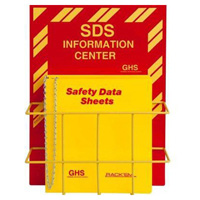
Your employees can stay informed and safety-ready with right to know stations and labels from Safety Emporium.
This is in response to your letter of July 10, regarding compliance with the Occupational Safety and Health Administration's Hazard Communication Standard (OSHA), 29 CFR 1910.1200.
[ILPI note: At issuance: 1910.1200, original 1983 rule (PDF). Current counterparts: article definition, chemical-manufacturer definition, mixture classification, and required SDS structure/content. SIC codes have been superseded by NAICS; OSHA Form 174 (PDF) is a historical format, not today's required SDS layout.]
The Hazard Communication Standard defines an article as a manufactured item: (i) which is formed to a specific shape or design during manufacture; (ii) which has end use function(s) dependent in whole or in part upon its shape or design during end use; and (iii) which does not release, or otherwise result in exposure to, a hazardous chemical under normal conditions of use. Accordingly, manufacturers or importers must do their best to anticipate the uses of their products and determine whether downstream employees can be exposed to a hazardous chemical. If such an exposure does occur or has the potential to occur then the product could not be considered as an article. Articles are exempt from the requirements of the standard.
The standard defines a chemical manufacturer as an employer in Standard Industrial Classification Codes 20 through 39 with a workplace where chemical(s) are produced for use or distribution. In addition, the standard also defines "chemical" to mean any element, chemical compound or mixture of elements and/or compounds. Therefore, any employer who is engaged in a manufacturing operation is considered a chemical manufacturer. Steel coils would be considered a chemical under the Hazard Communication Standard and therefore covered by the requirements of the standard.
With regard to the material safety data sheet referenced in your letter (Form OMB No. 1218-0072, more commonly referred to as OSHA Form 174) this is a non-mandatory form developed by OSHA to make it easier for employers to comply with the standard. The Hazard Communication Standard does not specify the format for a material safety data sheet but does specify the types of information that must be included.
[ILPI note: This optional-format statement is historical. Current SDS headings/order and Appendix D govern; Form 174 (PDF) is a historical example.]
Section II of the above form applies only to the hazardous ingredients of a product. "Hazardous," as defined by the standard, means any chemical which is a physical or health hazard. The enclosed copy of the standard provides definitions for physical and health hazards. All of the remaining sections of the form apply to the product and/or its hazardous ingredients.

For example, an employer could put the boiling point for a mixture or just indicate the boiling point for each hazardous ingredient. The "IDENTITY" space provided for on the material safety data sheet is used to indicate the chemical or common name of the product. Whatever identity is used by the chemical manufacturer or importer must permit cross-reference with the label. In other words, the employer is allowed to use any product name as long as the name is the same for both the label and the material safety data sheet.
In regard to Sections VI and VII, these items require employers filling out the form to evaluate the hazards of their products. Hazard determination is a requirement of the Hazard Communication Standard. The hazard determination can be made through a review of existing scientific literature. Appendix C of the enclosed standard provides a list of available data sources which chemical manufacturers or importers may wish to consult to evaluate the hazards of chemicals they produce or import.
If you need additional assistance you can contact Roy Gibbs or Steven Simon at (202) 523-8036. If I can be of further assistance please feel free to contact me again.
Sincerely,
Leo Carey, Director
Directorate of Field Operations
The original official public domain version of this document is available from OSHA at https://www.osha.gov/laws-regs/standardinterpretations/1987-08-18.