| The Home page of ILPI's Safety Data Sheet (SDS) Resource, the leader in SDS information since 1995! | |
| The history and philosophy behind this resource. | |
| A curated collection of books and reference materials concerning Safety Data Sheets and closely related topics. | |
| Paste your plain text SDS into the SDS-Demystifier, and it will be converted into a hypertext-enriched document with links to detailed explanations of each key term. | |
| An extensive list of frequently asked questions about Safety Data Sheets including regulations, content, compliance, and more. | |
| A humorous take on Safety Data Sheet jargon. Fill in the blanks on our entry form to generate a personalized Unsafety Data Sheet to share with your coworkers. | |
| Since 1995, we've maintained this massive curated list of the best places to find Safety Data Sheets on the Internet. | |
| Way more than a glossary, this hypertext-enhanced resource covers hundreds of SDS-related terms and expert knowledge. Each entry includes both the SDS relevance and links to additional authoritative resources. | |
| Archived results of Safety Data Sheet related polls taken by some of our millions of site visitors | |
| You are here! The OSHA regulations behind SDS regulations, including the inspection guidelines and over 400 official interpretations letters under the Hazard Communication Standard | |
| Commercial suppliers of SDS authoring and management software as well as cloud compliance services. | |
| Commercial companies that will create SDS's for your specific needs as well as SDS translation companies. |

Safety signs, banners, and scoreboards? Get yours at Safety Emporium!
OSHA Hazard Communication Letters of Interpretation
Labeling and MSDSs for a stump router cutter head which has carbide tips on the cutter teeth.
- Issued
- Record type
- Interpretation
- Historical standard
- 1910.1200, 1987 expanded rule (PDF)
- Current standard
- HCS 2024, as amended
ILPI assessment: Solid-material labeling and foreseeable-release principles retained
This letter addresses the HCS as expanded in 1987, an obsolete version of the Hazard Communication Standard. Its main HazCom principles remain relevant: sharpening carbide tips can create hazardous dust, and an article exemption must account for actual use and maintenance. Apply current article definition, known or reasonably anticipated uses, and hazard classification; see the article FAQ and discussion of downstream duties.
The limited label-transmission alternative now appears in current solid-material label provision. It does not eliminate required warnings or extend automatically to associated hazardous chemicals. Apply current SDS preparation and manufacturer/distributor transmittal duties. The one-time September 23, 1987 supply-date discussion is historical, not a current exemption from supplying required or updated SDSs. Use the local-office directory in “About this ILPI assessment” instead of the historical address below.
Last reviewed: .
About this ILPI assessment
This comparison with current requirements is not a finding that OSHA has formally withdrawn this letter. This assessment reflects editorial judgment informed by human review and AI assistance. It is an opinion, may contain errors or omissions, and is not an official OSHA determination. For guidance on how OSHA requirements apply to your circumstances, contact your local OSHA office.
OSHA's notice about interpretation letters
The following notice is published on OSHA's interpretation pages; it is general guidance, not a letter-specific withdrawal notice.
OSHA requirements are set by statute, standards and regulations. Our interpretation letters explain these requirements and how they apply to particular circumstances, but they cannot create additional employer obligations. This letter constitutes OSHA's interpretation of the requirements discussed. Note that our enforcement guidance may be affected by changes to OSHA rules. Also, from time to time we update our guidance in response to new information. To keep apprised of such developments, you can consult OSHA's website at https://www.osha.gov.
Source: OSHA's original letter page.
October 26, 1987
Mr. Keith Doty
President
Hodges Manufacturing Company, Inc.
Route 4, Box 328B
Mountain Home, Arkansas 72653
Dear Mr. Doty:
Ensure your workers are trained with safety posters and more at Safety Emporium.
This is an update to our response of October 1 to your inquiry concerning your labeling and material safety data sheet responsibilities under the expanded Hazard Communication Standard.
As you explained, your company manufactures stump removal equipment. Each stump router cutter head has carbide tips on the cutter teeth. Your customers sharpen the cutter teeth by grinding the carbide tips.
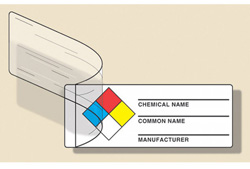
Since the cutter teeth are solid metal, the required label may be transmitted to your customers at the time of initial shipment and need not be included with subsequent shipment to the same employer unless the information on the label changes. The label may be transmitted with the initial shipment itself, or with appropriate material safety data sheets that are to be provided prior to or at the time of the first shipment. You may also affix the warning label on every cutter head guard of the machine. Such action may assist your customers in complying with the Hazard Communication Standard.
[ILPI note: Current counterpart: limited solid-material label transmission. Apply its full conditions and current label elements. Historical standard: 1910.1200, 1987 expanded rule (PDF).]
As discussed with Joyce Doty of your company, material safety data sheets are required for each hazardous chemical which could potentially present a physical or health hazard during the normal use of the product. Thus, a material safety data sheet would be necessary for the carbide tips. For the general metal components, however, a material safety data sheet would only be necessary if routine use or maintenance would likely involve exposure to metallic dust or fumes. Listing the general metal components of steel products is acceptable if a material safety data sheet is necessary. It is not a requirement to send material safety data sheets to nonmanufacturing customers who were shipped hazardous chemicals prior to September 23, 1987.
[ILPI note: This is a historical supply-date statement, not a current waiver. Apply manufacturer/distributor transmittal duties, including applicable updated/requested SDS requirements.]
If you have further questions, please feel free to contact the Occupational Safety and Health Administration's (OSHA) office closest to you. The address and telephone number are:
U.S. Department of Labor - OSHA
Savers Building, Suite 828
320 West Capital Avenue
Little Rock, Arkansas 72201
I hope this information is helpful.
Sincerely,
John A. Pendergrass
Assistant Secretary
The original official public domain version of this document is available from OSHA at https://www.osha.gov/laws-regs/standardinterpretations/1987-10-26.