| The Home page of ILPI's Safety Data Sheet (SDS) Resource, the leader in SDS information since 1995! | |
| The history and philosophy behind this resource. | |
| A curated collection of books and reference materials concerning Safety Data Sheets and closely related topics. | |
| Paste your plain text SDS into the SDS-Demystifier, and it will be converted into a hypertext-enriched document with links to detailed explanations of each key term. | |
| An extensive list of frequently asked questions about Safety Data Sheets including regulations, content, compliance, and more. | |
| A humorous take on Safety Data Sheet jargon. Fill in the blanks on our entry form to generate a personalized Unsafety Data Sheet to share with your coworkers. | |
| Since 1995, we've maintained this massive curated list of the best places to find Safety Data Sheets on the Internet. | |
| You are here! Way more than a glossary, this hypertext-enhanced resource covers hundreds of SDS-related terms and expert knowledge. Each entry includes both the SDS relevance and links to additional authoritative resources. | |
| Archived results of Safety Data Sheet related polls taken by some of our millions of site visitors | |
| The OSHA regulations behind SDS regulations, including the inspection guidelines and over 400 official interpretations letters under the Hazard Communication Standard | |
| Commercial suppliers of SDS authoring and management software as well as cloud compliance services. | |
| Commercial companies that will create SDS's for your specific needs as well as SDS translation companies. |

Safety signs, banners, and scoreboards? Get yours at Safety Emporium!
Hazard Classification, Hazard Class, and Hazard Category
Definition
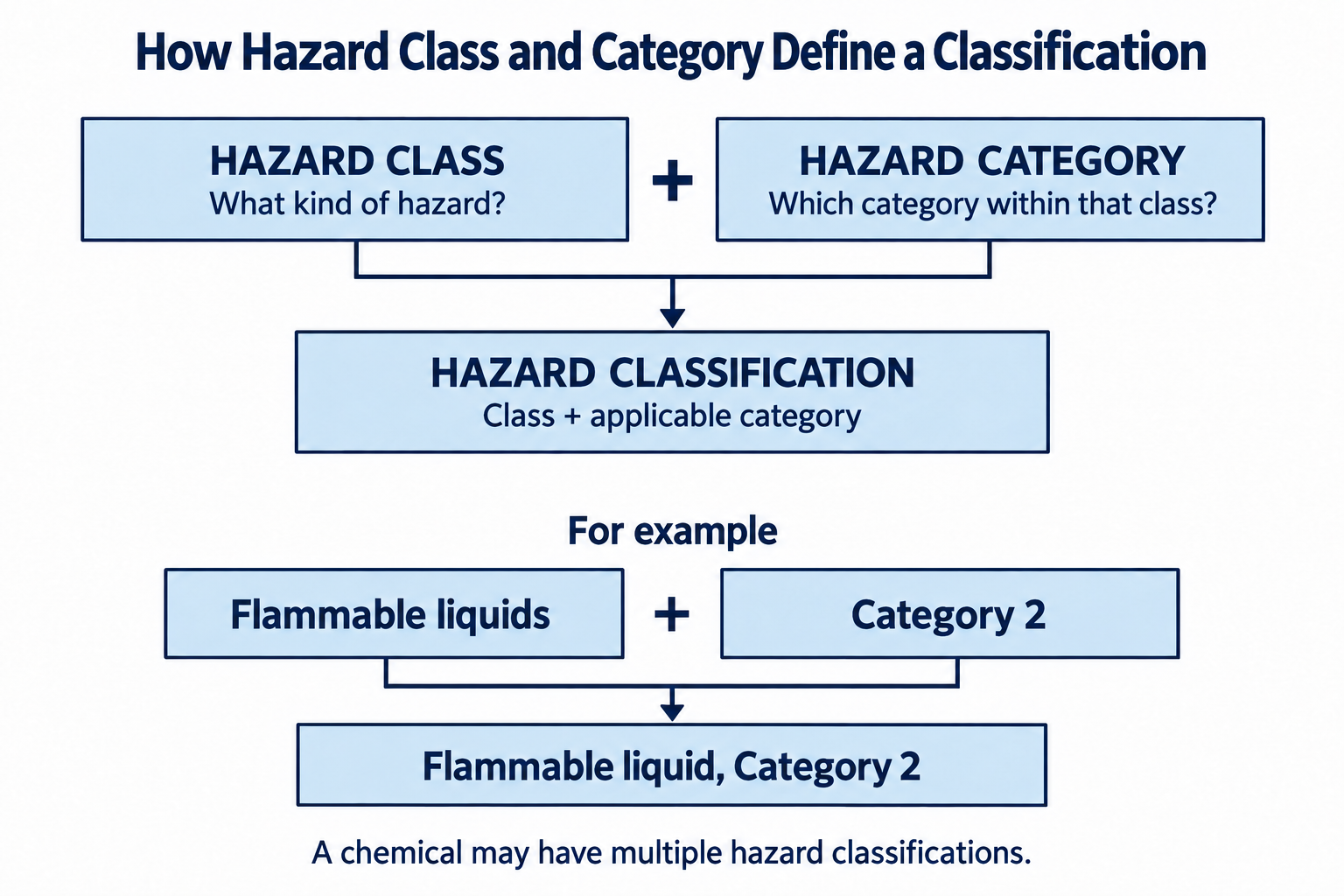
29 CR 1910.100, the OSHA Hazard Communication standard uses hazard classification to identify a chemical's hazards and, where applicable, their categories. The Standard defines these terms:
- A hazard class is defined as
the nature of the physical or health hazards, e.g., flammable solid, carcinogen, oral acute toxicity
, associated with a material. Ten health hazard classes are defined in Appendix A and seventeen physical hazard classes are defined in Appendix B of the Standard. These are summarized below. - A hazard category is defined as
the division of criteria within each hazard class, e.g., oral acute toxicity and flammable liquids
[which]include
[s]four hazard categories. These categories compare hazard severity within a hazard class and should not be taken as a comparison of hazard categories more generally.
- Hazard classification is a process defined in paragraph (d) of 29 CFR 1910.1200 as:
...For each chemical, the chemical manufacturer or importer shall determine the hazard classes, and where appropriate, the category of each class that apply to the chemical being classified...Chemical manufacturers, importers or employers classifying chemicals shall identify and consider the full range of available scientific literature and other evidence concerning the potential hazards. There is no requirement to test the chemical to determine how to classify its hazards. Appendix A to §1910.1200 shall be consulted for classification of health hazards, and Appendix B to §1910.1200 shall be consulted for the classification of physical hazards.
Additional Info
The Hazard Communication Standard’s classification system is adapted from the United Nations’ Globally Harmonized System of Classification and Labelling of Chemicals (GHS). HCS 2012 was based on GHS Revision 3, but the current version, HCS 2024, primarily aligns with Revision 7 and incorporates selected provisions from Revision 8. Because OSHA adopts selected GHS provisions through rulemaking, the applicable hazard classes, categories, and criteria depend on the version(s) of the HazCom Standard in force at the time of the hazard classification.
Get your SDS binders, centers and more from Safety Emporium.
The number of hazard categories, their labels, and what they signify vary by hazard class. Some hazard classes have only one hazard category, whereas others use numbered categories (such as 1–4), lettered subcategories (such as 1A, 1B, and 1C), or classifications called "types" (A–G) or "divisions" (1.1–1.6). Note, however, that these classifications describe severity or other hazard characteristics only within a particular hazard class and are not comparable across classes. So a category 1 under the aerosol hazard class is not "equivalent" to a category 1 under the pyrophoric liquids class.
This numeric ranking system where lower category numbers generally indicate greater hazard severity within a hazard class is the exact opposite of the NFPA and HMIS® systems, and is a serious potential point of confusion for untrained workers. Further, as can be seen in the next section, not all hazard classes have entries 1-4; some have only category 1, some have 1-2, 1-3 or 1-4, and Explosives is broken into 6 divisions!
Editorial aside: We have no idea how a respected agency like the UN could come up with such a muddled and unintuitive ranking system. Seriously, couldn't they have labeled everything with names - why not Highest, Severe, Moderate, and Low so people wouldn't have to deal with figuring out what numbers and letters mean? How hard would that have been?
How Hazard Classification Works
As described in 1910.1200 paragraph (d), a hazard classification considers both the intrinsic (inherent) hazardous properties of chemicals as well as hazards associated with changes in physical form and reaction products from known or reasonably anticipated uses or applications. The three steps involved are:
- Identification of relevant data regarding the hazards of a chemical;
- Subsequent review of those data to ascertain the hazards associated with the chemical;
- Determination of whether the chemical will be classified as hazardous and the degree of hazard.
The specific health hazard criteria to be reviewed are:
| Appendix section | Health hazard class | Classifications |
|---|---|---|
| A.1 | Acute toxicity (oral, Dermal and Inhalation) | Categories 1-4 |
| A.2 | Skin corrosion / irritation | Category 1 (subcategories 1A, 1B, and 1C); Category 2 |
| A.3 | Serious eye damage / eye Irritation | Category 1; Category 2 (2A and 2B) |
| A.4 | Respiratory or skin sensitization | Category 1 (subcategories 1A and 1B) |
| A.5 | Germ cell mutagenicity | Categories 1A, 1B, and 2 |
| A.6 | Carcinogenicity [1] | Categories 1A, 1B, and 2 |
| A.7 | Reproductive toxicity | Categories 1A, 1B, and 2; separate category for effects on or via lactation |
| A.8 | Specific target organ toxicity: single exposure (STOT-SE) | Categories 1-3 |
| A.9 | Specific target organ toxicity: repeated or prolonged exposure (STOT-RE) | Categories 1 and 2 |
| A.10 | Aspiration hazard | Category 1 |
| [1] Appendix F to §1910.1200 provides specific further guidance for the carcinogenicity assignment. | ||
The specific physical hazard criteria to be reviewed are:
| Appendix section | Physical hazard class | Classifications |
|---|---|---|
| B.1 | Explosives | Unstable explosives; Divisions 1.1-1.6 |
| B.2 | Flammable gases [2] | Categories 1A, 1B, and 2 |
| B.3.1 | Aerosols | Categories 1-3 |
| B.3.2 | Chemicals under pressure | Categories 1-3 |
| B.4 | Oxidizing gases | Category 1 |
| B.5 | Gases under pressure | Groups: compressed gas, liquefied gas, dissolved gas, refrigerated liquefied gas |
| B.6 | Flammable liquids | Categories 1-4 |
| B.7 | Flammable solids | Categories 1 and 2 |
| B.8 | Self-reactive chemicals | Types A-G |
| B.9 | Pyrophoric liquids | Category 1 |
| B.10 | Pyrophoric solids | Category 1 |
| B.11 | Self-heating chemicals | Categories 1 and 2 |
| B.12 | Chemicals which, in contact with water, emit flammable gases | Categories 1-3 |
| B.13 | Oxidizing liquids | Categories 1-3 |
| B.14 | Oxidizing solids | Categories 1-3 |
| B.15 | Organic Peroxides | Types A-G |
| B.16 | Corrosive to metals | Category 1 |
| B.17 | Desensitized explosives | Categories 1-4 |
| [2] Flammable gases: 1A includes pyrophoric gases and chemically unstable gases; chemical instability uses A/B distinctions. | ||
The GHS model standard on which current OSHA regulations are

Keep informed about workplace hazards with proper labeling techniques and safety posters available from Safety Emporium.
Several sections of 29 CFR 1910.1200 and the appendices deal with the complexity involved in assessing mixtures. A quick summary is:
- Follow the mixture-classification procedures specified for each applicable hazard class in Appendices A and B.
- Use available data on the mixture as a whole where the applicable criteria permit; the HCS does not require new testing.
- Where permitted, apply bridging principles to classify an untested mixture using sufficient information about its ingredients and similar tested mixtures.
- Apply the specified ingredient-based methods, such as concentration limits or additivity calculations, where appropriate. The applicable hazard class determines which methods take priority.
SDS Relevance
The hazards found in the classification process must be communicated using the Safety Data Sheet (SDS) and label. These are reflected in:
- Pictograms which convey the hazards
- Signal words (Danger or Warning)
- Hazard statements
- Precautionary statements
Of course, there are other required elements for the SDS and label. And the information contained in the SDS and label will be part of the training required for those employees who use or could be exposed to the material.
Classification is performed by the author of the sheet; there is no need for employers to perform an hazard classification of their own unless they are the manufacturer of the material. If you are a downstream user of the sheet, you are allowed to rely on the classification on the materials that you received.
Given that the complexity of the hazard classifications that must be communicated to your employees, a poster as well as training that explain the meanings of the various pictograms and such is a very good idea.

Ensure your workers are trained with safety posters and more at Safety Emporium.
Further Reading
- OSHA has a comprehensive 384 page document titled Hazard Classification Guidance for Manufacturers, Importers, and Employees.
- The European Chemicals Agency offers Guidance on the Application of the CLP Criteria with detailed technical guidance and practical examples for EU requirements (which differ from OSHA's).
- Classification and Labelling Summary Tables for GHS Rev 11 at UNECE.
- WHMIS - Hazard Classes and Categories at the Canadian Centre for Occupational Health & Safety.
- HCIS Hazardous Chemical Information List at Safe Work Australia contains a list of chemicals and their classifications under GHS.
- Chemical Hazard Classification (GHS) at the U of Illinois Division of Research Safety arranges hazard classes by pictogram.
- GHS Classification summary at the US NIH.
- OSHA Quick Card: Comparison of NFPA 704 and HazCom 2012 Labels is based on HCS 2012 but is still valuable.
See also: toxic, carcinogen.