| The Home page of ILPI's Safety Data Sheet (SDS) Resource, the leader in SDS information since 1995! | |
| The history and philosophy behind this resource. | |
| A curated collection of books and reference materials concerning Safety Data Sheets and closely related topics. | |
| Paste your plain text SDS into the SDS-Demystifier, and it will be converted into a hypertext-enriched document with links to detailed explanations of each key term. | |
| An extensive list of frequently asked questions about Safety Data Sheets including regulations, content, compliance, and more. | |
| A humorous take on Safety Data Sheet jargon. Fill in the blanks on our entry form to generate a personalized Unsafety Data Sheet to share with your coworkers. | |
| Since 1995, we've maintained this massive curated list of the best places to find Safety Data Sheets on the Internet. | |
| You are here! Way more than a glossary, this hypertext-enhanced resource covers hundreds of SDS-related terms and expert knowledge. Each entry includes both the SDS relevance and links to additional authoritative resources. | |
| Archived results of Safety Data Sheet related polls taken by some of our millions of site visitors | |
| The OSHA regulations behind SDS regulations, including the inspection guidelines and over 400 official interpretations letters under the Hazard Communication Standard | |
| Commercial suppliers of SDS authoring and management software as well as cloud compliance services. | |
| Commercial companies that will create SDS's for your specific needs as well as SDS translation companies. |

Safety signs, banners, and scoreboards? Get yours at Safety Emporium!
Aerosol
Definition
Under Section B.3.1.1 of Appendix B of 29 CFR 1910.1200, the OSHA Hazard Communication Standard (HCS 2024), an aerosol means any non-refillable receptacle containing a gas compressed, liquefied or dissolved under pressure, and fitted with a release device allowing the contents to be ejected as particles in suspension in a gas, or as a foam, paste, powder, liquid or gas.
The definition of aerosol used in HCS 2024 addresses aerosol products such as spray paint, insulating foam, or cans of bug spray. A broader, more general, definition of aerosol is a suspension of fine solid particles or liquid droplets in a gas, especially air. Fogs and mists are examples of aerosols. This broader definition does not require a container.
Additional Info
Section B.3.1.2 of Appendix B of 29 CFR 1910.1200 formally classifies aerosols into one of three categories depending on their flammability properties and their heats of combustion. Aerosols meeting the applicable flammability criteria are classified as Category 1 or Category 2. Aerosols that do not meet those criteria or those containing <1% flammable components by mass and having heats of combustion less than 20 kJ/g are assigned to Category 3. Some additional nuances are described in the Table B.3.1 Notes.
| Category | Criteria |
|---|---|
| 1 |
Contains ≥85% flammable components and the chemical heat of combustion is ≥30 kJ/g; or
|
| 2 |
Contains >1% flammable components, or the heat of combustion is ≥20 kJ/g; and
|
| 3 |
(1) The chemical does not meet the criteria for Categories 1 and 2; or
(2) The chemical contains ≤1% flammable components (by mass) and has a heat of combustion <20 kJ/g. |

Flame pictograms and other GHS-compliant labels and signs are available from Safety Emporium.
Flammable Aerosols
The term flammable aerosol was formally defined in HCS 1994 as an aerosol that, when tested by the method described in 16 CFR 1500.45, yields a flame projection exceeding 18 inches at full valve opening, or a flashback (a flame extending back to the valve) at any degree of valve opening;
At the same time, OSHA's Flammable Liquids standard, 29 CFR 1910.106, used a different definition for purposes of that standard. It defined a flammable aerosol as an aerosol which is required to be labeled flammable under the Federal Hazardous Substances Act
and specified that, for purposes of §1910.106(d), such aerosols were considered Class IA liquids. Thus, prior to HCS 2012, two different OSHA standards used the term flammable aerosol for somewhat different regulatory purposes.
HCS 2012 was adopted to bring US Safety Data Sheets into alignment with the Globally Harmonized System. The labeling provisions of HCS 2012 required that Category 1 or 2 flammable aerosol containers carry the flame pictogram (shown on the right) to provide a quick visual warning of the flammability hazard. The GHS does not require pictograms to appear on the SDS itself, however most responsible manufacturers will do so to preserve the correspondence between a substance's SDS and label.
Note: HCS 2012 was based on GHS Revision 3. Beginning with GHS Revision 4, the hazard class was broadened from Flammable Aerosols to Aerosols and a new Category 3 was established for aerosols that do not meet the criteria for Categories 1 or 2. This issue is discussed in Section A.1 of CPL 02-02-079 (2015), Inspection Procedures for the Hazard Communication Standard in detail as well as a November 29, 2017 OSHA interpretation letter to Dell Tech Laboratories.
With the adoption of HCS 2024 which is based primarily on GHS Revision 7, Flammable Aerosols is no longer the name of the hazard class. Instead, aerosols are now classified into Categories 1, 2, or 3 as discussed above. The phrase, however, remains in the hazard statements for Category 1 ("extremely flammable aerosol") and Class 2 ("flammable aerosol") in Appendix C of the Standard. Thus, "flammable aerosol" remains a useful regulatory description even though it is no longer the formal hazard-class name.
Currently, one inconsistency of the term flammable aerosol remains in OSHA's regulations. Section 1910.106(a)(13) states that a flammable aerosol means a flammable aerosol as defined by Appendix B to § 1910.1200.
Strictly speaking, however, HCS 2024 Appendix B does not define flammable aerosol it defines aerosol and classifies aerosols into Categories 1, 2, and 3, with Categories 1 and 2 assigned flammability hazard statements. Section 1910.106 further specifies that, for purposes of 1910.106(d), such aerosols are considered Category 1 flammable liquids. Complicating matters slightly, §1910.106(a)(1) retains its own definition of aerosol as a material dispensed from its container as a mist, spray, or foam by a propellant under pressure
, a definition that differs from the one used in HCS 2024 Appendix B. Because the definitions in §1910.106(a) expressly apply "as used in this section
", the reader should be aware that the terminology is not completely harmonized between the two OSHA standards.
SDS Relevance
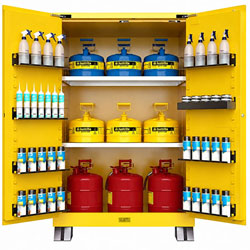
Store your aerosol cans safely with flammable storage safety cabinets from Safety Emporium.
If an aerosol has a Safety Data Sheet, that means the manufacturer has identified specific hazards that may pose risks when using the product. For example, the contents of an aerosol spray can could be flammable, toxic when inhaled, or pose a carcinogenic risk. In addition, the contents are under pressure, so the SDS may list storage recommendations, conditions to avoid, disposal considerations, or more.
Section 9 of the SDS lists the material's physical and chemical properties including flammability. The flammability of aerosols is often due to flammable solvents (such as butane) as a propellant or carrier. Use caution when using materials such as spray paints or aerosol solvents to avoid accidental ignition by a heat source or open flame. Some equipment may not be adequate to keep a flammable aerosol from flashing back into the container and result in an explosion or deflagration.
Most SDS's and fire safety experts recommend storing flammable aerosols in a flammable liquid storage cabinet. These are sold commercially by many vendors.
Further Reading
- This OSHA interpretation letter discusses flammable aerosol use with respect to OSHA 29 CFR 1910.107 and NFPA 33.
- Managing Aerosol Cans: Safe Use in the Workplace at EHS Leaders.
- A Guide To Staying Safe With Spray Paint Aerosols at DC Paint Solutions.
- Aerosol Can Safety: Pressure, Burst Tests & DOT Rules at Global Aerosols.
- The hidden dangers of aerosol cans at Safety Management Group.
- Aerosol Can Storage and OSHA Regulations at Justrite, a leading manufacturer of safety storage cabinets.
- GHS Compliance Spotlight: Aerosols Under WHMIS 2015 And OSHA 2012 at ERA Environmental.
- Safety Insight - Aerosol Testing - Aerosol Flammability Classification and Testing at Dekra.
- How to Work Safely with Hazardous Products Using the "Flame" Pictogram at the Canadian Centre for Occupational Health and Safety (CCOHS).
See also: flammable, flammable gas, flammable limits, flash point, solvent.