| The Home page of ILPI's Safety Data Sheet (SDS) Resource, the leader in SDS information since 1995! | |
| The history and philosophy behind this resource. | |
| A curated collection of books and reference materials concerning Safety Data Sheets and closely related topics. | |
| Paste your plain text SDS into the SDS-Demystifier, and it will be converted into a hypertext-enriched document with links to detailed explanations of each key term. | |
| An extensive list of frequently asked questions about Safety Data Sheets including regulations, content, compliance, and more. | |
| A humorous take on Safety Data Sheet jargon. Fill in the blanks on our entry form to generate a personalized Unsafety Data Sheet to share with your coworkers. | |
| Since 1995, we've maintained this massive curated list of the best places to find Safety Data Sheets on the Internet. | |
| Way more than a glossary, this hypertext-enhanced resource covers hundreds of SDS-related terms and expert knowledge. Each entry includes both the SDS relevance and links to additional authoritative resources. | |
| Archived results of Safety Data Sheet related polls taken by some of our millions of site visitors | |
| You are here! The OSHA regulations behind SDS regulations, including the inspection guidelines and over 400 official interpretations letters under the Hazard Communication Standard | |
| Commercial suppliers of SDS authoring and management software as well as cloud compliance services. | |
| Commercial companies that will create SDS's for your specific needs as well as SDS translation companies. |

Safety signs, banners, and scoreboards? Get yours at Safety Emporium!
OSHA Hazard Communication Letters of Interpretation
MSDS requirements for drugs
- Issued
- Record type
- Interpretation
- Historical standard
- 1910.1200, 1987 expanded rule (PDF)
- Current standard
- HCS 2024, as amended
ILPI assessment: Hazard-based duties remain; use the complete current drug exemption
This letter addresses the obsolete 1987 version of the Hazard Communication Standard (HCS). Its main conclusion remains useful: a supplier's hazardous-drug information must reach exposed employees, and mere familiarity or FDA approval does not establish harmlessness. The letter does not itself resolve a current product's classification.
Under the current HCS, use current drug exemption, hazard classification, manufacturer/importer evaluation duties and SDS access. The full drug exemption includes retail-packaged and personal-consumption cases as well as solid final doses. Distributor transmission obligations do not automatically make every distributor the primary classifier. Obtain the current formulation's SDS and resolve inadequate information with its responsible supplier; foreseeable exposure includes spills and other relevant emergencies. See OSHA's pharmacy guidance and the immediate-access FAQ.
Last reviewed: .
About this ILPI assessment
This comparison with current requirements is not a finding that OSHA has formally withdrawn this letter. This assessment reflects editorial judgment informed by human review and AI assistance. It is an opinion, may contain errors or omissions, and is not an official OSHA determination. For guidance on how OSHA requirements apply to your circumstances, contact your local OSHA office.
OSHA's notice about interpretation letters
The following notice is published on OSHA's interpretation pages; it is general guidance, not a letter-specific withdrawal notice.
OSHA requirements are set by statute, standards and regulations. Our interpretation letters explain these requirements and how they apply to particular circumstances, but they cannot create additional employer obligations. This letter constitutes OSHA's interpretation of the requirements discussed. Note that our enforcement guidance may be affected by changes to OSHA rules. Also, from time to time we update our guidance in response to new information. To keep apprised of such developments, you can consult OSHA's website at https://www.osha.gov.
Source: OSHA's original letter page.
August 13, 1993
Dr. Jay D. Willey
Eastland Medical Plaza
1505 Eastland Drive
Suite 210
Bloomington, Illinois 61701
Dear Dr. Willey:
This is in response to your April 26 letter addressed to Congressman Thomas Ewing concerning the Occupational Safety and Health Administration's (OSHA) Hazard Communication Standard (HCS), 29 CFR 1910.1200 [ILPI: Original HCS 1987 context (PDF) · Current HCS]. Your letter specifically questioned the requirements for Material Safety Data Sheets (MSDS) for drugs.

DOT shipping signs and labels plus a host of safety and compliance posters are available at Safety Emporium.
Drugs regulated by the U.S. Food and Drug Administration (FDA) are covered by the HCS. However, section (b)(6)(viii) of the HCS [ILPI: Original HCS 1987 context (PDF) · Current HCS; now 1910.1200(b)(6)(vii)] exempts FDA drugs when in solid final form, such as tablets or pills, for direct administration to the patient.
[ILPI note: At issuance: 1910.1200, 1987 expanded rule (PDF). This drug provision is now current drug exemption and includes all its stated categories. FDA regulation alone is not a blanket exemption; current supplier information and actual potential exposure govern nonexempt products.]
In your letter you have emphasized that the MSDS for the drug SoluMedrol does not clearly state if it is a hazardous drug. OSHA does not determine if a drug is hazardous. The drug manufacturer or distributor is responsible for conducting the hazard determination based upon the criteria specified in the standard. If there is any question if a drug is hazardous or not, please contact the drug manufacturer for clarification. If the drug manufacturer is not responsive you may refer the issue to your local OSHA Area Office at (309) 671-7033.
The intent of the HCS is to provide information to employees about the hazards of the chemicals they may be exposed to while working. In the health care industry this intent is met when drug manufacturers and health care employers work cooperatively to transmit hazard information to all affected employees facing potential downstream exposure to hazardous drugs.
OSHA does not maintain a list of chemicals covered under the HCS. The rule requires chemical manufacturers and importers to evaluate the information available regarding the hazards of any chemical they produce or import and to make that information available to their customers by means of appropriate labels and material safety data sheets (MSDS). It has been estimated that under this approach the HCS applies to some 600,000 hazardous chemical products in use in American workplaces.
As a user of chemicals you may rely on the evaluations performed by the suppliers of the chemicals you use. If you receive a label or MSDS from your suppliers that indicates the chemical being used is hazardous, then you must include it in your hazard communication program.
OSHA believes that the HCS is a performance oriented, common sense standard. The HCS does not apply to chemicals that do not present a health or physical hazard. Conversely, any substance that presents a potential health or physical hazard to which an employee may be exposed must be included in an employer's hazard communication program.
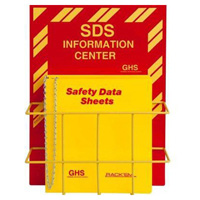
Your employees can stay informed and safety-ready with right to know stations and labels from Safety Emporium.
If the chemical is not available for exposure either under normal conditions of use or in a foreseeable emergency, then the chemical does not need to be included in your Hazard Communication Program. Section (b)(2) of the standard [ILPI: Original HCS 1987 context (PDF) · Current HCS] states that "This section applies to any chemical which is known to be present in the workplace in such a manner that employees may be exposed under normal conditions of use or in a foreseeable emergency.
" Exposure includes any route of entry (inhalation, ingestion, skin contact, or absorption) and includes potential (accidental or possible) exposure.
In response to your concerns about the cost of complying with the HCS OSHA is required to perform a feasibility analysis to determine whether a standard can be implemented, both technologically and economically. In the preamble to the final rule on Hazard Communication (FR Vol. 52 No. 163, page 31855) the agency concluded "... that the economic feasibility of extending the current HCS to the non-manufacturing sector (includes health care industry) is supported by the record." OSHA recognizes the program start up and maintenance costs to the non-manufacturing sector but finds they can feasibly provide employees with chemical hazard information as required by the HCS.
Included for your reference is a pamphlet on the HCS. We hope this information is useful to you.
Sincerely,
Roger A. Clark, Director
Directorate of Compliance Programs
Enclosure
cc: Congressman Thomas W. Ewing
June 28, 1993
Occupational Safety and Health Administration
Attention: Jackie
U.S. Department Of Labor
Rm N3641
200 Constitution Avenue N.W.
Washington, D.C. 20210
Dear Friend:
We received this letter from one of our constituents practicing in a rural area of Illinois. He is concerned that the OSHA MSDS's may be unnecessarily burdening to doctors in particular areas such as his.
In response to his letter, I spoke with Jackie on Friday, June 11th to gather some information about the requirements. She suggested that due to the technical nature of the constituent's questions, we should simply refer our letter to your office to be answered.
Thank you for handling this matter. I am confident that due to your expertise, you will be able to respond much more effectively than we could.
Sincerely,
Thomas W. Ewing
Member of Congress
TWE:jet
April 26, 1993
Senator Thomas Ewing
2401 E. Washington Street
Bloomington, IL 61701
Dear Congressman:

I am writing this letter in regards to the OSHA requirement for physicians' offices to maintain a Material Safety Data Sheet on harmful agents administered in their offices. I feel OSHA has gone overboard on this requirement as I have read the medications that they have listed as needing a Materials Data Sheet. I specifically will address the data sheet on the use of SoluMedrol, and, under Section 6, regarding Health Hazard, the very opening statement says that there are no adverse effects of overexposure anticipated during normal handling of vials of the finished product. If one continues to read through the remainder of the paragraph, they will see that the only way exposure can occur to a significant side effect is if the personnel are actively injecting the medication into their own bodies. In the medical fields of nursing and physician training, all of us have been told not to inject medicines into our own bodies, unless directed so under a doctor's guidance. This is just another example of the ridiculous bureaucratic nature of OSHA and their attempts to inflame the price of medication and price of health delivery within the United States.
This is not meant to undermine the importance of such a material safety data sheet as I do feel there are several medicines being administered within the United States that would be significant upon even minor exposure, but there are several dozen now listed, which on routine exposure have no significant consequence. The time and effort that I will be required to put into keeping this manual current, based on these OSHA regulations is very significant, and I will have to readjust my office fees based on the amount of time I am required to spend keeping my office within OSHA standards. I'm sure that all of you are aware of the healthcare issues that have been presented in the last several months regarding the enormous amount of time and cost that we are now putting toward paperwork and this is simply another example of that debate which has been raging in the United States over the last 13 months. If you are aware of another group or individual that I should be sending this letter to who can see to it that something is done about this ridiculous paper overload that we are now undergoing, I would be glad to send this letter to them as well. I would hope that you could send me some comment on your opinions as regard to this letter.
Sincerely yours,
Jay D. Willey, M. D.
The original official public domain version of this document is available from OSHA at https://www.osha.gov/laws-regs/standardinterpretations/1993-08-13.