| The Home page of ILPI's Safety Data Sheet (SDS) Resource, the leader in SDS information since 1995! | |
| The history and philosophy behind this resource. | |
| A curated collection of books and reference materials concerning Safety Data Sheets and closely related topics. | |
| Paste your plain text SDS into the SDS-Demystifier, and it will be converted into a hypertext-enriched document with links to detailed explanations of each key term. | |
| An extensive list of frequently asked questions about Safety Data Sheets including regulations, content, compliance, and more. | |
| A humorous take on Safety Data Sheet jargon. Fill in the blanks on our entry form to generate a personalized Unsafety Data Sheet to share with your coworkers. | |
| Since 1995, we've maintained this massive curated list of the best places to find Safety Data Sheets on the Internet. | |
| Way more than a glossary, this hypertext-enhanced resource covers hundreds of SDS-related terms and expert knowledge. Each entry includes both the SDS relevance and links to additional authoritative resources. | |
| Archived results of Safety Data Sheet related polls taken by some of our millions of site visitors | |
| You are here! The OSHA regulations behind SDS regulations, including the inspection guidelines and over 400 official interpretations letters under the Hazard Communication Standard | |
| Commercial suppliers of SDS authoring and management software as well as cloud compliance services. | |
| Commercial companies that will create SDS's for your specific needs as well as SDS translation companies. |

Safety signs, banners, and scoreboards? Get yours at Safety Emporium!
OSHA Hazard Communication Letters of Interpretation
Occupational health hazards to veterinarians.
- Issued
- Record type
- Memorandum
- Historical HazCom standard
- HCS 1994
- Current HazCom standard
- HCS 2024, as amended
ILPI assessment: Chemical hazard communication remains; old resource survey is incomplete today
The HazCom concern remains relevant: veterinary employees may need chemical hazard information for anesthetics, disinfectants, hazardous drugs and other materials. This memorandum is a historical resource survey, not a complete modern hazard evaluation or veterinary safety program.
Apply current hazard classification, ready SDS access, and effective information and training. The cited 1994 journal articles and third-edition biosafety manual are historical; assess current zoonotic, chemical, sharps and other hazards separately. Do not infer that every exposure to animal blood is covered by the bloodborne-pathogens definitions; that standard has specific human-blood/other-potentially-infectious-material scope. Other protective duties may still apply.
Last reviewed: .
About this ILPI assessment
This comparison with current requirements is not a finding that OSHA has formally withdrawn this letter. This assessment reflects editorial judgment informed by human review and AI assistance. It is an opinion, may contain errors or omissions, and is not an official OSHA determination. For guidance on how OSHA requirements apply to your circumstances, contact your local OSHA office.
OSHA's notice about interpretation letters
The following notice is published on OSHA's interpretation pages; it is general guidance, not a letter-specific withdrawal notice.
OSHA requirements are set by statute, standards and regulations. Our interpretation letters explain these requirements and how they apply to particular circumstances, but they cannot create additional employer obligations. This letter constitutes OSHA's interpretation of the requirements discussed. Note that our enforcement guidance may be affected by changes to OSHA rules. Also, from time to time we update our guidance in response to new information. To keep apprised of such developments, you can consult OSHA's website at https://www.osha.gov.
Source: OSHA's original letter page.
April 27, 1994
| MEMORANDUM FOR: | LINDA R. ANKU Regional Administrator Region III |
| THROUGH: | STEPHEN MALLINGER Acting Director Directorate of Technical Support MELISSA A. McDIARMID, MD, MPH, Director Office of Occupational Medicine |
| FROM: | JOSEPH M. TONNING, MD, MPH Preventive Medicine Resident Office of Occupational Medicine ANGELA C. PRESSON, MD, MPH Medical Officer Office of Occupational Medicine |
| SUBJECT: | Occupational Health Hazards to Veterinarians |
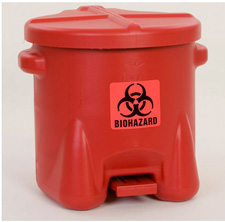
Safety Emporium carries biohazardous waste cans, labels, training materials and more...
This memo is in response to an earlier inquiry regarding occupational hazards to veterinarians. Several organizations have been contacted including the Centers for Disease Control and Prevention (404-639-3158), the American Animal Hospital Association (303-986-2800), and the American Veterinary Medical Association (708-925-8070). According to Arnold Kaufman, DVM, at the CDC, brucellosis is the major concern among diseases that could potentially be transmitted from animals to veterinarians. Dr. Kaufman was unaware of any specific guidelines for veterinarians when handling animals, although he referred to the CDC/NIH publication Biosafety in Microbiological and Biomedical Laboratories, 3rd Edition. This publication discusses many viral and bacterial diseases that may be transmitted from animals to humans (including Brucellosis, page 85). Proper means of handling animals with these diseases as well as personal protective equipment and medical waste disposal is also discussed.
Another excellent source of information regarding occupational hazards to veterinarians is the Journal of the American Veterinary Medical Association. This journal recently published a four-part series of articles by Philip J. Seibert, Jr., CVT, the first three of which are attached. These articles discuss various occupational hazards as well as OSHA regulations such as those governing anesthetic gases, hazardous chemicals, medical waste, and compressed gas cylinders. The February 1, 1994 issue (Vol. 204 pp. 356-358) specifically addresses disposal of medical waste and animal handling guidelines, citing the OSHA bloodborne pathogens standard. This journal is considered authoritative among veterinarians. Approximately 85% of all veterinarians in the United States are members of the American Veterinary Medical Association, according to the membership department of this organization.
[ILPI note: Original HCS 1994 context · Current HCS. The journal series and biosafety edition cited here are historical resources. For chemical hazards use current classification, ready SDS access, and effective information and training. Biological-hazard coverage must be assessed separately under the applicable current rules.]
Thank you for contacting us regarding this issue. We hope this information will be helpful for you in providing assistance in the veterinary area. If we can be of further assistance, please contact either Dr. Tonning or Dr. Presson at the Office of Occupational Medicine, (202) 219-5003.
Attachments
The original official public domain version of this document is available from OSHA at https://www.osha.gov/laws-regs/standardinterpretations/1994-04-27.