| The Home page of ILPI's Safety Data Sheet (SDS) Resource, the leader in SDS information since 1995! | |
| The history and philosophy behind this resource. | |
| A curated collection of books and reference materials concerning Safety Data Sheets and closely related topics. | |
| Paste your plain text SDS into the SDS-Demystifier, and it will be converted into a hypertext-enriched document with links to detailed explanations of each key term. | |
| An extensive list of frequently asked questions about Safety Data Sheets including regulations, content, compliance, and more. | |
| A humorous take on Safety Data Sheet jargon. Fill in the blanks on our entry form to generate a personalized Unsafety Data Sheet to share with your coworkers. | |
| Since 1995, we've maintained this massive curated list of the best places to find Safety Data Sheets on the Internet. | |
| Way more than a glossary, this hypertext-enhanced resource covers hundreds of SDS-related terms and expert knowledge. Each entry includes both the SDS relevance and links to additional authoritative resources. | |
| Archived results of Safety Data Sheet related polls taken by some of our millions of site visitors | |
| You are here! The OSHA regulations behind SDS regulations, including the inspection guidelines and over 400 official interpretations letters under the Hazard Communication Standard | |
| Commercial suppliers of SDS authoring and management software as well as cloud compliance services. | |
| Commercial companies that will create SDS's for your specific needs as well as SDS translation companies. |

Safety signs, banners, and scoreboards? Get yours at Safety Emporium!
OSHA Hazard Communication Letters of Interpretation
OSHA's hazard communication requirements for the wood products you sell
- Issued
- Record type
- Interpretation
- Historical standard
- HCS 1994, pre-GHS archive
- Current standard
- HCS 2024, as amended
ILPI assessment: Wood and retail distinctions remain conditional
This letter addresses the obsolete 1994 version of the Hazard Communication Standard (HCS). Its main HazCom distinction remains useful: untreated wood posing only the specified fire hazard differs from treated wood or wood that will be processed to generate dust. Ordinary retail consumer sales and sales to employers also have different requirements.
Under the current HCS, apply the exact wood-product exclusion and all applicable retail/commercial-account provisions, not the short upon-request summary alone. Nonexempt wood dust requires current hazard classification, including cancer evidence; see NTP's wood-dust assessment. Workplace employers retain applicable immediate SDS access (FAQ) and current information and training requirements.
OSHA marks its matching original corrected 12/6/2024.
Last reviewed: .
About this ILPI assessment
This comparison with current requirements is not a finding that OSHA has formally withdrawn this letter. This assessment reflects editorial judgment informed by human review and AI assistance. It is an opinion, may contain errors or omissions, and is not an official OSHA determination. For guidance on how OSHA requirements apply to your circumstances, contact your local OSHA office.
OSHA's notice about interpretation letters
The following notice is published on OSHA's interpretation pages; it is general guidance, not a letter-specific withdrawal notice.
OSHA requirements are set by statute, standards and regulations. Our interpretation letters explain these requirements and how they apply to particular circumstances, but they cannot create additional employer obligations. This letter constitutes OSHA's interpretation of the requirements discussed. Note that our enforcement guidance may be affected by changes to OSHA rules. Also, from time to time we update our guidance in response to new information. To keep apprised of such developments, you can consult OSHA's website at https://www.osha.gov.
Source: OSHA's original letter page.
December 5, 1994
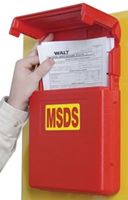
Many of our visitors use these weather-resistant SDS storage boxes like this one. We have 3 different sizes available at Safety Emporium.
Mr. Sidney L. Earnest
Aiken Builder's Supply Co., Inc.
156 Williamsburg Street, N.E.
Aiken, South Carolina 29801
Dear Mr. Earnest:
Congressman Butler Derrick forwarded your letter of August 15 to the Occupational Safety and Health Administration (OSHA) concerning OSHA's hazard communication requirements for the wood products you sell. In that letter, you express concern over the burden associated with providing Material Safety Data Sheets (MSDS's) for wood products to your customers.
Your responsibilities as a retail distributor under the amended Hazard Communication Standard (HCS) are limited. Specifically, section 1910.1200(g)(7)(iii) [ILPI: Original HCS 1994 context · Current HCS] requires a retail distributor to post a sign or otherwise inform their customers that MSDSs are available and to provide an MSDS to a customer only upon request; you are not obligated under the standard to provide a copy of the MSDS to each customer, unless requested by the customer to do so.
[ILPI note: At issuance: HCS 1994, pre-GHS archive. Current retail provisions distinguish commercial accounts and other purchasing circumstances. The wood exclusion is conditional and does not cover chemically treated wood or anticipated dust generation merely because the product is lumber.]
The amendments to the standard with respect to wood products reflect a clarification of OSHA's intent in the original standard; the amended standard does not impose new or additional requirements. Wood and wood products are still exempted from the hazard communication standard if the only hazard presented from use of the product is flammability or combustibility, which are hazards that are well-known among users of wood products. However, it may not be generally known among users that inhalation of certain types of wood dust or chemicals used to treat wood can present a serious lung disease hazard. For this reason, OSHA has always required under the hazard communication standard that distributors of wood products provide MSDS to employers whose employees may be exposed to these inhalation hazards.
We hope this clarifies your understanding of your obligations under the hazard communication standard. If you have additional questions, please feel free to contact OSHA's Office of Health Compliance Assistance at (202) 219-8036.
Sincerely,
Joseph A. Dear Assistant Secretary
The original official public domain version of this document is available from OSHA at https://www.osha.gov/laws-regs/standardinterpretations/1994-12-05.