| The Home page of ILPI's Safety Data Sheet (SDS) Resource, the leader in SDS information since 1995! | |
| The history and philosophy behind this resource. | |
| A curated collection of books and reference materials concerning Safety Data Sheets and closely related topics. | |
| Paste your plain text SDS into the SDS-Demystifier, and it will be converted into a hypertext-enriched document with links to detailed explanations of each key term. | |
| An extensive list of frequently asked questions about Safety Data Sheets including regulations, content, compliance, and more. | |
| A humorous take on Safety Data Sheet jargon. Fill in the blanks on our entry form to generate a personalized Unsafety Data Sheet to share with your coworkers. | |
| Since 1995, we've maintained this massive curated list of the best places to find Safety Data Sheets on the Internet. | |
| Way more than a glossary, this hypertext-enhanced resource covers hundreds of SDS-related terms and expert knowledge. Each entry includes both the SDS relevance and links to additional authoritative resources. | |
| Archived results of Safety Data Sheet related polls taken by some of our millions of site visitors | |
| You are here! The OSHA regulations behind SDS regulations, including the inspection guidelines and over 400 official interpretations letters under the Hazard Communication Standard | |
| Commercial suppliers of SDS authoring and management software as well as cloud compliance services. | |
| Commercial companies that will create SDS's for your specific needs as well as SDS translation companies. |

Safety signs, banners, and scoreboards? Get yours at Safety Emporium!
OSHA Hazard Communication Letters of Interpretation
Training in language and vocabulary employees understand
- Issued
- Record type
- Policy memorandum
- Historical HazCom standard
- HCS 1994
- Current HazCom standard
- HCS 2024, as amended
ILPI assessment: Comprehensible training principle generally consistent
Its HazCom conclusion remains consistent: training must be understandable in language, vocabulary and literacy level, and attendance records alone do not prove comprehension. This is a broader OSHA training policy memorandum, issued under the former HCS framework, rather than a requirement to use one particular teaching format for every standard.
For current HazCom, apply effective information and training, including the actual workplace hazards, labels, SDS access and protective measures. Each other standard can have its own demonstration, interaction or record requirements. The cited 1998 CPL is historically appropriate to this 2010 memo; the current HCS enforcement counterpart is CPL 02-02-079. Older contact/resource addresses should be checked against current OSHA resources.
Last reviewed: .
About this ILPI assessment
This comparison with current requirements is not a finding that OSHA has formally withdrawn this letter. This assessment reflects editorial judgment informed by human review and AI assistance. It is an opinion, may contain errors or omissions, and is not an official OSHA determination. For guidance on how OSHA requirements apply to your circumstances, contact your local OSHA office.
OSHA's notice about interpretation letters
The following notice is published on OSHA's interpretation pages; it is general guidance, not a letter-specific withdrawal notice.
OSHA requirements are set by statute, standards and regulations. Our interpretation letters explain these requirements and how they apply to particular circumstances, but they cannot create additional employer obligations. This letter constitutes OSHA's interpretation of the requirements discussed. Note that our enforcement guidance may be affected by changes to OSHA rules. Also, from time to time we update our guidance in response to new information. To keep apprised of such developments, you can consult OSHA's website at https://www.osha.gov.
Source: OSHA's original letter page.
U.S. Department of Labor
Assistant Secretary for
Occupational Safety and Health
Washington, D.C. 20210
April 28, 2010
- MEMORANDUM FOR:
- REGIONAL ADMINISTRATORS
- FROM:
- DAVID MICHAELS, PhD, MPH
Assistant Secretary - SUBJECT:
- OSHA Training Standards Policy Statement
The purposes of this memorandum are to reiterate OSHA's policy that employee training required by OSHA standards must be presented in a manner that employees can understand, and to provide enforcement guidance to the area and regional offices relative to the Agency's training standards. This position applies to all of the agency's agriculture, construction, general industry, and maritime training requirements.
Employer's Training Obligation
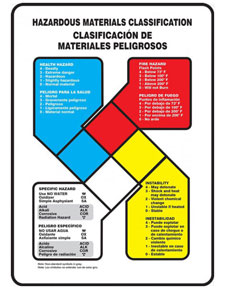
This English/Spanish instructional sign is one of many bilingual products available from Safety Emporium.
Many OSHA standards require that employees receive training so that work will be performed in a safe and healthful manner. Some of these standards require "training" or "instruction," others require "adequate" or "effective" training or instruction, and still others require training "in a manner" or "in language" that is understandable to employees. It is the Agency's position that, regardless of the precise regulatory language, the terms "train" and "instruct," as well as other synonyms, mean to present information in a manner that employees receiving it are capable of understanding. This follows from both the purpose of the standards -- providing employees with information that will allow work to be performed in a safe and healthful manner that complies with OSHA requirements -- and the basic definition that implies the information is presented in a manner the recipient is capable of understanding.
OSHA has a long and consistent history of interpreting its standards and other requirements to require employers to present information in a manner that their employees can understand. See, e.g., CPL 2-238(D)(1998) [ILPI: Original HCS 1994 context · Current HCS guidance; 1998 directive replaced by later enforcement guidance] ("[i]f the employees receive job instructions in a language other than English, then training and information to be conveyed under the [hazard communication standard] will also need to be conducted in a foreign language"); letter from Russell B. Swanson to Chip MacDonald (1999) ("instruction that employers must provide under §1926.21 must be tailored to the employees' language and education...."). Courts and the Commission have agreed with OSHA that an employer may not take advantage of "an adequately communicated work rule" when it did not communicate that rules to a non-English speaking employee in a language that employee could understand. See, e.g., Modern Continental Construction Company, Inc. v. OSHRC, 305 F.3d 43, 52 (1st Cir. 2002); Star Brite Construction Co., 19 (BNA) OSHC 1687, 1695 n.12 (N. 95-0343, 2001).
In practical terms, this means that an employer must instruct its employees using both a language and vocabulary that the employees can understand. For example, if an employee does not speak or comprehend English, instruction must be provided in a language the employee can understand. Similarly, if the employee's vocabulary is limited, the training must account for that limitation. By the same token, if employees are not literate, telling them to read training materials will not satisfy the employer's training obligation. As a general matter, employers are expected to realize that if they customarily need to communicate work instructions or otherworkplace information to employees at a certain vocabulary level or in language other than English, they will also need to provide safety and health training to employees in the same manner. Of course, employers may also provide instruction in learning the English language to non-English speaking employees. Over time this may lessen the to provide OSH Act training in other languages.
[ILPI note: Original HCS 1994 context · Current HCS. Current HazCom counterpart: effective information and training. An English label/SDS or a signed training record does not itself establish that employees understood the required instruction.]

Ensure worker safety with lockout/tagout (LOTO) supplies from Safety Emporium.
Additionally, OSHA's training provisions contain a variety of specific requirements related to employee comprehension. For example, §1910.147(c)(7)(i) (Lockout/Tagout) requires the employer to verify that the employees have "aquired" the knowledge and skills which they have been trained; §1910.134(k)(5)(ii) (Respiratory Protection) requires retraining when "inadequacies in the employee's knowledge or use of the respirator indicate that the employee has not retained the requisite understanding or skill;" §1910.1030(g)(2)(vii)(N) (Bloodborne Pathogens) requires "[a]n opportunity for interactive questions and answers with the person conducting the training session;" and many other standards have analogous requirements. Employers need to examine the standards applicable to their workplaces to be familiar with these specific requirements.
In order to assist employers in meeting their training obligations, OSHA has created a web-based assistance tool. The tool is intended to help employers with a Spanish-speaking workforce identify the Spanish-language outreach resources on OSHA's website. While the site includes links to Spanish-language resources, it is intended primarily for English-speaking and bilingual users. The site is located on OSHA's public website at the following address:
http://www.osha.gov/dcsp/compliance_assistance/index_hispanic.html.
Enforcement Guidance for OSHA Compliance Officers
OSHA compliance officers are responsible for checking and verifying that employers have provided training to employees. In addition, CSHOs must check and verify that the training was provided in a format that the workers being trained could understand.
CSHOs should determine whether the training provided by the employer meets the requirements and intent of the specific standard, considering the language of the standard and all of the facts and circumstances of the particular workplace. For example, CSHOs should look to whether workplace instructions regarding job duties are given in a language other than English and determine whether the employer already is transmitting information with comprehensibility in mind. CSHOs should also look beyond any basic paper documentation; i.e, an employer may have training records but employees may not have been able to understand the elements included in the training.
If the compliance officer determines that a deficiency exists in the employer's training program, he/she must document evidence of any barriers or impediments to understanding, as well as any other facts that would demonstrate that employees were unable to understand the training and apply it to their specific workplace conditions. If a reasonable person would conclude that the employer had not conveyed the training to its employees in a manner they were capable of understanding, then the violation may be cited as serious if it is within the guidelines set out in the FOM.
The original official public domain version of this document is available from OSHA at https://www.osha.gov/laws-regs/standardinterpretations/2010-04-28.