| The Home page of ILPI's Safety Data Sheet (SDS) Resource, the leader in SDS information since 1995! | |
| The history and philosophy behind this resource. | |
| A curated collection of books and reference materials concerning Safety Data Sheets and closely related topics. | |
| Paste your plain text SDS into the SDS-Demystifier, and it will be converted into a hypertext-enriched document with links to detailed explanations of each key term. | |
| An extensive list of frequently asked questions about Safety Data Sheets including regulations, content, compliance, and more. | |
| A humorous take on Safety Data Sheet jargon. Fill in the blanks on our entry form to generate a personalized Unsafety Data Sheet to share with your coworkers. | |
| Since 1995, we've maintained this massive curated list of the best places to find Safety Data Sheets on the Internet. | |
| You are here! Way more than a glossary, this hypertext-enhanced resource covers hundreds of SDS-related terms and expert knowledge. Each entry includes both the SDS relevance and links to additional authoritative resources. | |
| Archived results of Safety Data Sheet related polls taken by some of our millions of site visitors | |
| The OSHA regulations behind SDS regulations, including the inspection guidelines and over 400 official interpretations letters under the Hazard Communication Standard | |
| Commercial suppliers of SDS authoring and management software as well as cloud compliance services. | |
| Commercial companies that will create SDS's for your specific needs as well as SDS translation companies. |

Safety signs, banners, and scoreboards? Get yours at Safety Emporium!
Chemical Name
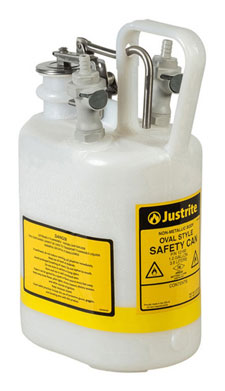
Keep your lab safe with HPLC Safety Cans from Safety Emporium.
Definition
Under the regulatory language of 29 CFR 1910.1200, the OSHA Hazard Communication Standard, a chemical name:
means the scientific designation of a chemical in accordance with the nomenclature system developed by the International Union of Pure and Applied Chemistry (IUPAC) or the Chemical Abstracts Service (CAS) rules of nomenclature, or a name that will clearly identify the chemical for the purpose of conducting a hazard classification.
The US EPA at 40 CFR § 721.3 uses a slightly different definition which refers to a "hazard evaluation" instead of a hazard classification.
Additional Info
IUPAC Names
In chemistry and other scientific fields, a chemical name identifies a chemical substance according to a standardized nomenclature system (set of rules), most commonly the one developed and maintained by the International Union of Pure and Applied Chemistry (IUPAC).
IUPAC nomenclature provides standardized methods for naming chemical substances. Because more than one name may conform to IUPAC rules for the same substance, IUPAC also provides rules for selecting a single preferred IUPAC name (PIN). IUPAC naming can be discussed in three contexts:
IUPAC name means any name that conforms to IUPAC nomenclature rules.
Preferred IUPAC name (PIN) is the single IUPAC name selected as preferred when more than one valid IUPAC name is possible. The PIN provides a preferred name for situations such as regulatory documents, legal documents, and databases where a consistent chemical name is desirable.
Systematic IUPAC name is a name constructed systematically from the structure of a compound according to IUPAC nomenclature rules. It can be distinguished from a retained name — a traditional or historical name that IUPAC continues to recognize.
Thus, every PIN is an IUPAC name, but not every valid IUPAC name is the PIN. A PIN will not necessarily be a systematic name. For example, acetic acid is a historical name for the compound whose systematic IUPAC name is ethanoic acid. However, IUPAC has retained acetic acid and selected it as the PIN.
Some common examples of retained names are:
| Compound | Familiar/retained name | Systematic name | Preferred IUPAC name (PIN) |
|---|---|---|---|
| CH3COOH | acetic acid | ethanoic acid | acetic acid |
| C6H5OH | phenol | benzenol | phenol |
| C6H6 | benzene | — | benzene |
Additional Names And Considerations
Other terms relating to chemical names are:
- Common name — a widely used name for a chemical other than its formal nomenclature-derived name. In the OSHA context, this is especially useful because HCS defines common name as
any designation or identification such as code name, code number, trade name, brand name or generic name used to identify a chemical other than by its chemical name.
- Synonym — an alternative name for the same chemical substance. A synonym could be another systematic name, a retained name, a common name, or in some circumstances a trade name. Thus, synonym describes the relationship between names rather than a particular nomenclature system.
- Brand name or trade name — a name assigned by a manufacturer or supplier to identify and market a particular product. For example, Clorox® is a brand name for products that may contain the chemical sodium hypochlorite.
- Generic name — a nonproprietary name used to identify a chemical or type of chemical product without reference to a particular brand. For example, bleach is a generic name for products sold under brand names such as Clorox® household chlorine bleach which typically contains sodium hypochlorite.
- Proper shipping names (PSN) are required by DOT and are discussed in the entry on NOS.
A common name or trade name describes the kind or origin of the name, whereas synonym indicates that two or more different names identify the same chemical substance. For example, 2-propanol, propan-2-ol, isopropyl alcohol, and isopropanol may all occur in chemical information sources. Their nomenclatural status differs, but in an SDS/database context they can function as synonyms because they identify the same substance.
SDS Relevance
The chemical name, common name, and synonyms are required information in Section 3 of a Safety Data Sheet under the HazCom Standard.
Paragraph (f)(1)(i) of the Standard requires a product identifier on every label. The product identifier will usually be the chemical name or trade name.

This guide to safer laboratories is available from Safety Emporium.
Further Reading
- A list of nomenclature "color books" published by IUPAC; each color covers a different area of chemistry.
- Brief Guides To Nomenclature published by IUPAC, cover the basics of organic, inorganic, and polymer nomenclature.
- IUPAC electronic databases.
- Naming Alkanes explains the nomenclature rules for this class of hydrocarbons. Similar tutorials can be found in the other chapters.
- Recommendations on Organic & Biochemical Nomenclature, Symbols & Terminology etc at Queen Mary University of London.
- Naming Organic Compounds in the Virtual Textbook of Organic Chemistry. Includes a quiz at the bottom of the page.
See also: CAS, chemical formula, NOS, product identifier, IUPAC, this SDS FAQ entry which addresses generic SDS's.