| The Home page of ILPI's Safety Data Sheet (SDS) Resource, the leader in SDS information since 1995! | |
| The history and philosophy behind this resource. | |
| A curated collection of books and reference materials concerning Safety Data Sheets and closely related topics. | |
| Paste your plain text SDS into the SDS-Demystifier, and it will be converted into a hypertext-enriched document with links to detailed explanations of each key term. | |
| An extensive list of frequently asked questions about Safety Data Sheets including regulations, content, compliance, and more. | |
| A humorous take on Safety Data Sheet jargon. Fill in the blanks on our entry form to generate a personalized Unsafety Data Sheet to share with your coworkers. | |
| Since 1995, we've maintained this massive curated list of the best places to find Safety Data Sheets on the Internet. | |
| Way more than a glossary, this hypertext-enhanced resource covers hundreds of SDS-related terms and expert knowledge. Each entry includes both the SDS relevance and links to additional authoritative resources. | |
| Archived results of Safety Data Sheet related polls taken by some of our millions of site visitors | |
| You are here! The OSHA regulations behind SDS regulations, including the inspection guidelines and over 400 official interpretations letters under the Hazard Communication Standard | |
| Commercial suppliers of SDS authoring and management software as well as cloud compliance services. | |
| Commercial companies that will create SDS's for your specific needs as well as SDS translation companies. |

Safety signs, banners, and scoreboards? Get yours at Safety Emporium!
OSHA Hazard Communication Letters of Interpretation
Interim Guidance on Enforcement of the revised Hazard Communication Standard
- Issued
- Record type
- Interpretation
- Historical standard
- HCS 2012 (historical)
- Current standard
- HCS 2024, as amended
ILPI assessment: Historical HCS 2012 implementation guidance
The December 1, 2013 training deadline and its interim enforcement instructions are historical. They do not establish current compliance dates or a current grace period. Employers still must provide effective HazCom information and training, including how to understand labels and SDSs.
Use the current effective-date provisions for HCS 2024 implementation and current HCS inspection guidance rather than the superseded directives cited here. Any present violation classification depends on its facts and current enforcement guidance; the memo is not a promise that training violations will be non-serious.
Last reviewed: .
About this ILPI assessment
This comparison with current requirements is not a finding that OSHA has formally withdrawn this letter. This assessment reflects editorial judgment informed by human review and AI assistance. It is an opinion, may contain errors or omissions, and is not an official OSHA determination. For guidance on how OSHA requirements apply to your circumstances, contact your local OSHA office.
OSHA's notice about interpretation letters
The following notice is published on OSHA's interpretation pages; it is general guidance, not a letter-specific withdrawal notice.
OSHA requirements are set by statute, standards and regulations. Our interpretation letters explain these requirements and how they apply to particular circumstances, but they cannot create additional employer obligations. This letter constitutes OSHA's interpretation of the requirements discussed. Note that our enforcement guidance may be affected by changes to OSHA rules. Also, from time to time we update our guidance in response to new information. To keep apprised of such developments, you can consult OSHA's website at https://www.osha.gov.
Source: OSHA's original letter page.
December 2, 2013
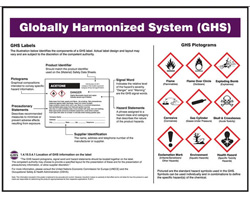
Ensure your workers are trained with safety posters and more from Safety Emporium.
MEMORANDUM FOR: REGIONAL ADMINISTRATORS
THROUGH: DOROTHY DOUGHERTY, Acting Deputy Assistant Secretary
FROM: THOMAS GALASSI, Director, Directorate of Enforcement Programs
SUBJECT: Interim Guidance on Enforcement of the revised Hazard Communication Standard
Although the revised Hazard Communication Standard (HCS 2012 [ILPI: Original HCS 2012 context · Current HCS]) does not become fully implemented until June 1, 2016, some provisions are already in effect or will soon be in effect (e.g., training). Per 29 CFR 1910.1200(j)(1) [ILPI: Original HCS 2012 context · Current HCS; historical HCS 2012 implementation dates], by December 1, 2013, all employers whose employees are potentially exposed to hazardous chemicals must provide training on the revised HCS label elements [ILPI: Original HCS 2012 context · Current HCS] and the new format [ILPI: Original HCS 2012 context · Current HCS] and types of information on each section of safety data sheets (SDSs). The purpose of this training is to ensure that when employees begin to see HCS 2012 [ILPI: Original HCS 2012 context · Current HCS] compliant labels and SDSs in their workplaces, they understand how to use them and access the information effectively. The Office of Health Enforcement is developing a revised Compliance Directive to outline procedures and policies for the new standard. This memo provides interim guidance to Compliance Safety and Health Officers (CSHOs) on the December 1, 2013, implementation date. Beginning December 2, 2013, if an employer has not provided the training required by the HCS, citations shall be issued for training deficiencies under 1910.1200(h) of HCS 2012 [ILPI: Original HCS 2012 context · Current HCS]. The following is a brief outline of the expectations on or after December 1, 2013, for all employers covered by the standard:
[ILPI note: At issuance: HCS 2012. This was the HCS 2012 training deadline. Current training duties and implementation dates apply today. Historical citations to CPL 2-2.38D and the 2011 FOM are not current enforcement instructions.]
- Employers must train all potentially exposed employees on the new label elements [ILPI: Original HCS 2012 context · Current HCS] (e.g., pictograms and signal words) and the new SDS format [ILPI: Original HCS 2012 context · Current HCS] (i.e., the section order and the type of information contained within each section) by this date.
- This compliance date does not change or increase the existing HCS requirement that employees be trained on the hazards of the chemicals in their work area.
- Prior to December 1, 2013, no citation will be issued to a company for not conducting training on the new information even if the company has received new labels and SDSs prior to the December 1, 2013 deadline.
- After December 1, 2013, employers that have not provided the updated training on SDSs and labels may be cited under 1910.1200(h)(3)(iv) of HCS 2012 [ILPI: Original HCS 2012 context · Current HCS] .
The National Office is also providing the attached frequently asked questions concerning the December 1, 2013, effective date. If you have any questions, please contact Mary Reynolds or Sven Rundman in the Office of Health Enforcement. Ms. Reynolds may be reached at reynolds.mary@dol.gov or 202-693-2187 and Mr. Rundman may be reached at rundman.sven@dol.gov or 202-693-2585.
Attachment
FREQUENTLY ASKED QUESTIONS ABOUT THE DECEMBER 1, 2013 IMPLEMENTATION DATE
- Is there a grace period for the December 1, 2013 training?
- Who needs to be trained?
- What do employers need to cover in this training?
- Do employers have to do training even if they have not received new SDSs or labels?
- If an employer has received SDSs and new labels prior to December 1, 2013, should a citation be issued if they have not provided training on the new label elements [ILPI: Original HCS 2012 context · Current HCS] and SDS format and content [ILPI: Original HCS 2012 context · Current HCS]?
- How does the December 1, 2013, implementation date affect other training citations?
- Should a citation of 1910.1200(j)(1) [ILPI: Original HCS 2012 context · Current HCS; historical HCS 2012 implementation dates] be issued as a serious violation or an other-than-serious violation?
- Do state plan states need to comply with the December 1, 2013, deadline?
- What resources are available?
No. HCS 2012 [ILPI: Original HCS 2012 context · Current HCS] was published as a final rule on March 26, 2012, and therefore, employers were provided adequate time to create and implement this training. See 29 CFR 1910.1200(j) [ILPI: Original HCS 2012 context · Current HCS; historical HCS 2012 implementation dates], Effective Dates. Compliance Safety and Health Officers (CSHOs) may issue citations starting on December 2, 2013, for not providing this updated training.
The scope of the standard has not changed. All employees who are potentially exposed to hazardous chemicals during normal conditions of use or in a foreseeable emergency must be trained.
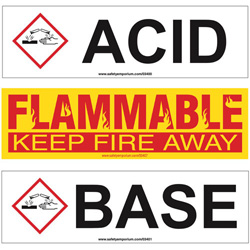
Protect your employees with cabinet labels from Safety Emporium.
Employers need to address the label elements [ILPI: Original HCS 2012 context · Current HCS] (product identifier, precautionary statements, hazard statements, pictograms, signal word, and manufacturer information), and the new SDS format [ILPI: Original HCS 2012 context · Current HCS] (e.g., Section 8 [ILPI: Original HCS 2012 context · Current HCS] is Exposure Controls/Personal Protection and will contain the PELs, TLVs, appropriate engineering controls and the recommended personal protective equipment). Employers also need to ensure that employees understand how to effectively access the appropriate hazard information on the updated labels and SDSs. This training supplements the rest of the employer's required HCS training, it is not a replacement.
Yes. This training ensures employees are aware of the new hazard information that manufacturers, importers and distributors will be providing under HCS 2012 [ILPI: Original HCS 2012 context · Current HCS].
No. Employers must provide the updated training by December 1, 2013. There is no requirement to provide training on the new information prior to that date. This does not change the requirement to provide training to employees on the hazards of the chemicals to which employees are potentially exposed. CSHOs must follow the requirements of the CPL 02-02-038, Inspection Procedures for the Hazard Communication Standard, March 20, 1998 [ILPI: Original CPL 2-2.38D (1998) · Current HCS inspection guidance] , concerning any training violation.
This implementation date does not affect any other training citation. CSHOs must follow CPL 2-2.38D, Inspection Procedures for the Hazard Communication Standard, March 20, 1998 [ILPI: Original CPL 2-2.38D (1998) · Current HCS inspection guidance] , when evaluating training and issue citations according to the information outlined in the directive. After December 1, 2013, training on the label elements [ILPI: Original HCS 2012 context · Current HCS] and SDS format [ILPI: Original HCS 2012 context · Current HCS] must be included in all employers' Hazard Communication training.
A citation may not be issued for 1910.1200(j)(1) [ILPI: Original HCS 2012 context · Current HCS; historical HCS 2012 implementation dates]; the citation must be issued under 1910.1200(h)(3)(iv) [ILPI: Original HCS 2012 context · Current HCS].
The classification of the violation must be done in accordance with CPL 02-02-038, Inspection Procedures for the Hazard Communication Standard, March 20, 1998 [ILPI: Original CPL 2-2.38D (1998) · Current HCS inspection guidance] , and CPL 02-00-150, Field Operations Manual (FOM), April 22, 2011 [ILPI: Original 2011 FOM (PDF) · Current FOM] . OSHA does not anticipate that the failure to train on the new SDS [ILPI: Original HCS 2012 context · Current HCS] and label format [ILPI: Original HCS 2012 context · Current HCS] would contribute to a potential serious exposure, and therefore would likely be classified as other-than-serious. However, if the training deficiency can contribute to a potential exposure capable of causing death or serious physical harm, the citation may be classified as serious.
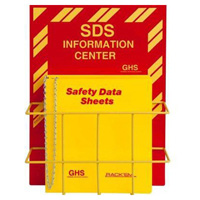
Your employees can stay informed and safety-ready with right to know stations and labels from Safety Emporium.
There are 22 states and jurisdictions operating complete
State Plans which cover both the private sector and state and local government
employees, and five that cover state and local government employees only. Each
State Plan must set occupational safety and health standards that are at least
as effective as comparable federal standards. The majority of the State Plans
have elected to adopt the revised Hazard Communications standard identically to
OSHA's standard, which would include the December 1, 2013 training
requirement. More information on the State Plans can be found at: https://www.osha.gov/stateplans https://www.osha.gov/stateplans.
Information concerning HCS 2012 [ILPI: Original HCS 2012 context · Current HCS] can be found at https://www.osha.gov/dsg/hazcom/index.html https://www.osha.gov/hazcom.
On this page there is a fact sheet concerning the December 1, 2013 training requirements,
two downloadable presentations concerning HCS 2012 [ILPI: Original HCS 2012 context · Current HCS], links to webinars performed by OSHA staff, as well as other resources for the revised HCS.
The original official public domain version of this document is available from OSHA at https://www.osha.gov/laws-regs/standardinterpretations/2013-12-02.