| The Home page of ILPI's Safety Data Sheet (SDS) Resource, the leader in SDS information since 1995! | |
| The history and philosophy behind this resource. | |
| A curated collection of books and reference materials concerning Safety Data Sheets and closely related topics. | |
| Paste your plain text SDS into the SDS-Demystifier, and it will be converted into a hypertext-enriched document with links to detailed explanations of each key term. | |
| An extensive list of frequently asked questions about Safety Data Sheets including regulations, content, compliance, and more. | |
| A humorous take on Safety Data Sheet jargon. Fill in the blanks on our entry form to generate a personalized Unsafety Data Sheet to share with your coworkers. | |
| Since 1995, we've maintained this massive curated list of the best places to find Safety Data Sheets on the Internet. | |
| Way more than a glossary, this hypertext-enhanced resource covers hundreds of SDS-related terms and expert knowledge. Each entry includes both the SDS relevance and links to additional authoritative resources. | |
| Archived results of Safety Data Sheet related polls taken by some of our millions of site visitors | |
| You are here! The OSHA regulations behind SDS regulations, including the inspection guidelines and over 400 official interpretations letters under the Hazard Communication Standard | |
| Commercial suppliers of SDS authoring and management software as well as cloud compliance services. | |
| Commercial companies that will create SDS's for your specific needs as well as SDS translation companies. |

Safety signs, banners, and scoreboards? Get yours at Safety Emporium!
OSHA Hazard Communication Letters of Interpretation
HCS classification and labeling requirements for products containing crystalline silica
- Issued
- Record type
- Interpretation
- Historical standard
- HCS 2012 (historical)
- Current standard
- HCS 2024, as amended
ILPI assessment: Generally consistent; distinguish classification from exposure compliance
The central point remains useful: a wet paste is not automatically exempt if normal or reasonably anticipated downstream sanding can generate respirable crystalline silica. Hazard classification must consider the relevant evidence and applicable carcinogenicity criteria, including below-cutoff hazards where the criteria require it.
No universal requirement to conduct new testing means neither that available evidence can be ignored nor that every test method is acceptable. The letter’s comments on the status of a particular 2010 method are historical, not a current finding about that method. Actual exposure controls and monitoring under the silica standard are separate from SDS/label classification.
Last reviewed: .
About this ILPI assessment
This comparison with current requirements is not a finding that OSHA has formally withdrawn this letter. This assessment reflects editorial judgment informed by human review and AI assistance. It is an opinion, may contain errors or omissions, and is not an official OSHA determination. For guidance on how OSHA requirements apply to your circumstances, contact your local OSHA office.
OSHA's notice about interpretation letters
The following notice is published on OSHA's interpretation pages; it is general guidance, not a letter-specific withdrawal notice.
OSHA requirements are set by statute, standards and regulations. Our interpretation letters explain these requirements and how they apply to particular circumstances, but they cannot create additional employer obligations. This letter constitutes OSHA's interpretation of the requirements discussed. Note that our enforcement guidance may be affected by changes to OSHA rules. Also, from time to time we update our guidance in response to new information. To keep apprised of such developments, you can consult OSHA's website at https://www.osha.gov.
Source: OSHA's original letter page.
February 10, 2015
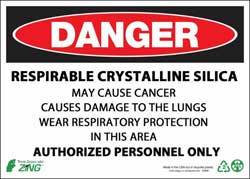
Get your OSHA Danger signs from Safety Emporium.
David Cawthon, Ph.D.
Center for Toxicology and Environmental Health, LLC
5120 North Shore Drive
North Little Rock, Arkansas 72118
Dear Dr. Cawthon:
Thank you for your March 4, 2014, letter to the Occupational Health and Safety Administration's (OSHA) Directorate of Enforcement Programs. Your questions concern classification and labeling requirements [ILPI: Original HCS 2012 context · Current HCS] under the Hazard Communication Standard (HCS 2012), 29 CFR 1910.1200 [ILPI: Original HCS 2012 context · Current HCS], for products containing crystalline silica. This letter constitutes OSHA's interpretation only of the requirements herein, and may not be applicable to any questions not delineated within your original correspondence. Your paraphrased questions and our responses are below.
Background: Joint compound and texture products that contain crystalline silica, an International Agency for Research on Cancer (IARC) Group 1 Carcinogen, are applied over wallboard to embed drywall tape, fasteners, metal corner beads, and drywall trims. These products can be sold as a dry powder or ready-to-apply pastes. After many of these products have been applied and allowed to dry the surfaces are typically sanded prior to finishing. During sanding, airborne dusts containing crystalline silica can be generated.
Question 1: What specific testing is necessary to determine that these products do not need to be classified or labeled as a Category 1 or Category 2 carcinogen?
Response: OSHA's HCS 2012 [ILPI: Original HCS 2012 context · Current HCS] standard does not require testing to determine a particular chemical's hazard classification. See Appendix A, Chapter A.0.2.1, of HCS 2012 [ILPI: Original HCS 2012 context · Current HCS] for further information. Criteria for the classification of carcinogens is found in Chapter A.6 [ILPI: Original HCS 2012 context · Current HCS], Carcinogenicity, and additional guidance for classifying carcinogens is located in Appendix F (non-mandatory) to HFCS 2012 [ILPI: Original HCS 2012 context · Current HCS].
Question 2: Is the classification of a mixture containing crystalline silica content based on the total silica content or the respirable silica content in the bulk product?
Response: The classification is based on the total crystalline silica by weight or volume in the mixture. As OSHA explained in its 1991 Lapp letter of interpretation (enclosed), this is because a mixture may contain silica particles that are not respirable, but can become respirable during normal conditions of use or foreseeable emergencies (e.g. blasting or grinding). Note that under HCS 2012 [ILPI: Original HCS 2012 context · Current HCS], a mixture containing at least one ingredient that has been classified as a carcinogen must be classified as a carcinogen when the mixture contains 0.1 percent or more total of the carcinogenic ingredient(s). See Appendix A, A.6.3.1 of HCS 2012 [ILPI: Original HCS 2012 context · Current HCS]. Additionally, if the mixture contains less than 0.1 percent of the carcinogenic ingredient but the classifier has information that the hazard of the ingredient will be evident (e.g. could be emitted at a level above an OSHA permissible exposure limit or action level), the mixture must be classified accordingly. See Appendix A, A.0.4.3.2 of HCS 2012 [ILPI: Original HCS 2012 context · Current HCS].
Question 3: Is the Industrial Minerals Association - Europe (IMA-EU) Size Weighted Respirable Fraction (SWeRF) (February 2010) fact sheet, which provides a method for evaluating the respirable silica content in bulk materials, representative of an acceptable test?
Response: As explained in the response to Question 1, the HCS [ILPI: Original HCS 2012 context · Current HCS] does not require testing in order to classify a chemical, but test methods relied upon must be "scientifically validated." See Appendix A, A.0.2.2 [ILPI: Original HCS 2012 context · Current HCS]. Under A.0.2.3 [ILPI: Original HCS 2012 context · Current HCS], "scientifically validated" "refers to the process by which the reliability and the relevance of a procedure are established for a particular purpose. Any test that determines hazardous properties, which is conducted according to recognized scientific principles, can be used for the purpose of a hazard determination for health hazards. Test conditions need to be standardized so that the results are reproducible with a given substance, and the standardization test yields "valid" data for defining the hazard class of concern." The IMA-EU SWeRF fact sheet indicates that the methodology will be submitted to the European Committee for Standardization (CEN) for standardization, but its current status is not specified. It therefore does not appear that the test method has been "scientifically validated."
Moreover, in classifying chemicals under the HCS [ILPI: Original HCS 2012 context · Current HCS], manufacturer2 must consider the hazards posed by the chemical under normal conditions of use and foreseeable emergencies. 29 CFR 1910.1200(b)(2) [ILPI: Original HCS 2012 context · Current HCS]. It is unclear whether the IMA-EU SWeRF methodology incorporates this concept.
Question 4: Is ready-to-apply paste that does not produce airborne silica classified the same as a dry product that does produce airborne silica?
Response: When classifying a chemical, manufacturers, importers or responsible parties must comply with all the information in Appendices A and B of HCS 2012 [ILPI: Original HCS 2012 context · Current HCS]. Specifically, the classification should start with Chapter A.0 [ILPI: Original HCS 2012 context · Current HCS], General Classification Considerations, as this chapter provides requirements on the appropriate data to use in determining a chemical's classification. In A.0.2 [ILPI: Original HCS 2012 context · Current HCS], Available Data, Test Methods and Test Data Quality, A.0.2.3 [ILPI: Original HCS 2012 context · Current HCS] defines the term "scientifically validated" as it relates to data used in classification. In addition, A.0.2.5 [ILPI: Original HCS 2012 context · Current HCS] and A.0.2.6 [ILPI: Original HCS 2012 context · Current HCS] discuss the type of data used and the use of epidemiological data and experience. In A.0.3 [ILPI: Original HCS 2012 context · Current HCS], Classification Based on Weight of Evidence, A.0.3.2 [ILPI: Original HCS 2012 context · Current HCS] discusses evaluating the quality and consistency of the data. Under Appendix A, A.0.4.1 of HCS 2012 [ILPI: Original HCS 2012 context · Current HCS], the classification sequence is specified for mixtures. For a mixture containing an ingredient that poses a carcinogen hazard, A.6.3.1 [ILPI: Original HCS 2012 context · Current HCS] provides that the mixture shall be classified as a carcinogen when at least one ingredient has been classified as a Category 1 or Category 2 carcinogen and is present at or above the appropriate cut-off value/concentration limit specified in Table A.6.1 [ILPI: Original HCS 2012 context · Current HCS]. Table A.6.1 [ILPI: Original HCS 2012 context · Current HCS] sets the cut-off value at greater than or equal to 0.1 percent.
Accordingly, if the ready-to-apply paste and the dry mixture both contain 0.1 percent or more crystalline silica, both of the mixtures would be classified as carcinogens. And, as explained in the response to question 3, a manufacturer must consider an employee's potential exposure during normal conditions of use and foreseeable emergencies when classifying a chemical. 29 CFR 1910.1200(b)(2) [ILPI: Original HCS 2012 context · Current HCS].
Question 5: Is a product that is sanded in the course of normal use or expected misuse classified the same as a product that is not sanded?
Response: The requirements of the HCS [ILPI: Original HCS 2012 context · Current HCS] are triggered where a chemical is known to be present in the workplace in such a manner that employees may be exposed under normal conditions of use or in a foreseeable emergency.
29 CFR 1910.1200(b)(2) [ILPI: Original HCS 2012 context · Current HCS]. "Exposure" is defined as including potential (e.g. accidental or possible) exposure.
29 CFR 1910.1200(c) [ILPI: Original HCS 2012 context · Current HCS]. OSHA has interpreted this language as excluding substances for which the hazardous chemical is inextricably bound or is not readily available, and, therefore, presents no potential for exposure.
See CPL, 02-08-038, Appendix A [ILPI: Original CPL 2-2.38D (1998) · Current HCS inspection guidance] .
Accordingly, consistent with OSHA's longstanding position, whether there is a potential for exposure during sanding (or any other potential exposure during normal conditions of use or a foreseeable emergency) must be considered in classification. See OSHA's 1989 Polsinelli and 2008 Dingess letters of interpretation (enclosed).
Question 6: Does exposure testing affect classification?
[ILPI note: At issuance: HCS 2012. Current classification duties include known or reasonably anticipated downstream processing. Silica exposure limits and controls do not replace the carcinogenicity classification criteria.]
Response: No. As explained in OSHA's 2004 Keane letter of interpretation (enclosed), exposure testing and exposure calculations assess risk and are not permitted in determining whether a chemical is covered by the HCS [ILPI: Original HCS 2012 context · Current HCS].

Thank you for your interest in occupational safety and health. We hope you find this information helpful. OSHA's requirements are set by statute, standards, and regulations. Our letters of interpretation do not create new or additional requirements but rather explain these requirements and how they apply to particular circumstances. This letter constitutes OSHA's interpretation of the requirements discussed. From time to time, letters are affected when the Agency updates a standard, a legal decision impacts a standard, or changes in technology affect the interpretation. To assure that you are using the correct information and guidance, please consult OSHA's website at https://www.osha.gov. If you have further questions, please feel free to contact the Office of Health Enforcement at (202) 693-2190.
Sincerely,
Thomas Galassi, Director
Directorate of Enforcement Programs
Enclosures (4)
The original official public domain version of this document is available from OSHA at https://www.osha.gov/laws-regs/standardinterpretations/2015-02-10-0.