| The Home page of ILPI's Safety Data Sheet (SDS) Resource, the leader in SDS information since 1995! | |
| The history and philosophy behind this resource. | |
| A curated collection of books and reference materials concerning Safety Data Sheets and closely related topics. | |
| Paste your plain text SDS into the SDS-Demystifier, and it will be converted into a hypertext-enriched document with links to detailed explanations of each key term. | |
| An extensive list of frequently asked questions about Safety Data Sheets including regulations, content, compliance, and more. | |
| A humorous take on Safety Data Sheet jargon. Fill in the blanks on our entry form to generate a personalized Unsafety Data Sheet to share with your coworkers. | |
| Since 1995, we've maintained this massive curated list of the best places to find Safety Data Sheets on the Internet. | |
| Way more than a glossary, this hypertext-enhanced resource covers hundreds of SDS-related terms and expert knowledge. Each entry includes both the SDS relevance and links to additional authoritative resources. | |
| Archived results of Safety Data Sheet related polls taken by some of our millions of site visitors | |
| You are here! The OSHA regulations behind SDS regulations, including the inspection guidelines and over 400 official interpretations letters under the Hazard Communication Standard | |
| Commercial suppliers of SDS authoring and management software as well as cloud compliance services. | |
| Commercial companies that will create SDS's for your specific needs as well as SDS translation companies. |

Safety signs, banners, and scoreboards? Get yours at Safety Emporium!
OSHA Hazard Communication Letters of Interpretation
Requirements for labeling of food additives and intermediate chemicals under the revised Hazard Communication Standard (HCS 2012)
- Issued
- Record type
- Interpretation
- Historical HazCom standard
- HCS 2012
- Current HazCom standard
- HCS 2024, as amended
ILPI assessment: Label-only exemption distinction generally consistent
Its central HazCom conclusion remains consistent: an applicable FDA labeling exemption does not automatically remove SDS, classification or worker-training duties. Food approval or ordinary consumer safety does not by itself establish safety for concentrated industrial exposures. This letter interprets HCS 2012.
Apply the specific FDA-related label exemption and distinguish the full personal-consumption food exemption. Manufacturers/importers evaluate hazards under current classification and prepare required SDSs; using employers generally maintain supplier SDSs and provide effective information and training. Intermediates need their own coverage analysis, not an automatic exemption because a later product is a food additive.
OSHA source notice: [Corrected 1/7/2016]
Last reviewed: .
About this ILPI assessment
This comparison with current requirements is not a finding that OSHA has formally withdrawn this letter. This assessment reflects editorial judgment informed by human review and AI assistance. It is an opinion, may contain errors or omissions, and is not an official OSHA determination. For guidance on how OSHA requirements apply to your circumstances, contact your local OSHA office.
OSHA's notice about interpretation letters
The following notice is published on OSHA's interpretation pages; it is general guidance, not a letter-specific withdrawal notice.
OSHA requirements are set by statute, standards and regulations. Our interpretation letters explain these requirements and how they apply to particular circumstances, but they cannot create additional employer obligations. This letter constitutes OSHA's interpretation of the requirements discussed. Note that our enforcement guidance may be affected by changes to OSHA rules. Also, from time to time we update our guidance in response to new information. To keep apprised of such developments, you can consult OSHA's website at https://www.osha.gov.
Source: OSHA's original letter page.
May 26, 2015
Mr. James C. Lee
3E Company
4520 East West Highway, Ste. 440
Bethesda, Maryland 20814
Dear Mr. Lee:
Thank you for your February 10, 2015, letter to the Occupational Safety and Health Administration's (OSHA) Directorate of Enforcement Programs. In your letter you requested interpretation on the requirements for labeling of food additives and intermediate chemicals under the revised Hazard Communication Standard (HCS 2012), 29 CFR 1910.1200 [ILPI: Original HCS 2012 context · Current HCS]. This letter constitutes OSHA's interpretation only of the requirements herein, and may not be applicable to any questions not delineated within your original correspondence. Your paraphrased scenario and questions are presented below, followed by our responses.

Safety Emporium carries all kinds of eye/face washes, safety showers, drench hoses and more.
Scenario: A food and beverage manufacturer uses natural and artificial food additives, which are subject to premarket approval by the U.S. Food and Drug Administration (FDA). Some of the food additives and intermediate chemicals used at the workplace to produce the food and beverage products are hazardous to the workers when exposed. These food additives become edible only after being highly diluted in a final product.
Under 29 CFR 1910.1200(b)(5)(iii) [ILPI: Original HCS 2012 context · Current HCS], any "food additive" or "color additive," as those terms are defined in the Federal Food, Drug and Cosmetic (FD&C Act) (21 U.S.C. 301 et seq.), is exempt from the HCS 2012 labeling requirements when it is subject to the labeling requirements under the FD&C Act by the FDA.
However, FDA's labeling requirements for food additives include direction on safe uses and specific limitations governing the use of the chemical as a food additive; they do not address any occupational hazards associated with the use of food additives in the workplace. The FD&C Act is not intended for occupational hazard communication like the labeling under HCS 2012. In addition, some of the chemicals and food additives used in the manufacturing process have occupational exposure limits (OELs).
Question 1: Does the labeling exemption of HCS 2012 still apply to the food additives described above, having corrosiveness and inhalation hazards at high concentrations and high quantity as used in the workplace?
Response: Yes. Nothing in the revised HCS changes the scope of the labeling exemption found in 29 CFR 1910.1200(b)(5)(iii) [ILPI: Original HCS 2012 context · Current HCS] for foods subject to and labeled in accordance with the FD&C Act.
Question 2: Does the existence of OELs have any bearing on applying the labeling exemptions to food additives used during manufacturing?
Response: No. Labeling exemptions are granted for food additives and certain other substances that are defined in the FD&C Act and labeled in accordance with FDA regulations. See 29 CFR 1910.1200(b)(5)(iii) [ILPI: Original HCS 2012 context · Current HCS].
Question 3: Is the FDA's labeling for food additives adequate to protect workers from occupational injuries when it does not communicate any occupational hazards associated with the use of food additives in the workplace, nor contain a reference to safety data sheets (SDS)?
Response: The FDA's labeling requirements for food additives are to protect consumers. To the extent that workers are exposed to the substances in a manner comparable to that of ordinary consumers, there is no need for additional OSHA labeling requirements. OSHA recognizes, however, that there may be situations where worker exposure is significantly greater than that of consumers, and that under these circumstances, substances which are safe for contemplated consumer use may pose unique hazards in the workplace. For this reason, the standard's exclusion is limited to labeling; the HCS does not exempt employers from their obligations to train employees about chemical hazards in the workplace and to prepare and maintain SDSs. See 29 CFR 1910.1200(g) [ILPI: Original HCS 2012 context · Current HCS], (h) [ILPI: Original HCS 2012 context · Current HCS].
[ILPI note: Original HCS 2012 context · Current HCS. Current counterparts: FDA label exemption, classification, SDS duties and effective information and training. The personal-consumption food exemption is a different provision.]
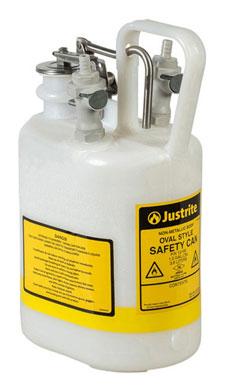
Keep your lab safe with HPLC Safety Cans from Safety Emporium.
Question 4: OSHA previously stated in a letter of interpretation to Dr. Shaun A. Gill, March 12,[1993], that FDA's granting approval to use iron oxide as a food colorant is not evidence that iron oxide dust is non-hazardous, and is not entirely relevant to occupational exposure from iron oxide. Therefore, is FDA's approval of food additives irrelevant to the potential hazardous exposures to workers using these food additives at a food and beverage manufacturing facility?
Response: The approval of food additives used in food and beverage manufacturing may or may not be relevant when evaluating occupational exposure. These products, even where exempt from HCS labeling requirements, must still be evaluated by chemical manufacturers and importers for hazard classification to comply with the requirements of HCS 2012. See 29 CFR 1910.1200(d) [ILPI: Original HCS 2012 context · Current HCS]. In addition, employers must prepare and maintain SDSs and provide information and training to employees about hazardous chemicals in the workplace. See 29 CFR 1910.1200(g) [ILPI: Original HCS 2012 context · Current HCS], (h) [ILPI: Original HCS 2012 context · Current HCS].
Question 5: Should the manufacturer treat these chemicals as industrial hazardous materials, rather than food additives, and apply the HCS 2012 labeling?
Response: See responses to Questions 1 and 4. HCS 2012 labeling requirements do not apply to food additives as defined by the FD&C Act, as long as those food additives are labeled in compliance with FDA requirements.
Question 6: Are intermediate hazardous chemicals used in the production of food additives subject to both the labeling and SDS requirements under HCS 2012?
Response: Yes, unless they are a food additive or color additive labeled under the FD&C Act. See responses to Questions 1 and 3.
Thank you for your interest in occupational safety and health. We hope you find this information helpful. OSHA requirements are set by statute, standards, and regulations. Our letters of interpretation do not create new or additional requirements but rather explain these requirements and how they apply to particular circumstances. This letter constitutes OSHA's interpretation of the requirements discussed. From time to time, letters are affected when the Agency updates a standard, a legal decision impacts a standard, or changes in technology affect the interpretation. To assure that you are using the correct information and guidance, please consult OSHA's website at http://www.osha.gov. If you have any further questions, please feel free to contact the Office of Health Enforcement at (202) 693-2190.
Sincerely,
Thomas Galassi, Director
Directorate of Enforcement Programs
[Corrected 1/7/2016]
The original official public domain version of this document is available from OSHA at https://www.osha.gov/laws-regs/standardinterpretations/2015-05-26.