| The Home page of ILPI's Safety Data Sheet (SDS) Resource, the leader in SDS information since 1995! | |
| The history and philosophy behind this resource. | |
| A curated collection of books and reference materials concerning Safety Data Sheets and closely related topics. | |
| Paste your plain text SDS into the SDS-Demystifier, and it will be converted into a hypertext-enriched document with links to detailed explanations of each key term. | |
| An extensive list of frequently asked questions about Safety Data Sheets including regulations, content, compliance, and more. | |
| A humorous take on Safety Data Sheet jargon. Fill in the blanks on our entry form to generate a personalized Unsafety Data Sheet to share with your coworkers. | |
| Since 1995, we've maintained this massive curated list of the best places to find Safety Data Sheets on the Internet. | |
| Way more than a glossary, this hypertext-enhanced resource covers hundreds of SDS-related terms and expert knowledge. Each entry includes both the SDS relevance and links to additional authoritative resources. | |
| Archived results of Safety Data Sheet related polls taken by some of our millions of site visitors | |
| You are here! The OSHA regulations behind SDS regulations, including the inspection guidelines and over 400 official interpretations letters under the Hazard Communication Standard | |
| Commercial suppliers of SDS authoring and management software as well as cloud compliance services. | |
| Commercial companies that will create SDS's for your specific needs as well as SDS translation companies. |

Safety signs, banners, and scoreboards? Get yours at Safety Emporium!
OSHA Hazard Communication Letters of Interpretation
HCS Labeling Requirements for Bulk Shipments of Small Packages
- Issued
- Record type
- Interpretation
- Historical standard
- HCS 2012 (historical)
- Current standard
- HCS 2024, as amended
ILPI assessment: Core shipping answer remains; current alternatives are conditional
The described packaged powder pillows still require appropriate immediate-container labeling when shipped between facilities. A package containing individual small containers is not a true bulk shipment without intermediate containment; electronic bulk-label transmission does not automatically apply.
Current small-container provisions allow reduced shipped labels only when full labels, pull-out labels, fold-back labels or tags are not feasible. The 100 mL and narrower 3 mL alternatives have specified immediate-container and outer-package requirements. Small size alone is not an exemption. The very-small-container alternative is limited to 3 mL or less and its other conditions; “less than 5 mL” alone does not establish eligibility. The current shipped-label elements also require U.S. responsible-party contact information.
Last reviewed: .
About this ILPI assessment
This comparison with current requirements is not a finding that OSHA has formally withdrawn this letter. This assessment reflects editorial judgment informed by human review and AI assistance. It is an opinion, may contain errors or omissions, and is not an official OSHA determination. For guidance on how OSHA requirements apply to your circumstances, contact your local OSHA office.
OSHA's notice about interpretation letters
The following notice is published on OSHA's interpretation pages; it is general guidance, not a letter-specific withdrawal notice.
OSHA requirements are set by statute, standards and regulations. Our interpretation letters explain these requirements and how they apply to particular circumstances, but they cannot create additional employer obligations. This letter constitutes OSHA's interpretation of the requirements discussed. Note that our enforcement guidance may be affected by changes to OSHA rules. Also, from time to time we update our guidance in response to new information. To keep apprised of such developments, you can consult OSHA's website at https://www.osha.gov.
Source: OSHA's original letter page.
July 25, 2019
Mr. James Lee
Senior Compliance Analyst
Hach Company
5600 Lindbergh Dr.
Loveland, Colorado 80538
Dear Mr. Lee:

Get your GHS-compliant labels and signs from Safety Emporium.
Thank you for your letter and follow up email to the Occupational Safety and Health Administration 's (OSHA) Directorate of Enforcement Programs, regarding labeling requirements under OSHA 's Hazard Communication Standard [ILPI: Original HCS 2012 context · Current HCS] (HCS), 29 CFR 1910.1200. This letter constitutes OSHA 's interpretation only of the requirements herein and may not be applicable to any situation not delineated within your original response. Your question is summarized below, followed by our reply.
Background: Your company manufactures buffer and reagent chemicals and packages these chemicals in small plastic powder pillows (less than 5 ml in capacity) measuring approximately 1.125 inch x 0.6 inch in size. The labels used for these powder pillows are in accordance to OSHA 's small package “practical accommodation” which involves having each powder pillow (immediate container) display the product identifier, signal word, pictogram, company name, and telephone number.
One of your facilities is nearing its maximum processing capacity for labeling powder pillows and you wish to ship unlabeled powder pillows in bulk packages from this facility to a second facility for HCS [ILPI: Original HCS 2012 context · Current HCS] compliant labeling. You referred to existing guidance that allows use of the Department of Transportation 's (DOT) label in lieu of OSHA 's HCS labeling on exterior packaging (shipping containers) for bulk shipments of hazardous chemicals. You inquired whether that approach would be acceptable for bulk shipment of unlabeled powder pillows to your second facility.
Question: Can a manufacturer wait to affix HCS [ILPI: Original HCS 2012 context · Current HCS] labels to the immediate containers of hazardous chemicals until after an intra-company shipment has taken place, but prior to final processing and shipment to customers?
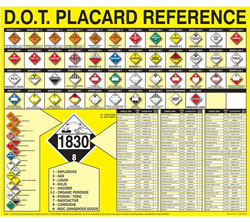
DOT shipping signs and labels plus a host of safety and compliance posters are available at Safety Emporium.
Reply: No. OSHA 's HCS [ILPI: Original HCS 2012 context · Current HCS] requires that each container of hazardous chemicals leaving the workplace is labeled, tagged, or marked in accordance with 29 CFR 1910.1200(f)(1)(i) [ILPI: Original HCS 2012 context · Current HCS]-(vi) . OSHA has reviewed your requested alternative approach to HCS labeling of the powder pillows after intra-company shipment to a second facility and finds it unacceptable. You state that you are shipping small containers of “work in progress” chemicals, however, OSHA views the unlabeled packaged powder pillows as immediate containers being shipped without proper HCS labeling. OSHA 's HCS labeling requirements are meant to be applied to the container that immediately holds the hazardous substance. So, the “practical accommodation” for HCS labeling of small packages is intended to be applied to the immediate containers when the outside packaging complies with all the applicable label elements, as defined in 29 CFR 1910.1200(f)(1) [ILPI: Original HCS 2012 context · Current HCS], before leaving the originating facility. This is to assure that HCS labeling of hazardous chemicals are in place in the event of an accident at any point during or after shipping it from the facility of origin.
[ILPI note: At issuance: HCS 2012. Compare current small-container conditions and the separate bulk-shipment provision. Packaging small containers together does not turn them into a bulk chemical shipment.]
As you noted in your letter, there is a joint DOT/OSHA guidance on bulk shipments which allows “either labeling the immediate container with hazard information or transmitting the required label with shipping papers, bills of lading, or by other technological or electronic means so that it is immediately available to workers in printed form on the receiving end of a shipment.” This guidance applies only to bulk shipments of hazardous chemicals that are loaded into large primary containers (i.e., tanker trucks or rail car) that have no intermediate form of containment. As the powder pillows are an immediate container or in this case an intermediate container to the external shipping container, each powder pillow must have an HCS [ILPI: Original HCS 2012 context · Current HCS] compliant label. To further point out, OSHA has not adopted the DOT definition of bulk packaging as equivalent to HCS 2012 compliant bulk shipment as detailed in the guidance.
Thank you for your interest in occupational safety and health. We hope you find this information helpful. OSHA 's requirements are set by statute, standards, and regulations. Our letters of interpretation do not create new or additional requirements but rather explain these requirements and how they apply to particular circumstances. This letter constitutes OSHA 's interpretation of the requirements discussed. From time to time, letters are affected when the Agency updates a standard, a legal decision impacts a standard, or changes in technology affect the interpretation. To ensure that you are using the correct information and guidance, please consult OSHA 's website at http://www.osha.gov. If you have further questions, please feel free to contact the Office of Health Enforcement at (202) 693-2190.
Sincerely,
Patrick J. Kapust, Acting Director
Directorate of Enforcement Programs
The original official public domain version of this document is available from OSHA at https://www.osha.gov/laws-regs/standardinterpretations/2019-07-25-1.