| The Home page of ILPI's Safety Data Sheet (SDS) Resource, the leader in SDS information since 1995! | |
| The history and philosophy behind this resource. | |
| A curated collection of books and reference materials concerning Safety Data Sheets and closely related topics. | |
| Paste your plain text SDS into the SDS-Demystifier, and it will be converted into a hypertext-enriched document with links to detailed explanations of each key term. | |
| An extensive list of frequently asked questions about Safety Data Sheets including regulations, content, compliance, and more. | |
| A humorous take on Safety Data Sheet jargon. Fill in the blanks on our entry form to generate a personalized Unsafety Data Sheet to share with your coworkers. | |
| Since 1995, we've maintained this massive curated list of the best places to find Safety Data Sheets on the Internet. | |
| You are here! Way more than a glossary, this hypertext-enhanced resource covers hundreds of SDS-related terms and expert knowledge. Each entry includes both the SDS relevance and links to additional authoritative resources. | |
| Archived results of Safety Data Sheet related polls taken by some of our millions of site visitors | |
| The OSHA regulations behind SDS regulations, including the inspection guidelines and over 400 official interpretations letters under the Hazard Communication Standard | |
| Commercial suppliers of SDS authoring and management software as well as cloud compliance services. | |
| Commercial companies that will create SDS's for your specific needs as well as SDS translation companies. |

Safety signs, banners, and scoreboards? Get yours at Safety Emporium!
Bulk Shipment
Definition
Under Paragraph (c) of 29 CR 1910.1200, the OSHA Hazard Communication Standard, a bulk shipment means any
hazardous chemical transported where the mode of transportation comprises the immediate container (i.e., contained in tanker truck, rail car, or intermodal container).
This definition was added to the Standard starting with HCS 2024, and was not defined in the the previous version, HCS 2012.
Additional Information
OSHA provides additional guidance on bulk shipments as they apply to tanker truck and railroad tank cars under HCS 2024 in paragraph X.F.3.c of Directive Number CPL 02-02-079.

We've got your DOT number at Safety Emporium with DOT placards, NFPA labels and more!
The OSHA definition of bulk shipment is more narrow than many common definitions as OSHA has no jurisdiction over transportation unless a hazardous chemical is involved. For example, the commercial carrier, UPS, defines bulk cargo thusly: Cargo that is shipped loosely and unpackaged in large quantities (as opposed to being shipped in packages or containers). Bulk Cargo is typically dropped or poured directly into a railway car, tanker truck or the hold of a ship. Bulk cargo can be classified as either liquid or dry. Some common examples of bulk cargo include oil, grains and coal.
Most definitions of the term generally agree on the following points:
- No packaging. The items are moved unpacked for efficiency, saving money and space.
- Special equipment. The process of bulk shipment requires cranes, hoists, pumps, hoses, conveyers and the like.
- High volume. The materials are usually raw materials that move in high volume such as raw materials like ore or industrial commodities such as oil and hydrocarbons.
Bulk shipments can be broken down into three general classes:
- Dry bulk are solid materials like grain, coal, sand, ore, and cement shipped loose.
- Liquid bulk are fluids like crude oil, liquid chemicals, and refined fuels carried in large tanks such as railcars and ocean tankers.
- Gas bulk are typically liquified gases such as liquefied natural gas (LNG) kept in special pressurized tanks.
Note that OSHA does not define bulk packaging, only bulk shipment. A bulk shipment may contain one or more bulk packages (or no packaging at all, of course) as defined by the US Department of Transportation at 49 CFR § 171.8:
Bulk packaging means a packaging, other than a vessel or a barge, including a transport vehicle or freight container, in which hazardous materials are loaded with no intermediate form of containment. A Large Packaging in which hazardous materials are loaded with an intermediate form of containment, such as one or more articles or inner packagings, is also a bulk packaging. Additionally, a bulk packaging has:
A maximum capacity (maximum inner volume greater than 450 L (119 gallons) as a receptacle for a liquid;
A maximum net mass greater than 400 kg (882 pounds) and a maximum capacity greater than 450 L (119 gallons) as a receptacle for a solid; or
A water capacity greater than 454 kg (1000 pounds) as a receptacle for a gas as defined in § 173.115 of this subchapter.
SDS Relevance
OSHA addresses bulk shipments in the labeling requirement of HCS 2024. Specifically, paragraph (f)(5)(ii) states:
The label for bulk shipments of hazardous chemicals must be on the immediate container, transmitted with the shipping papers or the bills of lading, or, with the agreement of the receiving entity, transmitted by technological or electronic means so that it is immediately available to workers in printed form on the receiving end of shipment.
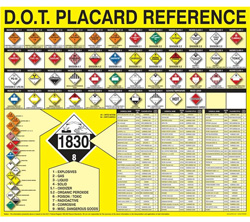
DOT shipping signs and labels plus a host of safety and compliance posters are available at Safety Emporium.
With respect to Safety Data Sheets, a key point is that transport of goods falls under the jurisdiction of the US Department of Transportation, not OSHA. Therefore, while US SDSs are required to have a Section 14 devoted to transport information, this section is non-mandatory. Canada's regulations work similarly. Because this information is not required by law, the manufacturer can meet their OSHA requirements simply by putting "N/A" or "not applicable" in Section 14 if they choose; the only requirement is that this section cannot not left blank.
However, some other countries do require this data under their implementation of the GHS model system. For example, the European Union requires this data under REACH as does Australia, Singapore and (effectively) New Zealand.
Therefore, it behooves most manufacturers to include this information so they don't have to maintain two versions of their SDS's - one for domestic and one or more for other countries. This is true whether or not the shipments are bulk.
A good SDS will list the following sort of data in section 14:
- UN number
- UN proper shipping name;
- Transport hazard class(es);
- Packing group, if applicable;
- Environmental hazards (e.g., Marine pollutant (Yes/No));
- Transport in bulk (according to IMO instruments)
- Special precautions which a user needs to be aware of, or needs to comply with, in connection with transport or conveyance either within or outside their premises
Further Reading
- OSHA has issued several Interpretation Letters on the subject of bulk shipment with respect to the HazCom Standard; some of this guidance has been incorporated into the Standard as it has evolved into its current version.
- Application of the HCS to non-manufacturing scrap dealers who collect waste metal for resale (May 23, 1986).
- Labeling requirements for bulk shipments of metallic scrap under the HCS (Aug 11, 1986).
- HCS Labeling Requirements for Bulk Shipments of Small Packages (Jul 25, 2019).
- Transmitting bulk shipment labels by technological or other means (Nov 9, 2022).
- Labeling of Hazardous Chemicals for Bulk Shipments, a joint memorandum from OSHA and the US Pipeline and Hazardous Materials Safety Administration (PHMSA).
- 49 CFR 172.514 - Bulk Packagings covers DOT regulations on the placarding of hazardous materials.
- How to Comply with Federal Hazardous Materials Regulations at the US Federal Motor Carrier Safety Administration.
See also: DOT, pictogram, UN and NA numbers.