| The Home page of ILPI's Safety Data Sheet (SDS) Resource, the leader in SDS information since 1995! | |
| The history and philosophy behind this resource. | |
| A curated collection of books and reference materials concerning Safety Data Sheets and closely related topics. | |
| Paste your plain text SDS into the SDS-Demystifier, and it will be converted into a hypertext-enriched document with links to detailed explanations of each key term. | |
| An extensive list of frequently asked questions about Safety Data Sheets including regulations, content, compliance, and more. | |
| A humorous take on Safety Data Sheet jargon. Fill in the blanks on our entry form to generate a personalized Unsafety Data Sheet to share with your coworkers. | |
| Since 1995, we've maintained this massive curated list of the best places to find Safety Data Sheets on the Internet. | |
| Way more than a glossary, this hypertext-enhanced resource covers hundreds of SDS-related terms and expert knowledge. Each entry includes both the SDS relevance and links to additional authoritative resources. | |
| Archived results of Safety Data Sheet related polls taken by some of our millions of site visitors | |
| You are here! The OSHA regulations behind SDS regulations, including the inspection guidelines and over 400 official interpretations letters under the Hazard Communication Standard | |
| Commercial suppliers of SDS authoring and management software as well as cloud compliance services. | |
| Commercial companies that will create SDS's for your specific needs as well as SDS translation companies. |

Safety signs, banners, and scoreboards? Get yours at Safety Emporium!
CPL 02-02-079, Appendix A
Table of Contents for Appendices A and B of the 2024 Hazard Communication Standard
Directive Table of Contents | Next: Appendix B
This list is provided for easy reference to the chapters of Appendices A and B of the [2024] Hazard Communication Standard (HCS). This Appendix provides CSHOs with an easy way to quickly find the appropriate chapters when reviewing the classification of chemicals. Please review each chapter of the Appendices to the HCS as needed. Note: This list does not contain all subheadings included in Appendices A and B.
Appendix A: Health Hazard Criteria
- A.0 General Classification Considerations
- A.0.1: Classification
- A.0.2: Available data, test methods and test data quality
- A.0.3: Classification based on weight of evidence
- A.0.4: Considerations for the classification of mixtures
- A.0.5: Bridging principles for the classification of mixtures where test data are not available for the complete mixture
- A.0.5.1.1: Dilution
- A.0.5.1.2: Batching
- A.0.5.1.3: Concentration of mixtures
- A.0.5.1.4: Interpolation within one hazard category
- A.0.5.1.5: Substantially similar mixtures
- A.0.5.1.6: Aerosols
Protect your workers in cold weather with ADA-compliant safety stations from Safety Emporium.
- A.1 Acute Toxicity
- Table A.1.1: Acute toxicity estimate (ATE) values and criteria for acute toxicity hazard categories
- Figure A.1.1: Tiered approach to classification of mixtures for acute toxicity
- Table A.1.2: Conversion from experimentally obtained acute toxicity range values (or acute toxicity hazard categories) to acute toxicity point estimates for use in the formulas for the classification of mixtures
- A.2 Skin Corrosion/Irritation
- Table A.2.1: Skin corrosion category and sub-categories
- Table A.2.2: Skin irritation category
- Figure A.2.1: Application of the tiered approach for skin corrosion and irritation
- Table A.2.3: Concentration of ingredients of a mixture classified as skin Category 1 or 2 that would trigger classification of the mixture as hazardous to skin (Category 1 or 2)
- Table A.2.4: Concentration of ingredients of a mixture when the additivity approach does not apply, that would trigger classification of the mixture as hazardous to skin
- A.3 Serious Eye Damage/Eye Irritation
- Table A.3.1: Serious eye damage/Irreversible effects on the eye category
- Table A.3.2: Reversible effects on the eye categories
- Figure A.3.1: Tiered evaluation for serious eye damage and eye irritation
- Table A.3.3: Concentration of ingredients of a mixture classified as Skin Category 1 and/or Eye Category 1 or 2 that would trigger classification of the mixtures as hazardous to the eye
- Table A.3.4: Concentration of ingredients of a mixture for which the additivity approach does not apply, that would trigger classification of the mixture as hazardous to the eye
- A.4 Respiratory or Skin Sensitization
- Table A.4.1: Hazard category and sub-categories for respiratory sensitizers
- Table A.4.2: Hazard category and sub-categories for skin sensitizers
- Table A.4.3: Animal test results for sub-Category 1A
- Table A.4.4: Animal test results for sub-Category 1B
- Table A.4.5: Cut-off values/concentration limits of ingredients of a mixture classified as either respiratory sensitizers or skin sensitizers that would trigger classification of the mixture
- A.5 Germ Cell Mutagenicity
- Figure A.5.1: Hazard categories for germ cell mutagens
- Table A.5.1: Cut-off values/concentration limits of ingredients of a mixture classified as germ cell mutagens that would trigger classification of the mixture
- A.6 Carcinogenicity
- Figure A.6.1: Hazard categories for carcinogens
- Table A.6.1: Cut-off values/concentration limits of ingredients of a mixture classified as carcinogen that would trigger classification of the mixture
- A.7 Reproductive Toxicity (This category would include endocrine disrupters)
- Figure A.7.1(a): Hazard categories for reproductive toxicants
- Figure A.7.1(b): Hazard category for effects on or via lactation
- Table A.7.1: Cut-off values/concentration limits of ingredients of a mixture classified as reproductive toxicants or for effects on or via lactation that trigger classification of the mixture
- A.8 Specific Target Organ Toxicity Single Exposure
- Figure A.8.1: Hazard categories for specific target organ toxicity following single exposure
- Table A.8.1: Guidance value ranges for single-dose exposures
- Table A.8.2: Cut-off values/concentration limits of ingredients of a mixture classified as a specific target organ toxicant that would trigger classification of the mixture as Category 1 or 2
- A.9 Specific Target Organ Toxicity Repeated or Prolonged Exposure
- Figure A.9.1: Hazard categories for specific target organ toxicity following repeated exposure
- Table A.9.1: Guidance values to assist in Category 1 classification (applicable to a 90-day study)
- Table A.9.2: Guidance values to assist in Category 2 classification (applicable to a 90-day study)
- Table A.9.3: Cut-off value/concentration limits of ingredients of a mixture classified as a specific target organ toxicant that would trigger classification of the mixture as Category 1 or 2
- A.10 Aspiration Hazard
- Table A.10.1: Criteria for aspiration toxicity
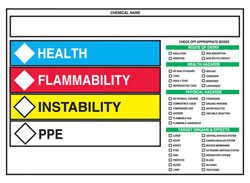
Safety Emporium carries Right To Know labels like these which include target organ checkboxes.
Appendix B - Physical Hazard Criteria
- B.1 Explosives
- B.2 Flammable Gases
- Table B.2.1: Criteria for flammable gases
- B.3 Aerosols and Chemicals Under Pressure
- Table B.3.1: Criteria for aerosols
- Table B.3.2: Criteria for chemicals under pressure
- B.4 Oxidizing Gases
- Table B.4.1: Criteria for oxidizing gases
- B.5 Gases Under Pressure
- Table B.5.1: Criteria for gases under pressure
- B.6 Flammable Liquids
- Table B.6.1: Criteria for flammable liquids
- B.7 Flammable Solids
- Table B.7.1: Criteria for flammable solids
- B.8 Self-Reactive Chemicals
- B.9 Pyrophoric Liquids
- Table B.9.1: Criteria for pyrophoric liquids
- B.10 Pyrophoric Solids
- Table B.10.1: Criteria for pyrophoric solids
- B.11 Self-Heating Chemicals
- Table B.11.1: Criteria for self-heating chemicals
- B.12 Chemicals which, in contact with water, emit flammable gases
- Table B.12.1: Criteria for chemicals which, in contact with water, emit flammable gases
- B.13 Oxidizing Liquids
- Table B.13.1: Criteria for oxidizing liquids
- B.14 Oxidizing Solids
- Table B.14.1: Criteria for oxidizing solids
- B.15 Organic Peroxides
- B.16 Corrosive to Metals
- Table B.16.1: Criteria for chemicals corrosive to metal
- B.17 Desensitized Explosives
- Table B.17.1: Criteria for desensitized explosive

Get your GHS-compliant labels and signs from Safety Emporium.
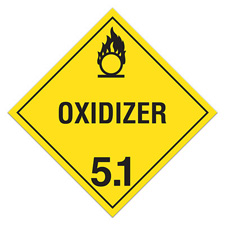
Be sure you're in compliance with DOT placards and labels from Safety Emporium.
Directive Table of Contents | Next: Appendix B
The official, public domain, OSHA version of this document is available at https://www.osha.gov/sites/default/files/enforcement/directives/CPL-02-02-079_0.pdf.