| The Home page of ILPI's Safety Data Sheet (SDS) Resource, the leader in SDS information since 1995! | |
| The history and philosophy behind this resource. | |
| A curated collection of books and reference materials concerning Safety Data Sheets and closely related topics. | |
| Paste your plain text SDS into the SDS-Demystifier, and it will be converted into a hypertext-enriched document with links to detailed explanations of each key term. | |
| An extensive list of frequently asked questions about Safety Data Sheets including regulations, content, compliance, and more. | |
| A humorous take on Safety Data Sheet jargon. Fill in the blanks on our entry form to generate a personalized Unsafety Data Sheet to share with your coworkers. | |
| Since 1995, we've maintained this massive curated list of the best places to find Safety Data Sheets on the Internet. | |
| You are here! Way more than a glossary, this hypertext-enhanced resource covers hundreds of SDS-related terms and expert knowledge. Each entry includes both the SDS relevance and links to additional authoritative resources. | |
| Archived results of Safety Data Sheet related polls taken by some of our millions of site visitors | |
| The OSHA regulations behind SDS regulations, including the inspection guidelines and over 400 official interpretations letters under the Hazard Communication Standard | |
| Commercial suppliers of SDS authoring and management software as well as cloud compliance services. | |
| Commercial companies that will create SDS's for your specific needs as well as SDS translation companies. |

Safety signs, banners, and scoreboards? Get yours at Safety Emporium!
De minimis
Definition
De minimis is a Latin term meaning "concerning the smallest things" or "about the smallest things". It is a commonly used legal term derived from the fuller Latin maxim de minimis non curat lex, literally "the law does not concern itself with the smallest things", and is often used to describe something that does not warrant legal or regulatory action.
Chapter 4 of OSHA's Field Operations Manual (FOM), the resource that OSHA inspectors use for determining violations of OSHA policy, states de minimis conditions are those where an employer has implemented a measure different from one specified in a standard, that has no direct or immediate relationship to safety or health.
Additional Info
While violations may be de minimis, they must still be documented in the same manner as violations even though no citation is issued and no penalty or abatement is required. The FOM states:
- The criteria for finding a de minimis condition are as follows:
-
An employer complies with the intent of the standard, yet deviates from its particular requirements in a manner that has no direct or immediate impact on employee safety or health. These deviations may involve, for example, distance specifications, construction material requirements, use of incorrect color, minor variations from recordkeeping, testing, or inspection regulations.
EXAMPLE 4-31: §1910.27(b)(1)(ii) allows 12 inches as the maximum distance between ladder rungs. Where the rungs are 13 inches apart, the condition is de minimis.
EXAMPLE 4-32: §1910.217(e)(1)(ii) requires that mechanical power presses be inspected and tested at least weekly. If the machinery is seldom used, inspection and testing prior to each use is adequate to meet the intent of the standard.
- An employer complies with a proposed OSHA standard or amendment or a consensus standard rather than with the standard in effect at the time of the inspection, and the employer's action clearly provides equal or greater employee protection.
- An employer complies with a written interpretation issued by the OSHA National Office or an OSHA Regional Office.
- An employer's workplace protections are state-of-the-art and technically more enhanced than the requirements of the applicable standard, and provides equivalent or more effective employee safety or health protection.
-
- Professional Judgment.
Professional judgment should be exercised in determining whether noncompliance with a standard constitutes a de minimis condition. - Area Director Responsibilities.
Area Directors shall ensure that all proposed de minimis notices meet the criteria set out above.
De minimis may also be referenced in determining whether the amount of a substance is of consequence. In general, almost any amount of material that can be classified as hazardous requires a Safety Data Sheet. As OSHA wrote in a October 6, 1994 interpretation letter:
The HCS addresses chemical hazards which are inherent properties of the hazardous chemical and would exist no matter what quantity was present in the workplace. Risk is a function of the inherent hazard and level of exposure. A substance either is or is not a
hazardous chemical; the HCS definition cannot be read to indicate that a substance could be a hazardous chemical in some concentrations but not in others.

These LED floor and wall projector signs from Safety Emporium are the ultimate long-lasting floor marking solution.
Exposure calculations are not permitted in determining whether a hazard must appear on a label. OSHA discusses this in a February 11, 2004 interpretation letter and we have an entry What is the minimum amount of material that requires an SDS? in our SDS FAQ.
Where employees are exposed or potentially exposed to a hazardous chemical, and labeling, SDS, chemical inventory, and training requirements are met, but there is no written program, a citation for paragraph (e)(1) of the HazCom Standard should not be issued, as it is considered a de minimis violation. See CPL 02-02-079, Paragraph E(5)(a).
That said, OSHA specifically outlines multiple ways a workplace can incur a serious violation, one that can possibly result in fines. Some examples from CPL 02-02-079, Paragraph G(7) include:
- Not having the SDS available or having made a good faith effort to do so.
- SDS with incomplete or missing required information.
- Failing to provide an SDS upon request or with the initial shipment.
- SDS's not being readily accesible to employees while in their work area.
Serious SDS violations can carry penalties of several thousand dollars. In our analysis of OSHA records for citations issued during 2021–2025, serious SDS citations carried a median penalty of $2,210 with the middle half ranging from approximately $1,200 to $3,550. While many of these serious citation items were assessed a zero penalty, that does not make them de minimis violations.
SDS Relevance
While this term is unlikely to appear on a Safety Data Sheet, there are a number of examples of how it can apply with respect to the sheet content or compliance during an OSHA inspection. Examples of de minimis violations include:
- If the company name, address and phone number are located at the top of the page instead of in Section 1. See CPL 02-02-079, App H, Paragraph 1
- If the headers for Sections 12 through 15 are missing (no information is required in these sections because OSHA does not have jursdiction). See CPL 02-02-079, App H, Paragraph 12.
- If a substance is a nuisance particulate, and has no other discernible health or physical hazards such as being an irritant or posing a dust explosion risk, failure to comply with SDS or label requirements would be a de minimis violation.
Further Reading
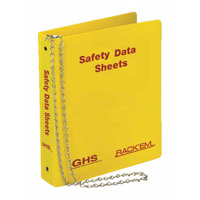
Get your SDS binders, centers and more from Safety Emporium.
- For a discussion of de minimis first aid violations under the Bloodborne Pathogen Standard see this January 25, 1993 OSHA interpretation.
- A discussion of de minimis violations regarding employee rescue activities is cound in 29 CFR 1903.14.
- Understanding De Minimis OSHA Violations: What They Mean for Workplace Safety and Compliance at Tri-Link.
- De Minimis Violation Definition and Examples [Compliance Guide] at LegalSolutions.blog digs deeper into the legal aspects.
- OSHA Violations, Citations, & Fines List for 2026 Guide at Safety By Design.
- Chapter 6 - Penalties and Debt Collection of OSHA's Field Operations Manual (FOM) summarizes OSHA's penalty structure.
See also: HMIS, incompatible chemicals, peroxide, polymerization.