
|
 The Glassware Gallery
Gas Regulators
Introduction
An entire web site could be devoted to explaining the various kinds of regulators (high pressure, corrosive gas, fluorine etc.) that are available! This page is not meant to be comprehensive, merely an introduction to regulators you might find in a typical inorganic or organic laboratory. If you are ever unsure about how to use a regulator or another piece of equipment, ask your laboratory supervisor or safety expert.
There are typically a wide variety of gas regulators in your average chemistry department. The majority of these are single stage and two stage regulators such as the one shown below.
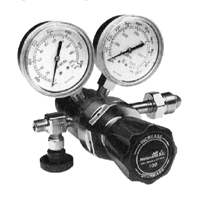
The advantage of a two stage regulator is that the pressure flow remains consistent until the tank is nearly empty. Therefore, you might want to use a double stage regulator on a gas chromatograph (GC), but for a typical Schlenk line a single stage regulator would suffice.
Two other common types of "regulators" that you might encounter are actually called flow control valves. Unlike a regulator, these DO NOT control pressure, only flow. However, they permit one to easily dispense gas from a cylinder. As they lack gauges, be extremely cautious when hooking a flow valve up to a vacuum line!!
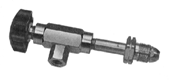
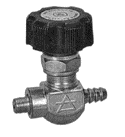
The manual flow control valve shown below on the left is usually used on small cylinders (carbon dioxide, ethylene etc.) and the one on the right is typically used on lecture bottles. Small single and double stage lecture bottle regulators are also available.
Finally, note that you should NEVER use grease or oil on a regulator. Not only will it gunk up the inside and contaminate your reaction system, but these organic materials can react with the gas being dispensed. Never use an oxygen regulator for other gases. Cross-contamination of internal parts (especially with grease or oil) could cause a rapid oxidation and fire.
Select the Proper Regulator
Not all regulators can be used on all cylinders. For example, flammable gases such as hydrogen require brass fittings. The Compressed Gas Association (CGA) has devised a system that ensures accidental mix-ups can not occur. Each cylinder and regulator have connection fittings that are designated by a CGA number. Below are some common CGA numbers. High pressure tanks or lecture bottles require different fittings:
| Gases | CGA Connection # |
|---|---|
| Carbon dioxide | 320 |
| Boron trifluoride, hydrogen chloride, hydrogen bromide, hydrogen iodide, hydrogen sulfide, silicon tetrafluoride | 330 |
| Carbon monoxide, ethylene, hydrogen, hydrogen selenide | 350 |
| Acetylene, allene, butadiene, butane, butenes, cyclopropane, dimethylether, methane, propane, propylene, vinyl methyl ether | 510 |
| Oxygen | 540 |
| Argon, nitrogen, helium, noble gases | 580 |
| Air (industrial grade) | 590 |
| Boron trichloride, chlorine, nitric oxide, nitrogen dioxide, nitrogen trioxide, sulfur dioxide, phosphorous pentafluoride, many halocarbons | 660 |
| Anyhdrous ammonia | 705 |
CGA numbers are typically (but not always) stamped on the regulator just above the threads of the cylinder connection. Some will even state specifically which gas(es) for which they can be used. It is a very bad idea alter a regulator or use an adapter to "make" a regulator fit a tank for which it was not designed. This kind of deliberate tampering with a safety feature could lead to a serious accident.
 | Here's an example where someone hooked a nitrogen tank to an oxygen supply line, resulting in the deaths of 3 people. This is not an isolated example, either. | |
Flammable gases have reverse threads meaning that the connection is tightened by turning the nut counterclockwise. You can always tell a reverse thread connection because the nut that you tighten has a line inscribed around its circumference. Compare the nut on the manual flow control valve (reverse threaded) with the one on the double stage regulator (regular thread) shown above.
Installing and Using a Regulator
- Make sure your cylinder is properly secured, that you have the correct regulator and that you are aware of any special hazards of the gas you are working with.
- Remove the cylinder valve cap (counterclockwise). Place it somewhere nearby.
- Some regulators (on lecture bottles and certain corrosive gases) require a Teflon or lead washer to be inserted between the tank outlet and regulator. Check to see if this is required before continuing.
- Make sure that the regulator outlet valve (A) is shut. Screw it clockwise until it seats. Do not overtighten it or you can damage the valve seat.
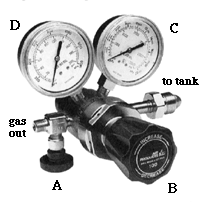
- Make sure that the regulator control valve (B) is shut. Screw it counterclockwise until it is almost completely unscrewed. If you unscrew it completely, just put it back in.
- Screw the regulator onto the tank by hand until it is almost finger tight. Some people like to use Teflon tape on this connection, but that's generally not a good idea. Bits of Teflon tape can get blown into the regulator, causing a leak, valve malfunction or erroneous reading.
- What you do next depends on the kind of gas you are working with and whether you need to exclude air from the gas line you're connecting to. Aldrich Chemical discusses this in more detail in their Technical Bulletin AL-151, Gas Equipment Configurations.
- If you don't need to purge out the "dead volume" of air in the regulator body, simply tighten the regulator firmly with a wrench (use the correct tool for the job, not pliers!).
- If you need to exclude air from your line then you can purge out the "dead volume", there are special methods and procedures that are beyond the scope of this document. A commonly used, but not recommnended technique is as follows. With the regulator on finger-tight, crack open the tank valve until gas just begins to flow. Once the dead volume is purged (2-4 seconds) and with the tank still open a minimum amount, tighten the regulator firmly with a wrench. Note: This procedure carries definite risks. Never use this technique on an unsecured cylinder, for any other gases or in an unventilated area!!
- Make sure you are using the proper regulator (typically these will be made of stainless steel or Monel).
- Tighten the regulator firmly with a wrench (use the correct tool for the job, not pliers!).
- Purge the regulator with an inert dry gas or evacuate the system (depending on the exact set-up). Specific instructions for this will vary depending on what you need to do so consult your instructor or this Aldrich technical bulletin
- Be sure to install some kind of suck-back trap after the regulator or at least use clear Tygon tubing so that the backflow of corrosive reaction mixtures into the regulator and cylinder can be avoided.
- If you are using acetylene be certain that you are using an acetylene regulator with proper fittings. Alloys containing copper or silver can cause explosions when used with acetylene! Also be certain that acetylene won't contact mercury in your system (in a mercury bubbler, for example) and that you are properly venting and flaring off acetylene from your system.
- Ideally, ground the system to avoid static discharges.
- Tighten the regulator firmly with a wrench (use the correct tool for the job, not pliers!).
- If necessary, follow the purge instructions for corrosive or reactive gases as shown above.
- Open the tank valve slowly (counterclockwise). Watch the tank pressure on the regulator (C).
- Slowly turn the regulator control valve (B) until the regulator pressure (D) is at the desired level.
- Open the regulator outlet valve (A). You can regulate flow with this valve, but the ultimate pressure depends on the setting of the regulator control valve!
- Check your system for leaks using Snoop (a commercial product) or some soapy water. Snoop is preferred since it leaves no residue. If you find leaks and tightening the connections does not help ask your instructor for assistance. Reminder: Do not use Teflon tape on Swagelock ferrule compression fittings.
For nitrogen and argon cylinders:
For corrosive or reactive gases:
For flammable gases:
Disconnecting a Regulator
- Shut the tank valve on the gas cylinder.
- Slowly open the outlet valve (A) on the regulator .
- Watch the pressure gauges C and D drop to zero.
- Open the regulator control valve (B) (turn it clockwise) to ensure that all pressure has been released.
- If you were using a corrosive gas, purge the system with a dry inert gas.
- Using a wrench (not pliers!) disconnect the regulator from the gas cylinder. Replace the protective cylinder cap immediately.
- If your regulator was used with a corrosive gas, purge it again with dry air or nitrogen in the hood for several minutes.
- If your cylinder is empty, it must be properly labeled and then returned to the manufacturer or distributor (in many cases, this is your school or company stockroom). Do not store empty gas cylinders in the laboratory. Reminder: Make sure the tank valve is closed whenever you are not dispensing gas through the regulator.
Further Information

-
Air Products Corporation offers several great PDF readings about compressed gas cylinders and their use. These are recommended reading for anyone who uses compressed gases!
- Safetygram 12: Regulator selection, installation and operation.
- Safetygram 10: Handling, storage and use of compressed gas cylinders.
- Safetygram 31: Cylinder valve outlet connections.
Air Products has lots of additional Safetygram information that includes how to handle leaking cylinders, specific gases, and more.