
|
Safety Emporium for all your lab and safety needs
 The Glassware Gallery
Bubblers
Introduction
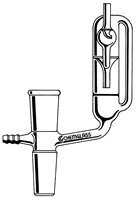
Bubblers are simple devices used to maintain an inert atmosphere over a reaction apparatus while also providing for a means for pressure relief. Bubblers are typically filled with mercury or mineral oil, however the latter is recommended because mercury bubblers splash quite a bit and pose a toxicity hazard. Shown here is the simplest possible setup involving a bubbler:
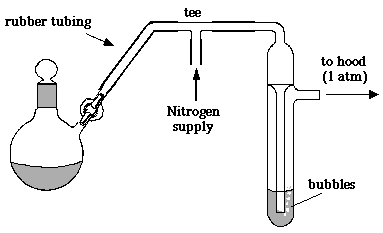
When the pressure inside your apparatus is greater than the laboratory's atmospheric pressure, excess gas will bubble down the tube and out through the mineral oil. If the pressure inside your apparatus falls below atmospheric pressure, oil will rise in the tube and prevent air from entering the system. However, if the pressure is too low, air will eventually get in and you will suck oil (or mercury) into your apparatus. This is the kind of mistake you generally make only once or twice (the tedious cleanup is a great learning experience).
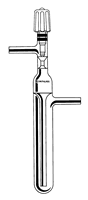
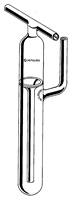
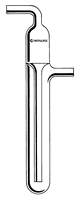
Click on any bubbler for details or to purchase.
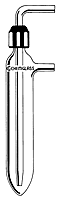
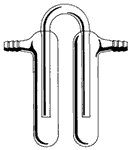
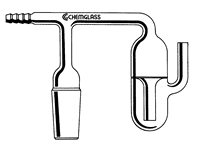
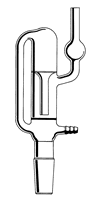
Usage tips
- You can avoid having your bubbler "suck back" by:
- Being careful not to induce negative pressure in your system while it is open to the bubbler. The three most common causes of this are:
- Pulling a vacuum on the flask when it is open to the bubbler.
- Turning off the heat on a hot reaction, but not increasing the nitrogen flow.
- Cooling your reaction in a cold bath, but not increasing the nitrogen flow.
- Using specially modified bubblers.
- Using a mercury bubbler that is taller than 760 mm (the maximum height that mercury can achieve with 1 atm of pressure).
- If you bubble something other than nitrogen (HCl, solvents, reaction byproducts) through your bubbler be sure to either bubble pure nitrogen through it when you are done or clean the bubbler. This way you'll avoid contaminating your next reaction.
- To reduce the chance of accidental pressure explosions, NEVER open a gas cylinder to a vacuum manifold unless the manifold is open to a bubbler!
- To maintain a positive pressure on a reaction that is simply stirring, the bubbler should bubble once every few seconds. A greater flow wastes nitrogen and can bubble away volatile solvents. A lesser flow increases the chances of air diffusing into your apparatus
- To prevent oil or mercury from splashing out of your bubbler, connect a piece of Tygon tubing to the outlet. Arrange this vertically several inches or make several coils in the tubing. Alternatively, you can attach an empty bubbler to your bubbler outlet to retain any splashed material.
- Avoid using mercury in the laboratory whenever possible. But if you must use it, be sure to read these tips, warnings and guidelines.
Note: Be sure your bubbler liquid does not react with the gases you are using. For example, mercury is incompatible with ammonia and acetylene.