| The Home page of ILPI's Safety Data Sheet (SDS) Resource, the leader in SDS information since 1995! | |
| The history and philosophy behind this resource. | |
| A curated collection of books and reference materials concerning Safety Data Sheets and closely related topics. | |
| Paste your plain text SDS into the SDS-Demystifier, and it will be converted into a hypertext-enriched document with links to detailed explanations of each key term. | |
| An extensive list of frequently asked questions about Safety Data Sheets including regulations, content, compliance, and more. | |
| A humorous take on Safety Data Sheet jargon. Fill in the blanks on our entry form to generate a personalized Unsafety Data Sheet to share with your coworkers. | |
| Since 1995, we've maintained this massive curated list of the best places to find Safety Data Sheets on the Internet. | |
| You are here! Way more than a glossary, this hypertext-enhanced resource covers hundreds of SDS-related terms and expert knowledge. Each entry includes both the SDS relevance and links to additional authoritative resources. | |
| Archived results of Safety Data Sheet related polls taken by some of our millions of site visitors | |
| The OSHA regulations behind SDS regulations, including the inspection guidelines and over 400 official interpretations letters under the Hazard Communication Standard | |
| Commercial suppliers of SDS authoring and management software as well as cloud compliance services. | |
| Commercial companies that will create SDS's for your specific needs as well as SDS translation companies. |

Safety signs, banners, and scoreboards? Get yours at Safety Emporium!
Volatility
Definition
Volatility describes how easily a substance will vaporize (turn into a gas or vapor).
A volatile substance can be defined as (1) a substance that evaporates readily at normal temperatures and/or (2) one that has a measurable vapor pressure.
The term volatile usually applies to liquids. However, some solid materials can change directly from solid to vapor without ever becoming liquid, a process called sublimation.
The rate at which a substance vaporizes (volatilizes) under a fixed set of conditions is called the evaporation rate.
Additional Info
The volatility of a substance is a physical property that depends on the intermolecular forces holding the atoms or molecules of the substance together. For example, methane molecules have only weak forces holding them together, so the boiling point of liquid methane is -258.9 °F (-161.6 °C). In contrast, water molecules, which have almost the same size and mass, have dipolar attraction and hydrogen bonding that make the boiling point of liquid water 212 °F (100 °C). Metals, which have some of the strongest intermolecular bonds between their atoms, may have boiling points of thousand of degrees F!
Raising the temperature supplies energy to overcome the intramolecular forces holding a solid or liquid together. Therefore, substances become more volatile (vaporize more easily) when heated. This behavior can be exploited to purify materials by distillation (see Further Reading below). However, the greater the concentration of a flammable or toxic vapor, the greater the likelihood of an explosion or accidental poisoning.
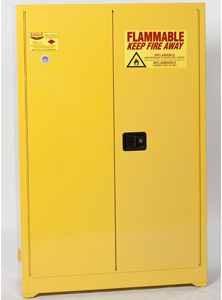
To reduce the risks associated with volatile materials, always use caution when heating them and avoid storing such materials in hot or sunny locations. Use code-approved storage such as solvent safety cans and flammable liquid storage cabinets which can reduce the likelihood and effect of a catastrophic fire.
Organic chemicals that easily form vapors are called volatile organic compounds (VOC's). Given the health and physical hazards associated with common VOC's, many companies have either reduced their use of these materials or substituted other, less hazardous, materials and processes. Substitution of this nature is called "green chemistry" as it also benefits the environment.
SDS Relevance
This term usually appears on Safety Data Sheets of materials that have a high vapor pressure. The vapor pressure, vapor density, flammability, autoignition temperature and more, if known or applicable, will be found in Section 9 (physical and chemical properties)
Depending on its vapor pressure, a volatile substance can easily form a significant concentration of vapor, especially in an enclosed space. If that vapor is flammable, a fire or explosion could result.
Other materials may emit enough vapor to exceed the permissible exposure limit (PEL) for inhalation. Always minimize your exposure to volatile chemicals by using engineering controls such as a fume hood or local exhaust ventilation. If those methods are not sufficient to protect you, be sure to use an approved respirator.
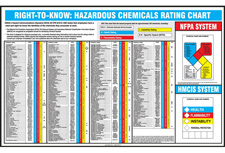
This poster from Safety Emporium contains NFPA numeric ratings for hundreds of common chemicals.
Further Reading
- Separating Mixtures at General Chemistry Online!
- Vapor pressures of Volatile Chemicals, an online calculator that is part of John Byers' Chemical Ecology of Insects site.
- Green Chemistry, which focuses on reducing the use of VOC's and other harmful substances, at the US EPA.
- Volatile Organic Compounds in Your Home at the MN Department of Health.
- Distillation at Chemistry LibreTexts.
- Intermolecular Forces at Chemistry LibreTexts.
- Organic chemistry: 10.21 - Volatility at IB Chemistry Web. Available thanks to the Internet Archive.
See also: boiling point, evaporation rate, NFPA, vapor pressure, ventilation.