| The Home page of ILPI's Safety Data Sheet (SDS) Resource, the leader in SDS information since 1995! | |
| The history and philosophy behind this resource. | |
| A curated collection of books and reference materials concerning Safety Data Sheets and closely related topics. | |
| Paste your plain text SDS into the SDS-Demystifier, and it will be converted into a hypertext-enriched document with links to detailed explanations of each key term. | |
| An extensive list of frequently asked questions about Safety Data Sheets including regulations, content, compliance, and more. | |
| A humorous take on Safety Data Sheet jargon. Fill in the blanks on our entry form to generate a personalized Unsafety Data Sheet to share with your coworkers. | |
| Since 1995, we've maintained this massive curated list of the best places to find Safety Data Sheets on the Internet. | |
| You are here! Way more than a glossary, this hypertext-enhanced resource covers hundreds of SDS-related terms and expert knowledge. Each entry includes both the SDS relevance and links to additional authoritative resources. | |
| Archived results of Safety Data Sheet related polls taken by some of our millions of site visitors | |
| The OSHA regulations behind SDS regulations, including the inspection guidelines and over 400 official interpretations letters under the Hazard Communication Standard | |
| Commercial suppliers of SDS authoring and management software as well as cloud compliance services. | |
| Commercial companies that will create SDS's for your specific needs as well as SDS translation companies. |

Safety signs, banners, and scoreboards? Get yours at Safety Emporium!
Vapor
Definition
A vapor refers to a gas-phase material that that normally exists as a liquid or solid under a given set of conditions. As long as the temperature is below a certain point (the critical temperature; this varies for each substance), the vapor can be condensed into a liquid or solid with the application of pressure.
The most common example of a vapor is water vapor (gas phase water) at room temperature and one atmosphere of pressure. Do not confuse a vapor with a dust, a fine suspension of solid particles or a mist, a fine suspension of liquid droplets. A good synonym (alternate word) for vapor is gas.
When a substance turns changes from a solid or liquid into a gas, the process is called vaporization. The material is said to vaporize or evaporate.
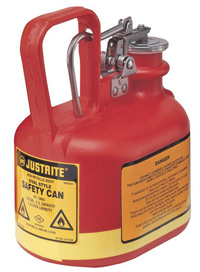
Store and dispense flammable liquids safely with flammable liquid safety cans from Safety Emporium.
Additional Info
We can classify most materials as solids, liquids or gases. The primary distinction between these phases deals with the attractions/forces between the atoms or molecules that make up the material.
- Solids have strong intramolecular (between molecule) forces that hold the atoms or molecules together. Each molecule interacts closely with those around it and has very little freedom to change position. Solids that have an ordered array of atoms/molecules are called crystalline solids. Those that have no long-range order are called amorphous.
- Liquids have somewhat weaker interactions between the atoms or molecules. The molecules can move fairly freely past one another, and the material will tend to take the shape of its container. Liquids have no long-range order and very little short-range order.
- Gases have little or no interactions between the atoms or molecules. The distance between adjacent molecules is many times larger than in liquids and solids. Gases generally diffuse, spacing themselves throughout the container.
We can express these states of matter pictorially. Of course, the molecules are shown millions of times their actual size:

It is quite common for materials to undergo phase transitions, i.e. a change between one state and another. For example, solids can melt to give liquids; the reverse process is freezing. Liquids can evaporate into gases; the reverse process is called condensation. Solids can sublime to give gases without ever forming a liquid; the reverse process is called deposition.
SDS Relevance
This term is quite common on SDS's and usually refers to hazards associated with the vapor phase of the material. Such hazards appear in Section 2 (Hazard(s) identifications) and the physical properties of the substance appear in Section 9 (physical and chemical properties). Some of the information in Section 8 of the SDS may include occupational exposure limits established under 29 CFR 1926.55, Gases, vapors, fumes, dusts, and mists.
Many vapors present both physical and chemical hazards. Substances that have high vapor pressures generate significant amounts of vapors. If these are asphxiants, flammable, and/or toxic, that can be bad news!
Always use proper personal protective equipment (PPE) such as respirators and/or engineering controls such as fume hoods when working with hazardous vapors. If possible, avoid conditions which generate such vapors in the first place. Remember that vapors can travel a long distance from their point or origin, and that some heavier-than-air vapors may tend to collect in small areas.
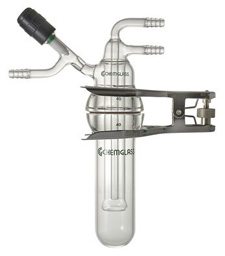
You can get cryogenic sublimators and other lab glassware from Safety Emporium.
Further Reading
- Each year, OSHA records multiple deaths in preventable tank explosions. Type in "tank explosion" under Hazard Description to see select examples. Also, sadly, look at the ridiculously low penalty the employers have been assessed (and had reduced upon challenge).
- Acute Exposure Guideline Levels for Selected Airborne Chemicals: Volume 20 (2016), is available as a free download from the National Academies Press.
- We can express the relationships between phases using a phase diagram.
- More on the State of Matter at Wikipedia.
- In 2011, a Pennsylvania judge ruled that pizza is a solid in a criminal misdemeanor case.
See also: boiling point, dust, fume, mist, vapor pressure.