| The Home page of ILPI's Safety Data Sheet (SDS) Resource, the leader in SDS information since 1995! | |
| The history and philosophy behind this resource. | |
| A curated collection of books and reference materials concerning Safety Data Sheets and closely related topics. | |
| Paste your plain text SDS into the SDS-Demystifier, and it will be converted into a hypertext-enriched document with links to detailed explanations of each key term. | |
| An extensive list of frequently asked questions about Safety Data Sheets including regulations, content, compliance, and more. | |
| A humorous take on Safety Data Sheet jargon. Fill in the blanks on our entry form to generate a personalized Unsafety Data Sheet to share with your coworkers. | |
| Since 1995, we've maintained this massive curated list of the best places to find Safety Data Sheets on the Internet. | |
| You are here! Way more than a glossary, this hypertext-enhanced resource covers hundreds of SDS-related terms and expert knowledge. Each entry includes both the SDS relevance and links to additional authoritative resources. | |
| Archived results of Safety Data Sheet related polls taken by some of our millions of site visitors | |
| The OSHA regulations behind SDS regulations, including the inspection guidelines and over 400 official interpretations letters under the Hazard Communication Standard | |
| Commercial suppliers of SDS authoring and management software as well as cloud compliance services. | |
| Commercial companies that will create SDS's for your specific needs as well as SDS translation companies. |

Safety signs, banners, and scoreboards? Get yours at Safety Emporium!
Asphyxiant
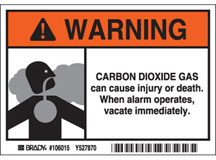
All rooms with fixed extinguishing systems must have appropriate warning signs like this one from Safety Emporium.
Definition
An asphyxiant is a substance that can cause unconsciousness or death by suffocation (asphyxiation). Asphyxiants which have no other health effects and are sometimes referred to as simple asphyxiants.
29 CFR 1910.1200, the OSHA Hazard Communication Standard, defines a simple asphyxiant as a substance or mixture that displaces oxygen in the ambient atmosphere, and can thus cause oxygen deprivation in those who are exposed, leading to unconsciousness and death
.
Additional Info
Asphyxiants work by displacing so much oxygen from the ambient atmosphere that the hemoglobin in the blood can not pick up enough oxygen from the lungs to fully oxygenate the tissues. As a result, the victim slowly suffocates.
Asphyxiation is an extreme hazard when working in enclosed spaces. Be sure you are trained in confined space entry before working in sewers, storage tanks etc. where gases such as methane may displace oxygen from the atmosphere. Be aware that some asphyxiants are heavier or lighter than air and can concentrate near floors or ceilings. See the Further Reading links below for an example of where a worker died from asphyxiation because carbon dioxide invisibly pooled in a stairwell.
Workplaces that use asphyxiants should establish training and protocols to prevent accidental releases as well as measures to take in the event of an accident. In 2021, six workers were killed and a dozen were injured at a poultry processing plant when a freezer malfunctioned and released nitrogen gas into a closed room. OSHA found that these deaths were completely preventable and cited the three companies involved in the operation for 59 safety violations and assessed $998,637 in penalties.
Oxygen level alarms should be installed in any room where sudden release of an asphyxiant could displace oxygen to a level that is immediately dangerous to life or health (IDLH).
The normal composition of air is:
| Gas | Chemical Formula | Percent by Volume |
| Nitrogen | N2 | 78.03 |
| Oxygen | O2 | 20.99 |
| Argon | Ar | 0.94 |
| Carbon Dioxide | CO2 | 0.033 |
| Neon | Ne | 0.0015 |
According to the Canadian Centre for Occupational Health and Safety (CCOHS) the health effects of asphyxiation are:
| % O2 by volume | Symptoms or effects |
| 16 to 12 | Breathing and pulse rate increased, muscular coordination slightly disturbed |
| 14 to 10 | Emotional upset, abnormal fatigue, disturbed respiration |
| 10 to 6 | Nausea and vomiting, collapse or loss of consciousness |
| Below 6 | Convulsive movements, possible respiratory collapse and death |
Examples of asphyxiating gases are nitrogen (N2), helium (He), neon (Ne), argon (Ar), methane (CH4), propane (CH3CH2CH3), and carbon dioxide (CO2).
SDS Relevance
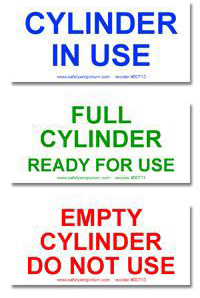
Safety Emporium has a great lineup of gas cylinder signs, storage racks, clamps and more.
All of the asphyxiants listed above are odorless and tasteless except carbon dioxide and propane that has been commercially odorized. You can become unconscious by inhalation of these gases without realizing they are present. Again, follow OSHA-approved protocols for confined space entry into sewers, storage tanks etc. Also note that some of these materials (methane and propane, for example) are also flammable and can form a flammable mixture in air.
Remember also that simple air-purifying respirators or dust masks do not protect you from asphyxiation in an oxygen-deficient atmosphere. See the first link below for accidents involving supplied air respirators!
Under HCS 2012 and the GHS a simple asphyxiant" must utilize the signal word "Warning" and the hazard statement "May displace oxygen and cause rapid suffocation" on both the product label and Safety Data Sheet. MSDS's and labels prepared before HCS 2012's SDS provisions took full effect in on June 1, 2015 (December 1, 2015 for labels) may lack these indicators. On some older MSDS's the abbreviations S/A or SA were sometimes used for "simple asphyxiant".
Simple asphyxiants have no pictogram requirement under HCS 2012.
Further Reading
- Foundation Food Group Fatal Chemical Release, a CSB report and video on a a liquid nitrogen release that lead to six fatalities and multiple injuries.
- OSHA has a publication titled Deaths Involving the Inadvertent Connection of Air-line Respirators to Inert Gas Supplies
- OSHA Fatal Fact Sheet #36 and OSHA Accident 14401913 from 07/17/1985 both discuss a sandblaster who was asphyxiated when his air supply was hooked up to a nitrogen line instead.
- A carbon dioxide delivery driver died of asphyxiation when his supply hose leaked. This OSHA page includes safety info and precautions.
- This OSHA PowerPoint presentation Silent Killer in a Newly Constructed Manhole discusses an unexpected asphyxiation death during confined space entry into a manhole.
- 20 Russian submariners were killed in November 2008 after being asphyxiated by the fire control system on their vessel.
See also: air, anoxia, asphyxia, asphyxiation, IDLH - Immediately Dangerous to Life or Health.