| The Home page of ILPI's Safety Data Sheet (SDS) Resource, the leader in SDS information since 1995! | |
| The history and philosophy behind this resource. | |
| A curated collection of books and reference materials concerning Safety Data Sheets and closely related topics. | |
| Paste your plain text SDS into the SDS-Demystifier, and it will be converted into a hypertext-enriched document with links to detailed explanations of each key term. | |
| An extensive list of frequently asked questions about Safety Data Sheets including regulations, content, compliance, and more. | |
| A humorous take on Safety Data Sheet jargon. Fill in the blanks on our entry form to generate a personalized Unsafety Data Sheet to share with your coworkers. | |
| Since 1995, we've maintained this massive curated list of the best places to find Safety Data Sheets on the Internet. | |
| You are here! Way more than a glossary, this hypertext-enhanced resource covers hundreds of SDS-related terms and expert knowledge. Each entry includes both the SDS relevance and links to additional authoritative resources. | |
| Archived results of Safety Data Sheet related polls taken by some of our millions of site visitors | |
| The OSHA regulations behind SDS regulations, including the inspection guidelines and over 400 official interpretations letters under the Hazard Communication Standard | |
| Commercial suppliers of SDS authoring and management software as well as cloud compliance services. | |
| Commercial companies that will create SDS's for your specific needs as well as SDS translation companies. |

Safety signs, banners, and scoreboards? Get yours at Safety Emporium!
Corrosive
Definition
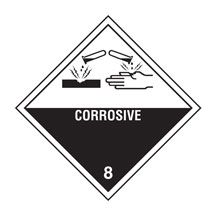
A corrosive material is a highly reactive substance that causes obvious damage to living tissue. Corrosives act either directly, by chemically destroying the part (oxidation), or indirectly by causing inflammation.
Acids and bases are common corrosive materials. Corrosives such as these are also sometimes referred to as caustics.
Typical examples of acidic corrosives are hydrochloric (muriatic) acid and sulfuric acid. Typical examples of basic corrosives are sodium hydroxide and lye.
The OSHA definition of corrosive in 29 CFR 1910.1200 App A is:
"... a chemical that produces destruction of skin tissue, namely, visible necrosis through the epidermis and into the dermis, in at least 1 of 3 tested animals after exposure up to a 4-hour duration. Corrosive reactions are typified by ulcers, bleeding, bloody scabs and, by the end of observation at 14 days, by discoloration due to blanching of the skin, complete areas of alopecia and scars. Histopathology should be considered to discern questionable lesions.
Rust and electrochemical oxidation are forms of corrosion that occur on metals, but a) these typically occur on a much slower time scale and b) these are not a health effect and, therefore, are not usually noted on an SDS except perhaps in storage recommendations. The U.S. Department of Transportation includes metal in their definitions.
Additional Info
Corrosive materials can be in solid, liquid or gas form and pose serious immediate risk to skin, tissues, eyes, lungs, and other parts of the body. Any external body part coming in contact with a corrosive material must be flushed with water IMMEDIATELY and then medical attention or opinion should be sought.
Almost every medical resource, consensus standard, and SDS says that the water flushing should last 15 minutes, however there is some question whether such long flushing periods may offer significant benefit in all cases, particularly when it could unnecessarily delay the course of emergency treatment.
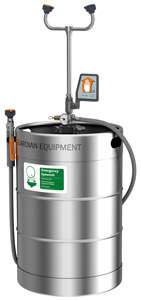
Safety Emporium carries all kinds of eye/face washes, safety showers, drench hoses and more.
For example, with a particularly dangerous chemicals such as concentrated hydrofluoric acid, rinsing more than 5 minutes would undoubtedly be less effective than administering treatment with calcium gluconate gel. Likewise, if a chemical accident involves traumatic injuries, a shorter rinse period may be necessary in order to stem bleeding etc.
The Canadian Centre for Occupational Health & Safety has indicated that The flushing or rinsing time can be modified if the identity and properties of the chemical are known. For example:
- a minimum 5-minute flushing time is recommended for mildly irritating chemicals,
- at least 20 minutes for moderate-to-severe irritants,
- 20 minutes for non-penetrating corrosives, and
- at least 60 minutes for penetrating corrosives.
Non-penetrating corrosives are chemicals which react with human tissue to form a protective layer which limits the extent of damage. Most acids are non-penetrating corrosives. Penetrating corrosives, such as most alkalis, hydrofluoric acid and phenol, enter the skin or eyes deeply. Penetrating corrosives require longer water flushing (a minimum of 60 minutes) than non-penetrating corrosives (a minimum of 20 minutes).
Note that while the CCOHS advice is a sensible risk-based approach, we would not recommend that anyone delay treatment of an hydrofluoric acid exposure for 60 minutes! As should be readily apparent by now, the flushing period that gives the best clinical outcome for the victim is going to depend on the nature of the chemical, its concentration, the availability of medical treatment, the available water temperature, the condition of the victim and many other factors. The bottom line is that "15 minutes" is a rule of thumb (or best guess), not an ironclad rule. The actual time necessary in a given situation may be shorter or longer.
Corrosives that are inhaled or ingested (eaten) must be dealt with by medical professionals. DO NOT induce vomiting for ingestion of a corrosive material as additional damage to the esophagus, throat and mouth will occur upon regurgitation. Consult the SDS, an emergency room and/or your poison control center for first aid procedures in the event of ingestion.
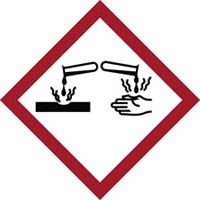
Get your GHS-compliant labels and signs from Safety Emporium.
SDS Relevance
When the term "corrosive" appears on Section 2 (Hazard(s) identifications) of a Safety Data Sheet, it will generally also appear in multiple other sections regarding storage, spill control, health effects and more. Corrosive materials demand great care, so read the SDS in carefully and completely to ensure you are fully informed on about the hazard as well as how to reduce your risk of working with material.
Per the Globally Harmonized System of Classification and Labeling of Chemicals (which is implemented in the US under the OSHA Hazard Communication Standard 29 CFR 1910.1200), substances which pose a corrosive hazard must use a corrosive pictogram on the SDS and label. These include substances which are corrosive to metals as well as those which are corrosive to the eyes or skin.
As required by Paragraph e of the OSHA Hazard Communication standard, workplaces using any hazardous chemical must have a written plan that includes labeling, information, SDS's, and training in the hazards associated with those chemicals. In addition, a number of additional OSHA standards for eye protection etc. also apply to the use of corrosive chemicals. See our PPE entry and the resources below for more information on how to set up standard procedures for corrosive handling as well as PPE recommendations.
Note: Although this is not explained on most SDS's, corrosives can also etch or pit metals such as stainless steel. This can occur without visible surface damage, but stress cracks invisible to the naked eye can form. These microscopic cracks can severely weaken or degrade the material, leading to unexpected failure (or explosions in the case of pressure vessels).
Further Reading

Ensure a safe workplace with antislip floor marking signs from Safety Emporium.
- How to Work Safely with - Hazardous Products using the "Corrosion" Pictogram at CCOHS.
- How to Work Safely with - Corrosive Liquids and Solids, also courtesy of the CCOHS.
- Corrosive Materials courtesy of Princeton University.
- Standard Operating Procedure for Corrosive Chemicals at the University of Pennsylvania.
- Corrosive Chemical guidelines at Brandeis University.
- 10 Tips For Working Safely With Corrosives courtesy of CHEMSAFE.
- Spill Response Guide: Corrosive Acids at the University of Iowa; the current version is behind a firewall.
- Guide for Chemical Spill Response at the American Chemical Society (ACS).