| The Home page of ILPI's Safety Data Sheet (SDS) Resource, the leader in SDS information since 1995! | |
| The history and philosophy behind this resource. | |
| A curated collection of books and reference materials concerning Safety Data Sheets and closely related topics. | |
| Paste your plain text SDS into the SDS-Demystifier, and it will be converted into a hypertext-enriched document with links to detailed explanations of each key term. | |
| An extensive list of frequently asked questions about Safety Data Sheets including regulations, content, compliance, and more. | |
| A humorous take on Safety Data Sheet jargon. Fill in the blanks on our entry form to generate a personalized Unsafety Data Sheet to share with your coworkers. | |
| Since 1995, we've maintained this massive curated list of the best places to find Safety Data Sheets on the Internet. | |
| Way more than a glossary, this hypertext-enhanced resource covers hundreds of SDS-related terms and expert knowledge. Each entry includes both the SDS relevance and links to additional authoritative resources. | |
| Archived results of Safety Data Sheet related polls taken by some of our millions of site visitors | |
| You are here! The OSHA regulations behind SDS regulations, including the inspection guidelines and over 400 official interpretations letters under the Hazard Communication Standard | |
| Commercial suppliers of SDS authoring and management software as well as cloud compliance services. | |
| Commercial companies that will create SDS's for your specific needs as well as SDS translation companies. |

Safety signs, banners, and scoreboards? Get yours at Safety Emporium!
OSHA Hazard Communication Letters of Interpretation
Hazard Communication Standard as it applies to wholesalers and distributors of hazardous chemicals.
- Issued
- Record type
- Interpretation
- Historical standard
- 1910.1200, original 1983 rule (PDF)
- Current standard
- HCS 2024, as amended
ILPI assessment: Requesting supplier labels remains useful; distributor duties still apply
This letter addresses the original 1983 Hazard Communication Standard (HCS), which is now obsolete. Contacting the supplier for a correct label remains sensible, but the letter should not be read as relieving a distributor of current duties when a container arrives unlabeled. Current paragraph (f)(1) expressly places shipped-container labeling duties on chemical manufacturers, importers, and distributors. Obtain appropriate information and ensure applicable label requirements are met for onward shipments.
Current paragraph (f)(9) also addresses preserving incoming labels unless the container is immediately marked with required information. Apply shipped-container label requirements and Appendix C and current SDS/training duties as appropriate. The current HCS scope is broader than the letter's manufacturing-only description; supplier contact is a means of resolving missing information, not a general permission to distribute unlabeled hazardous chemicals.
Last reviewed: .
About this ILPI assessment
This comparison with current requirements is not a finding that OSHA has formally withdrawn this letter. This assessment reflects editorial judgment informed by human review and AI assistance. It is an opinion, may contain errors or omissions, and is not an official OSHA determination. For guidance on how OSHA requirements apply to your circumstances, contact your local OSHA office.
OSHA's notice about interpretation letters
The following notice is published on OSHA's interpretation pages; it is general guidance, not a letter-specific withdrawal notice.
OSHA requirements are set by statute, standards and regulations. Our interpretation letters explain these requirements and how they apply to particular circumstances, but they cannot create additional employer obligations. This letter constitutes OSHA's interpretation of the requirements discussed. Note that our enforcement guidance may be affected by changes to OSHA rules. Also, from time to time we update our guidance in response to new information. To keep apprised of such developments, you can consult OSHA's website at https://www.osha.gov.
Source: OSHA's original letter page.
September 16, 1986
The Honorable Dan Glickman
Member, U.S. House of Representatives
U.S. Court House Box 403 - Room 224
Wichita, Kanssas 67201
Dear Congressman Glickman:
Thank you for your letter, dated August 18 and addressed to Ms. Ruth Knight of the Occupational Safety and Health Administration (OSHA) wherein you forwarded a communication which you had received from Mr. Tom Stanion, President of Stanion Wholesale Electric Company of Pratt, Kansas. Mr. Stanion expressed his strong opposition to the Hazard Communication Standard as it applies to wholesalers and distributors of hazardous chemicals.
[ILPI note: The original 1983 rule is obsolete. Current counterparts: distributor labeling duties, incoming-label preservation/display, and scope. Asking the supplier for a label does not waive a distributor's current shipped-label obligations.]
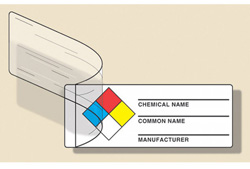
Specifically, he objected to the requirement of the Standard that labels be provided for every container of hazardous chemicals leaving the employer's premises. These labels must identify the chemical, warn of its hazards, and provide the name and address of the manufacturer, importer, or other responsible party.
The Hazard Communication Standard does indeed establish labeling requirements for shipped containers as well as for inplant containers. Both must contain (1) the identity of hazardous chemical(s) and (2) appropriate hazard warnings. In addition, labels on shipped containers must include the name and address of the manufacturer, importer, or other responsible party.
In establishing this requirement the Agency intended that all employees, particularly those who do not work for the companies manufacturing the hazardous chemicals and who, consequently, may not have a training program which would bring these hazards to their attention, be made aware of the hazardous effects of the chemicals they work with. The label also provides a link to the material safety data sheet involved. Since non-covered employees (that is, employees in industries other than manufacturing) will generally not be provided with material safety data sheets, the requirement for appropriate hazard warnings on the label becomes the most useful information element for this group of workers and information element for this group of workers and informs them and their employers of the source of additional information, should they desire to have it.

Your employees can stay informed and comply with OSHA regulations with SDS information stations and compliance products from Safety Emporium.
If a wholesaler/distributor receives containers from a manufacturer which do not have the appropriate labels, the wholesaler/distributor is under no obligation actually to create labels. Rather, since the shipping manufacturer is in violation of the requirements, the wholesaler/distributor is required only to contact the manufacturer immediately and request that the labels be provided for these containers and that all future shipments be properly labeled. Since the wholesaler/distributor does not repackage these materials, the original label should remain affixed to the container.
I hope that this response adequately addresses Mr. Stanion's concerns. Please feel free to contact us again, if we can be of further assistance.
Sincerely,
John A. Pendergrass
Assistant Secretary
August 18, 1986
Ruth Knight
Chief of Legislation
Occupational Safety and Health Administration
Department of Labor
200 Constitution Avenue, N.W.
Room N-3623
Washington, D.C. 20210
Dear Ms. Knight:
Enclosed you will find a copy of a letter I received from Mr. Tom Stanion, President of Stanion Wholesale Electric Company of Pratt, Kansas, regarding his opposition to an OSHA regulation concerning Hazard Communications Standards.
Any information you can provide me which may be of benefit to Mr. Stanion would be very much appreciated. Please direct your response, as well as any questions you may have, to the attention of Mr. Patrick Garcia of my Wichita, Kansas office who is assisting me in the is matter.
With best regard,
DAN GLICKMAN
Member of Congress
Pratt, Kansas
July 25, 1986
Representative Dan Glickman
2435 Rayburn House O.B.
Washington, D.C. 20515
Dear Representative Glickman:

Keep informed about workplace hazards with proper labeling techniques and safety posters available from Safety Emporium.
We strongly object to the latest OSHA Hazard, Communications Standards. The regulation states that, "All hazardous chemicals that leave the place of business of the wholesaler-distributor must carry the following label. This label must contain at least the following information: 1. Identify the hazardous chemical; 2. Appropriate hazardous warnings; and 3. Name and address of chemical manufacturer, importer, or other responsible party."
Wholesaler-distributors are not packagers or even repackagers of chemical equipment. Therefore, it's impossible for us to accurately comply with the regulations as it is stated. We believe that the regulation should be amended to exclude wholesaler-distributors, unless they package bulk chemicals.
Sincerely yours,
STANION WHOLESALE ELECTRIC COMPANY
Tom Stanion
President
The original official public domain version of this document is available from OSHA at https://www.osha.gov/laws-regs/standardinterpretations/1986-09-16.