Safety
This lesson is not about how to make repairs, but to understand the issues you face when attempting to repair broken or damaged glassware.
Repairs to scientific glassware should be attempted with caution. Assuming the glassware was broken in use, or has been used in the laboratory at some point in time, it would be wise to assume the glass has some chemical
residue on or in it.
Do not attempt to repair any glass until it has been cleaned to your satisfaction. Many glassblowers as policy will not accept glassware for repair until the user has cleaned the glass of all chemical and grease residue. Remember, as you heat the glass any outgassing that occurs is deposited directly into your mouth via the blowhose assembly.
See Ways to endear yourself to your local glassblower in the Glassware Gallery for more on this topic.
Repair or Replace?
Some items are not worth repairing. For example, simple Erlenmeyer flasks and beakers are generally considered "comsumables", and are thrown away if they develop breaks or cracks. Likewise,
fritted glass funnels which have cracks from the top down through the frit are generally thrown away (but a broken off stem is easily fixed). Some minor defects, such as small star cracks in round bottom flasks, are generally easy to repair.
While components of more complex items may not repairable, components can often be replaced. For example, a crack that goes through a standard taper joint can not be fixed, but the glassblower can normally remove the joint by cutting it off and then butt sealing a new one on. The same goes for high vacuum stopcocks.
All repaired pieces must be fully annealed before being returned to service. Remember, a glass project is never "done" until the piece has been annealed.
Minimize Repairs
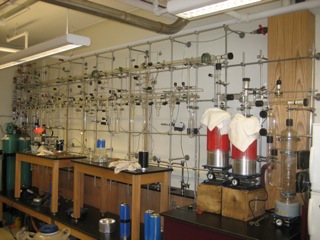
One can minimize the need for repairs through better glass design. For example, if a piece of a complex glass manifold system is likely to experience torque, then glass bracing or clamping to an external support can help minimize the chance of breakage.
Consider the awe-inspiring 15-foot long vacuum manifold pictured to the right. Repairing something on this manifold would be a nightmare (or a fun challenge, depending on your skill level), so every piece on it is designed with structural integrity in mind!