| The Home page of ILPI's Safety Data Sheet (SDS) Resource, the leader in SDS information since 1995! | |
| The history and philosophy behind this resource. | |
| A curated collection of books and reference materials concerning Safety Data Sheets and closely related topics. | |
| Paste your plain text SDS into the SDS-Demystifier, and it will be converted into a hypertext-enriched document with links to detailed explanations of each key term. | |
| An extensive list of frequently asked questions about Safety Data Sheets including regulations, content, compliance, and more. | |
| A humorous take on Safety Data Sheet jargon. Fill in the blanks on our entry form to generate a personalized Unsafety Data Sheet to share with your coworkers. | |
| Since 1995, we've maintained this massive curated list of the best places to find Safety Data Sheets on the Internet. | |
| Way more than a glossary, this hypertext-enhanced resource covers hundreds of SDS-related terms and expert knowledge. Each entry includes both the SDS relevance and links to additional authoritative resources. | |
| Archived results of Safety Data Sheet related polls taken by some of our millions of site visitors | |
| You are here! The OSHA regulations behind SDS regulations, including the inspection guidelines and over 400 official interpretations letters under the Hazard Communication Standard | |
| Commercial suppliers of SDS authoring and management software as well as cloud compliance services. | |
| Commercial companies that will create SDS's for your specific needs as well as SDS translation companies. |

Safety signs, banners, and scoreboards? Get yours at Safety Emporium!
OSHA Hazard Communication Letters of Interpretation
Interpretation on whether "an equivalent electronic information system" could be used in lieu of MSDSs to satisfy the HCS.
- Issued
- Record type
- Interpretation
- Historical standard
- 1910.1200, 1987 expanded rule (PDF)
- Current standard
- HCS 2024, as amended
ILPI assessment: Required SDSs remain distinct from generic data; drug exemption expanded
This letter addresses the obsolete 1987 version of the Hazard Communication Standard (HCS). Its central HazCom conclusion remains useful: electronic delivery is acceptable when employees can obtain the required, accurate SDS information, but a generic drug/chemical reference is not automatically a substitute for a required SDS. The national response and enclosed regional/vendor correspondence must be read separately.
Under the current HCS, apply electronic access without barriers, product-specific identification/contact information, and current content requirements. See the immediate-access FAQ. The current drug exemption includes specified retail-packaged/personal-use cases beyond final solid doses; the separate FDA label exemption is not full relief. Package inserts do not automatically replace required SDSs.
The proposed 1988 rule and old CPL are historical. The 1990 Supreme Court discussion does not freeze those exemptions forever; see the legal-history memorandum and its subsequent-law comparison. The exact old CPL 2-2.38B text has not been independently verified here; the later 1998 CPL 2-2.38D is not its original. Current enforcement counterpart: current HCS inspection procedures.
Last reviewed: .
About this ILPI assessment
This comparison with current requirements is not a finding that OSHA has formally withdrawn this letter. This assessment reflects editorial judgment informed by human review and AI assistance. It is an opinion, may contain errors or omissions, and is not an official OSHA determination. For guidance on how OSHA requirements apply to your circumstances, contact your local OSHA office.
OSHA's notice about interpretation letters
The following notice is published on OSHA's interpretation pages; it is general guidance, not a letter-specific withdrawal notice.
OSHA requirements are set by statute, standards and regulations. Our interpretation letters explain these requirements and how they apply to particular circumstances, but they cannot create additional employer obligations. This letter constitutes OSHA's interpretation of the requirements discussed. Note that our enforcement guidance may be affected by changes to OSHA rules. Also, from time to time we update our guidance in response to new information. To keep apprised of such developments, you can consult OSHA's website at https://www.osha.gov.
Source: OSHA's original letter page.
July 6, 1990
Betty J. Dabney, Ph.D.
Managing Editor
TOMES Plus Information System
Micromedex, Inc.
600 Grant Street
Denver, Colorado 80203-3527
Dear Dr. Dabney:

Many of our visitors use these weather-resistant SDS storage boxes like this one. We have 3 different sizes available at Safety Emporium.
Thank you for your letter of May 23, addressed to my attention, and also your letter of May 30, addressed to Ms. Melody Sands of my staff, requesting an interpretation on whether "an equivalent electronic information system" could be used in lieu of Material Safety Data Sheets (MSDSs) to satisfy the requirements of the Occupational Safety and Health Administration's (OSHA) Hazard Communication Standard (HCS), 29 CFR 1910.1200 [ILPI: Original HCS 1987 context (PDF) · Current HCS]. My office also is in receipt of copies of other letters you have sent to OSHA's Regional Offices. This letter serves as our consolidated response to all these similar requests.
First of all, let me clarify that while each of OSHA's Regional Administrators does have authority over the compliance activities in his or her region, each also ensures that OSHA's standards are uniformly enforced throughout the country. Further, OSHA's -National Office develops and disseminates to all OSHA regions inspection guidelines for OSHA enforcement personnel to utilize when checking for compliance with the HCS. A copy of the current OSHA Instruction, CPL 2-2.38B, "Inspection procedures for the Hazard Communication Standard," [ILPI note: Obsolete. Current enforcement counterpart: CPL 02-02-079] is enclosed for your reference. All inspections are conducted in accordance with the policies and procedures set forth in CPL 2-2.38B.
With regard to the specific questions raised in your letters regarding the MSDS requirements of the HCS, the standard requires that the MSDS itself, not just "MSDS information" be kept at the workplace. The Agency has interpreted the MSDS availability requirement to allow the use of computers or telefax or any other means, as long as a readable copy of the MSDS is available to the workers while they are in their work areas, during each workshift. The key to compliance with this provision is that employees have no barriers to access the information. This can be accomplished by the employer maintaining a hard copy of the MSDS itself on-site, or, again, by using a computer or telefax system capable of producing the same readable copy on-site.
Under the HCS, MSDSs are the basis of the employer's hazard communication program. Employers must have at their workplace the MSDS for each hazardous chemical they use, and they may rely on the validity of the MSDS information received from the supplier. As you are aware, it is the responsibility of the chemical manufacturer or importer to evaluate and compile all the hazard information known about the chemicals he produces. It is also his responsibility to transmit and update that information on MSDSs sent to downstream users. Any party who changes a chemical's MSDS or label then becomes the responsible party for the change.
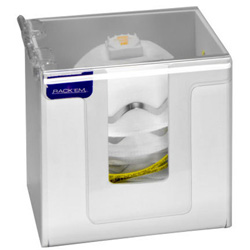
Make your PPE readily available with safety dispensers from Safety Emporium.
The MSDS used in an employer's hazard communication program must be specific to each chemical used on-site, since each MSDS contains the specific chemical identity as used on and therefore cross-referenced to the required label on the chemical's container. Further, the HCS requires that each chemical manufacturer or importer list on the chemical's MSDS his name, address and telephone number or the same information for a "responsible party" who will provide additional information on the hazardous chemical and appropriate emergency procedures (see 1910.1200(g)(2)(xii) [ILPI: Original HCS 1987 context (PDF) · Current HCS; contact information now in SDS Section 1]). MSDSs therefore provide specific telephone number or other emergency contact information for the chemical manufacturer, again, for the specific chemical that is being used on-site, as required at 1910.1200(g)(2)(xii) [ILPI: Original HCS 1987 context (PDF) · Current HCS; contact information now in SDS Section 1] of the standard. For these reasons, the use-of "the same information covered by an MSDS" cannot be used "in lieu of an MSDS" as proposed in your letter.
You also raised a question regarding enforcement of the HCS with respect to "non-manufacturing exposure to drugs in hospitals." MSDS are required for all drugs defined under the Federal Food, Drug and Cosmetic Act except for drugs in solid, final form for direct administration to the patient (i.e., tablets, pills, capsules). The Supreme Court upheld this requirement in its decision dated February 21, 1990 (see Dole, Secretary of for, et. al. v. United Steel workers of America et. al. No. 88-1434). The requirement to have on-site MSDSs for pharmaceuticals workers may be exposed to therefore remains in effect and is fully enforceable. In its Notice of Proposed Rulemaking on the HCS (Federal Register, Vol. 53, No. 152, August 8, 1988), OSHA proposed for public comment the provision that package inserts or information from the Physician's Desk Reference (PDR) be considered a MSDS for purposes of compliance with the HCS in the non-manufacturing sector. This is only a proposed provision, however, awaiting final rulemaking by the Agency. At the present time, the package insert or PDR reference is not acceptable in lieu of the MSDS.
[ILPI note: At issuance: 1910.1200, 1987 expanded rule (PDF). Current counterpart: the full drug exemption, including specified retail-packaged/personal-use cases. If an SDS is required, its current content is not automatically supplied by an insert or general reference database.]
We hope this answers your questions regarding the MSDS requirements of OSHA's HCS. Please feel free to contact us again if we can be of further service.
Sincerely,
Patricia K. Clark Director
Designate Directorate of Compliance Programs
Enclosure

Get your GHS-compliant labels and signs from Safety Emporium.
May 3, 1990
Dean Ikeda
Department of Labor-OSHA
111 3rd Ave. Suite 715
Seattle, WA 98101
Dear Mr. Ikeda,
We would like a clarification from the OSHA Regional Office as to whether or not equivalent information in some other form, such as a comprehensive computerized information system, would satisfy the information requirements of CFR 1910.1200 [ILPI: Original HCS 1987 context (PDF) · Current HCS], the OSHA Hazard Communication Standard, in lieu of Material Safety Data Sheets in your region. As I understand it, each Regional Office has the authority to determine how the OSHA standards are enforced in its region, and there is no required format for MSDS's under the Federal Standard.
We have received requests from several of our users for clarification of this point, especially with respect to enforcement of the Hazard Communication Standard for non-manufacturing exposure to drugs in hospitals. We are therefore contacting every OSHA Regional Office to get a ruling on this question.
Enclosed for your information is a packet containing product literature on the various databases in the TOMES Plus Information System and document outlines for all the databases. I understand that it is OSHA's policy not to endorse specific products, and we are not asking for your endorsement. Rather, we would like your ruling on whether the same information covered by an MSDS could be used in lieu of an MSDS to satisfy the information requirement in your region.
Your written reply would be greatly appreciated. Thank you very much for your consideration of this matter.
Yours truly,
Betty J. Dabney, Ph.D.
Managing Editor
TOMES Plus Information System
cc: Ms. Kitty Gallagher Micromedex Regional Sales Manager
May 3, 1990
Enforcement Officer/Hazard Communication
Department of Labor-OSHA Region IV
1375 Peachtree Street, N.E. Suite 587
Atlanta, GA 30367
Dear Sir,
We would like a clarification from the OSHA Regional Office as to whether or not equivalent information in some other form, such as a comprehensive computerized information system, would satisfy the information requirements of CFR 1910.1200 [ILPI: Original HCS 1987 context (PDF) · Current HCS], the OSHA Hazard Communication Standard, in lieu of Material Safety Data Sheets in your region. As I understand it, each Regional Office has the authority to determine how the OSHA standards are enforced in its region, and there is no required format for MSDS's under the Federal Standard.

Protect your workers with ADA-compliant safety stations from Safety Emporium.
We have received requests from several of our users for clarification of this point, especially with respect to enforcement of the Hazard Communication Standard for non-manufacturing exposure to drugs in hospitals. We are therefore contacting every OSHA Regional Office to get a ruling on this question.
Enclosed for your information is a packet containing product literature on the various databases in the TOMES Plus Information System and document outlines for all the databases. I understand that it is OSHA's policy not to endorse specific products, and we are not asking for your endorsement. Rather, we would like your ruling on whether the same information covered by an MSDS could be used in lieu of an MSDS to satisfy the information requirement in your region.
Your written reply would be greatly appreciated. Thank you very much for your consideration of this matter.
Yours truly,
Betty J. Dabney, Ph.D.
Managing Editor
TOMES Plus Information System
May 15, 1990
Betty J. Dabney, Ph.D.
Managing Editor
TOMES plus Information System
Micromedix, Inc.
600 Grant Street
Denver, Colorado 80203-3527
Dear Dr. Dabney:
This is in reply to your request for clarification concerning whether maintaining information on a computerized system is acceptable in lieu of a material safety data sheet. Such a system would be acceptable provided that access to the information is not impeded by the use of a computerized information system, i.e. all employees have ready access to terminals and are familiar with access procedures. All other access provisions of the OSHA hazard communication standard as applied to MSDS access would also be necessary, such as terminals located in work areas which are accessible during all times that the employees are working.
Please contact this office if we can be of further assistance.
Sincerely,
LINDA R. ANKU
Regional Administrator
May 15, 1990
Betty J. Dabney, Ph.D
Managing Editor
Micromedex, Inc.
660 Grant Street
Denver, CO 80203-3527
Dear Ms. Dabney:
Thank you for your letter requesting a clarification on using a comprehensive computerized information system, in lieu of Material Safety Data Sheets. Your request has been forwarded to our National Office for response.

Get your AED and other wall-projecting safety signs from Safety Emporium.
If you have any questions for them you may contact Patricia K. Clark, Director, Directorate of Compliance Programs. She ~may be reached at U.S. Department of Labor, Occupational Safety and Health Administration, Room N-3463, 200 Constitution Ave., N.W., Washington, D.C. 20210.
If you have any further questions for us, please contact Sven Rundman of my staff at (404)347-2281.
Sincerely,
CYNTHIA P. WOLFE
Assistant Regional Administrator
for Technical Support
May 23, 1990
Patricia K. Clark Director,
Directorate of Compliance Programs
U.S. Department of Labor
Occupational Safety and Health Administration
Room N-3463
200 Constitution Ave., N.W.
Washington, D.C. 20210
Dear Ms. Clark,
We would like a clarification from OSHA as to whether or not equivalent information in some other form, such as a comprehensive computerized information system, would satisfy the information requirements of CFR 1910.1200 [ILPI: Original HCS 1987 context (PDF) · Current HCS], the OSHA Hazard Communication Standard, in lieu of Material Safety Data Sheets.
We have received requests from several of our users for clarification of this point, especially with respect to enforcement of the Hazard Communication Standard for non-manufacturing exposure to drugs in hospitals.
Enclosed for your information is a packet containing product literature on the various databases in the TOMES Plus Information System and document outlines for all the databases. I understand that it is OSHA's policy not to endorse specific products, and we are not asking for your endorsement. Rather, we would like your ruling on whether' the same information covered by an MSDS could be used in lieu of an MSDS to satisfy the information requirement in individual regions.
We have already written the eight Regional Offices for clarification on this question. As I understand it, each Regional Office has the authority to determine how the OSHA standards are enforced in its region, and there is no required format for MSDS's under the Federal Standard. Enclosed are copies of the two replies we have received so far. The Atlanta office referred our request to you, and the Philadelphia office said that such a system would be acceptable so long as the information was accessible to employees in the workplace.
Your written reply would be greatly appreciated. Thank you very much for your consideration of this matter.
Yours truly,
Betty J. Dabney, Ph.D.
Managing Editor
TOMES Plus Information System
Attachments: OSHA Regional Letters
Enclosure: TOMES Plus Literature Packet

Keep your work documents organized on the go with SDS information stations and compliance products from Safety Emporium.
May 30, 1990
Ms. Melody Sands
Department of Labor
Occupational Safety and Health Administration
200 Constitution Avenue, N.W.
Washington, D.C. 20210
Dear Ms. Sands
Mr. Stan Rundman of the Atlanta office asked me to send you a copy of the original cover letter we sent to him for a ruling on whether or not an equivalent electronic information system could be used in lieu of Material Safety Data Sheets to satisfy the Hazard Communication Standard. Also enclosed is a copy of the reply from the Atlanta region referring this request to your office.
Last week we sent a duplicate letter and packet of information to Patricia Clark in the Washington office of OSHA. Hopefully you have all the information you need to give Us a ruling.
If you have any further needs or questions, please feel free to give me a call. Thank you for your Consideration of this matter
Yours truly,
Betty J. Dabney Ph.D.
Managing Editor,
TOMES Plus Information System
Attachments: Previous letters
U.S. DEPARTMENT OF LABOR
Occupational Safety and Health Administration
1111 Third Avenue, Room 715
Seattle, Washington 98101-3212
May 31, 1990
MEMORANDUM FOR: PATRICIA CLARK, Director, Directorate of Compliance Programs
FROM: JAMES W. LAKE Regional Administrator Region X
SUBJECT: Hazard Communication Interpretation Request, Micromedex, Inc.
This is in response to your memorandum of May 21, 1990, wherein you requested that inquiries from Micromedex, Inc., be forwarded to your office for a reply. Attached is the letter we received from Micromedex, Inc. We have advised them that a response from the National Office is forthcoming.
Attachment
The original official public domain version of this document is available from OSHA at https://www.osha.gov/laws-regs/standardinterpretations/1990-07-06.