| The Home page of ILPI's Safety Data Sheet (SDS) Resource, the leader in SDS information since 1995! | |
| The history and philosophy behind this resource. | |
| A curated collection of books and reference materials concerning Safety Data Sheets and closely related topics. | |
| Paste your plain text SDS into the SDS-Demystifier, and it will be converted into a hypertext-enriched document with links to detailed explanations of each key term. | |
| An extensive list of frequently asked questions about Safety Data Sheets including regulations, content, compliance, and more. | |
| A humorous take on Safety Data Sheet jargon. Fill in the blanks on our entry form to generate a personalized Unsafety Data Sheet to share with your coworkers. | |
| Since 1995, we've maintained this massive curated list of the best places to find Safety Data Sheets on the Internet. | |
| You are here! Way more than a glossary, this hypertext-enhanced resource covers hundreds of SDS-related terms and expert knowledge. Each entry includes both the SDS relevance and links to additional authoritative resources. | |
| Archived results of Safety Data Sheet related polls taken by some of our millions of site visitors | |
| The OSHA regulations behind SDS regulations, including the inspection guidelines and over 400 official interpretations letters under the Hazard Communication Standard | |
| Commercial suppliers of SDS authoring and management software as well as cloud compliance services. | |
| Commercial companies that will create SDS's for your specific needs as well as SDS translation companies. |

Safety signs, banners, and scoreboards? Get yours at Safety Emporium!
Standard Temperature and Pressure (STP)
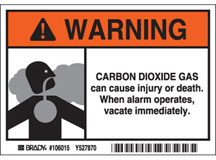
All rooms with fixed extinguishing systems must have appropriate warning signs like this one from Safety Emporium.
Definition
Standard Temperature and Pressure (STP) is defined as 0 degrees Celsius and 1 atmosphere of pressure.
Do not confuse STP with the STP Products Company, a maker of oil and fuel additives...unless you are reading one of their Safety Data Sheets!
Additional Info
STP is used in many thermodynamic calculations and tabulations. Certain properties of matter such as density, viscosity, boiling point etc. will vary with changes in temperature or pressure. Having one common set of conditions ("state") for tabulating these values makes comparisons possible and eases calculations.
The concept of matter in its standard state (also called "standard conditions") is closely related. "Standard state" does not generally imply a specific temperature, but 25 °C (298 K) is most often used:
| State of Matter | Standard State |
|---|---|
| Gas | 1 atm of pressure |
| Liquid | Pure liquid |
| Solid | Pure solid |
| Solution | 1 molar |
| Elements | The most stable allotrope at STP, with  Gf0 = 0 Gf0 = 0 |
Many chemistry calculations are for materials that are in their standard state. One very useful rule for gases that does not necessarily require standard state conditions is the Ideal Gas Law (eq 1).
 | (1) |
Where:
| Symbol | Meaning | Typical Unit |
|---|---|---|
| P | Pressure | atm |
| V | Volume | liter |
| n | # of moles of material | mole |
| R | The Ideal Gas Constant | 0.08206 L.atm.mol-1.K-1 |
| T | Temperature | Kelvin |
Using the Ideal Gas Law, one can determine the value of any one of the four variables (P, V, n, T) if we know the value of the other three (R is a constant).
For example, 1,000 grams (1 kilogram = 2.2 pounds) of ethylene (which has a molar mass of 28 grams/mol) will occupy a volume of 800 liters at STP :

If we wished to calculate this volume at another, non-standard state temperature, such as 100 °C, we would simply substitute 373 K for the temperature (100 °C = 373 K) in the above calculation. The Ideal Gas Law is a very handy equation for estimating gas properties at both standard and non-standard conditions.
SDS Relevance
Safety Emporium has all kinds of lab equipment such as stirring hot plates.
The letters "STP" occur most commonly on a Safety Data Sheet after a physical property such as the density , flammable limit, or vapor pressure of the material. These properties are found in Section 9 (physical and chemical properties) of the SDS.
Remember: STP is 0 °C, NOT room temperature. Usually the properties at STP versus room temperature vary by less than 10% for gases and even less for liquids or solids. For example, in the calculation in the previous section, the volume would be 858 liters at 20 °C, a difference of 7%. And the density of water is 0.99987 g/ml at 0 °C versus 0.99823 g/ml at 20 °C, a difference of 0.16%.
However, sometimes the differences can be extreme - dimethylamine is a volatile liquid with a specific gravity of 0.680 at STP, but it is a gas above its boiling point of 7 °C!
Further Reading
- Wikipedia's entry on Standard Conditions For Temperature and Pressure.
- Some Ideal Gas Law calcuations at Towson U.
- Deviations from Ideal Gas Law Behavior at Purdue University.
- STP - Standard Temperature and Pressure & NTP - Normal Temperature and Pressure. along with some others at The Engineering ToolBox.
See also: mass units, mole, pressure units