| The Home page of ILPI's Safety Data Sheet (SDS) Resource, the leader in SDS information since 1995! | |
| The history and philosophy behind this resource. | |
| A curated collection of books and reference materials concerning Safety Data Sheets and closely related topics. | |
| Paste your plain text SDS into the SDS-Demystifier, and it will be converted into a hypertext-enriched document with links to detailed explanations of each key term. | |
| An extensive list of frequently asked questions about Safety Data Sheets including regulations, content, compliance, and more. | |
| A humorous take on Safety Data Sheet jargon. Fill in the blanks on our entry form to generate a personalized Unsafety Data Sheet to share with your coworkers. | |
| Since 1995, we've maintained this massive curated list of the best places to find Safety Data Sheets on the Internet. | |
| Way more than a glossary, this hypertext-enhanced resource covers hundreds of SDS-related terms and expert knowledge. Each entry includes both the SDS relevance and links to additional authoritative resources. | |
| Archived results of Safety Data Sheet related polls taken by some of our millions of site visitors | |
| You are here! The OSHA regulations behind SDS regulations, including the inspection guidelines and over 400 official interpretations letters under the Hazard Communication Standard | |
| Commercial suppliers of SDS authoring and management software as well as cloud compliance services. | |
| Commercial companies that will create SDS's for your specific needs as well as SDS translation companies. |

Safety signs, banners, and scoreboards? Get yours at Safety Emporium!
OSHA Hazard Communication Letters of Interpretation
Regarding labeling requirements order the OSHA's Hazard Communication Standard.
- Issued
- Record type
- Interpretation
- Historical standard
- 1910.1200, 1987 expanded rule (PDF)
- Current standard
- HCS 2024, as amended
ILPI assessment: Bulk-label alternative remains; use current classification and worker protections
This letter addresses the obsolete 1987 version of the Hazard Communication Standard (HCS). Its main HazCom conclusions remain useful: bulk shipments need hazard communication, and concrete-related silica exposure must be addressed even when the employer did not originally bring that material to the site. A beach or other open area is not itself a chemical container.
Under the current HCS, bulk-shipment labeling expressly permits specified container, shipping-paper/bill-of-lading, or agreed electronic delivery methods. The label must still convey the required modern elements. Apply hazard classification, anticipated downstream uses, and workplace program/current information and training requirements. Wet concrete can have hazards besides airborne silica; the old discussion is not a complete product hazard list. Separate construction silica controls may apply. The exact old CPL 2-2.38B text has not been independently verified here; the later 1998 CPL 2-2.38D is not its original. Current enforcement counterpart: current HCS inspection procedures.
Last reviewed: .
About this ILPI assessment
This comparison with current requirements is not a finding that OSHA has formally withdrawn this letter. This assessment reflects editorial judgment informed by human review and AI assistance. It is an opinion, may contain errors or omissions, and is not an official OSHA determination. For guidance on how OSHA requirements apply to your circumstances, contact your local OSHA office.
OSHA's notice about interpretation letters
The following notice is published on OSHA's interpretation pages; it is general guidance, not a letter-specific withdrawal notice.
OSHA requirements are set by statute, standards and regulations. Our interpretation letters explain these requirements and how they apply to particular circumstances, but they cannot create additional employer obligations. This letter constitutes OSHA's interpretation of the requirements discussed. Note that our enforcement guidance may be affected by changes to OSHA rules. Also, from time to time we update our guidance in response to new information. To keep apprised of such developments, you can consult OSHA's website at https://www.osha.gov.
Source: OSHA's original letter page.
May 16, 1990
Mr. Robert G. Bartlett
President
National Stone Association
1415 Elliot Place, N.W.
Washington, D.C. 20007-2599
Dear Bob:

Get your OSHA Danger signs from Safety Emporium.
Thank you for your letter of December 8, 1989, regarding labeling requirements under the Occupational Safety and Health Administration's (OSHA) Hazard Communication Standard (HCS), 29 CFR 1910.1200 [ILPI: Original HCS 1987 context (PDF) · Current HCS]. You specifically were interested in the standard's labeling requirements with regard to cancer warnings required for vehicles containing crystalline silica during the transportation of crushed stone products, ready mixed concrete and hot mixed asphalt concrete. I apologize for the long delay in this response to you. This letter will respond to your questions in the order in which they were raised:
Question 1.
It is really OSHA's intent that all shipments of the 1.25 billion tons of crushed stone consumed annually in this country carry some form of cancer warning because that stone may contain within its matrix some small amount of quartz material?
Answer:
As indicated to OSHA staff during a recent telephone conversation concerning this response, you have advised your member companies that, until this issue is finally decided by OSHA, vehicles hauling shipments of crushed stone should include hazard warnings concerning the carcinogenicity of crystalline silica on their shipping papers or bills of lading. This practice is already current Agency policy for tank trucks and rail cars, and is set forth in OSHA Instruction CPL 2-2.38B, "Inspection Procedures for the Hazard Communication Standard." [ILPI note: Exact CPL 2-2.38B text not independently verified here; the later 1998 CPL 2-2.38D is not the original. Current enforcement counterpart: CPL 02-02-079.] Regarding labeling and other forms of hazard warnings required under paragraph (f) of the HCS [ILPI: Original HCS 1987 context (PDF) · Current HCS], CPL 2-2.38B states:
Where the shipping container is a tank truck or rail car the appropriate label or label information may either be posted on the tank or vehicle, or attached to the accompanying shipping papers. Employers purchasing hazardous chemicals must ensure that their employees are aware of the label warning before potential exposure to incoming chemicals occurs.
As you are aware, the primary purpose of the HCS is to ensure that employees are aware of the potential hazards of the chemicals to which they are exposed. Employees exposed to the "small amount of quartz material" present in the crushed stone they work with have the right to information regarding the health hazards associated with that material. Advising your member companies to include a label or label information along with the truck's accompanying shipping papers meets the intent of the standard. This practice will help to ensure that employees handling hazardous chemicals shipped in vehicles are made aware of the label warning information and will be able take the necessary precautions to protect themselves from potential exposure.
[ILPI note: At issuance: 1910.1200, 1987 expanded rule (PDF). Current counterpart: bulk-shipment label delivery, with the required label elements. This is not permission to omit hazard information or an endorsement of every old cancer-warning summary.]
Question 2.
What rationale supports the position that transporters of wet Portland Cement concrete or hot mixed asphalt concrete must label because the stone in the concrete might contain some quartz mineral? Certainly dust emissions from wet concrete are negligible and, therefore, the possibility of worker exposure nil. From an exposure standpoint I would be more concerned about the individual with a jack hammer breaking up a concrete sidewalk becoming exposed than I would the wet concrete worker finishing a concrete pour. Yet we are told the sidewalk is an article and therefore does not have to be labeled, but the wet concrete does.
Answer:
Applicability of the provisions of the HCS [ILPI: Original HCS 1987 context (PDF) · Current HCS], including labeling and MSDS transmittal requirements, is based on the potential for employee exposure to hazardous chemicals which are known to be present under normal conditions of use. Under normal conditions of use, wet concrete is poured and then is left to set or dry. If employees' normal conditions of use of wet concrete involve exposure to airborne levels of silica that could occur with exposure to the concrete after it is dried (such as might occur during clean-up operations of hardened cement), then information on the potential hazards must be transmitted on the MSDS and label. The responsibility to perform a hazard determination on a chemical product is the chemical manufacturer's. If hazardous exposure potentials could occur based on anticipated downstream exposures under normal conditions of use of the chemical product, then the material would be covered under the provisions of the HCS. Appropriate hazard information would be required on the labels and/or MSDS.
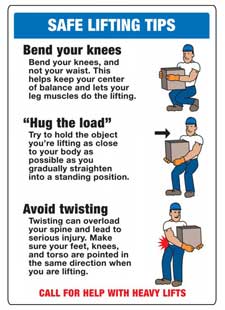
Keep your employees healthy and safe with ergonomic signs and posters from Safety Emporium.
Under the requirements of the HCS [ILPI: Original HCS 1987 context (PDF) · Current HCS], exposure to silica that may occur when a worker uses a jackhammer to break up a sidewalk represents a situation where workers are to be apprised of the hazardous substances to which they are exposed. The hazardous substance is known to be present (the concrete containing silica) and, while the employer is not responsible for "bringing" the hazard to the site, he is exposing his employees to the hazard. In such a situation, these hazards would need to be addressed in that employer's on-site Hazard Communication Program. Even though other provisions of the standard would not be applicable (providing an MSDS or label for that specific piece of concrete, for example, which the employer would not have access to), the employer would still need to address the hazardous exposure to the silica from the concrete in his program, since it is a hazardous chemical known to be present and one he is exposing his employees to.
Lastly, you raised a question regarding OSHA's position on labeling "work stations on a public beach." The HCS [ILPI: Original HCS 1987 context (PDF) · Current HCS] requires labeling of containers of hazardous substances. OSHA has always interpreted the standard to not be applicable where there is no container. A room or open area such as a beach are not considered to be "containers" and would not, indeed could not, be labeled.
The intent of the HCS [ILPI: Original HCS 1987 context (PDF) · Current HCS], to provide information to employees about the hazards of the chemical they may be exposed to while working, is met when chemical manufacturers and employers work cooperatively to transmit hazard information to all affected employees facing downstream exposure potentials. To that end, the cooperation of all chemical manufacturers and employers who are responsible for unimpeded hazard information transmittal is of paramount importance, and I trust OSHA can continue to look forward to working cooperatively with you to achieve these goals.
Sincerely,
Alan C. McMillan
Deputy Assistant Secretary
The original official public domain version of this document is available from OSHA at https://www.osha.gov/laws-regs/standardinterpretations/1990-05-16-3.